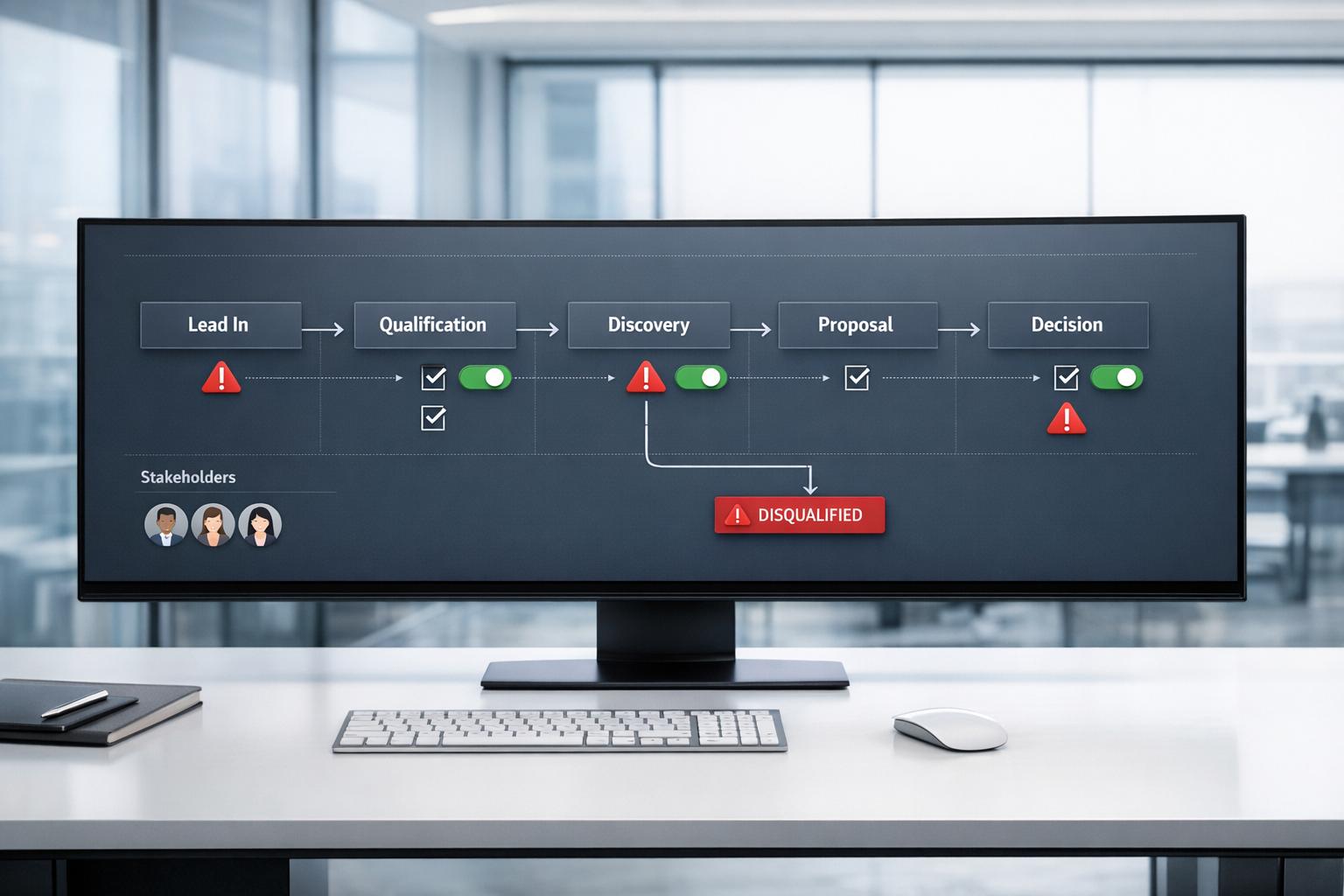
Efficient pipeline qualification is essential for scaling B2B startups. Without structured processes, sales teams waste time on poor-fit leads, forecasting becomes unreliable, and leadership makes decisions based on flawed data. Here are the five most common mistakes and how to fix them:
- Focusing on Volume Over Quality
Prioritizing lead quantity clogs your pipeline with unqualified prospects. Instead, use measurable fit and intent scores to identify high-value leads. Tools like Clay and Apollo can automate this process, improving reply rates by 3–5x. - Inconsistent Qualification Criteria
Subjective decisions lead to uneven pipeline quality. Adopt frameworks like BANT or MEDDIC and supplement them with data-driven scorecards. Standardize lead handoffs with CRM templates to avoid information loss. - Qualifying Contacts, Not Buying Processes
Engaging a single contact often stalls deals. Map the entire buying committee (6–10 stakeholders on average) and track their roles to ensure you’re addressing decision-makers, not just interested individuals. - Letting Weak Deals Linger
Stale opportunities distort forecasts and drain resources. Enforce strict disqualification rules, such as flagging deals with no engagement for 14 days. Regular pipeline reviews and automated alerts can maintain CRM accuracy. - Over-Relying on Coaching
Coaching addresses individual behavior but doesn’t fix systemic issues. Automate lead scoring and data enrichment to enforce consistent qualification standards. Historical data can further refine your approach.
Key Takeaway:
Effective qualification systems rely on automation, clear criteria, and regular pipeline hygiene. These practices improve forecasting accuracy, reduce wasted effort, and create a scalable foundation for growth.
Mistake #1: Prioritizing Pipeline Volume Over Lead Quality
It’s easy to assume that more leads equal more progress. A pipeline packed with potential deals can give the impression of momentum. But chasing sheer volume without assessing fit and intent often clogs the funnel with leads that will never convert. This focus on quantity over quality makes accurate forecasting nearly impossible.
The data paints a clear picture. Customer acquisition costs have jumped 14% year-over-year, while reply rates for generic outreach hover at a dismal 1% to 3%. Simply adding more SDRs to boost lead volume only scales costs without improving efficiency. As Jonathan Green from GTM Engineering Services succinctly puts it:
"The answer isn’t more headcount. It’s better infrastructure."
When poor-quality leads dominate the pipeline, leadership is left guessing which opportunities are genuine, leading to shaky revenue predictions.
How to Shift Focus to Lead Quality
The solution lies in moving away from volume-driven metrics and adopting measurable standards for lead fit and intent. Start by creating a Fit Score that evaluates firmographics like company size, industry, revenue, and tech stack. Pair this with an Intent Score that tracks real-time signals, such as recent funding rounds, leadership changes, or job postings for roles aligned with your product.
This approach, known as signal-based selling, can boost reply rates by 3–5x compared to traditional volume-based outreach. For instance, a newly hired VP of Sales within their first 90 days is likely exploring new tools, making this a high-intent opportunity. Contrast that with a company that fits your ideal customer profile on paper but shows no activity or interest – clearly a weaker prospect. Tools like Clay and Apollo can automate data enrichment, pulling 15–20 key data points per prospect to eliminate guesswork and help reps focus on leads that truly matter.
Another critical step is defining your Anti-ICP criteria – a list of profiles that consistently fail to convert. This might include companies in specific industries, those below a certain revenue threshold, or those outside your target size range. Filtering out poor-fit leads before they hit your pipeline is just as important as identifying the right ones.
These refined metrics not only improve lead selection but also bring much-needed accuracy to forecasting.
Why Quality Beats Quantity in Forecasting
When every deal in your pipeline meets clear fit and intent standards, forecasting becomes far more reliable. Reps may work on fewer deals, but those deals are much more likely to close. This means pipeline coverage ratios and win rates reflect reality, not wishful thinking. Additionally, 61% of B2B revenue leaders cite pipeline leakage due to poor lead routing and delayed follow-up. By focusing on high-quality leads, you reduce this leakage, enabling sharper messaging, better follow-up, and quicker movement through the sales process.
Mistake #2: Using Inconsistent Qualification Criteria
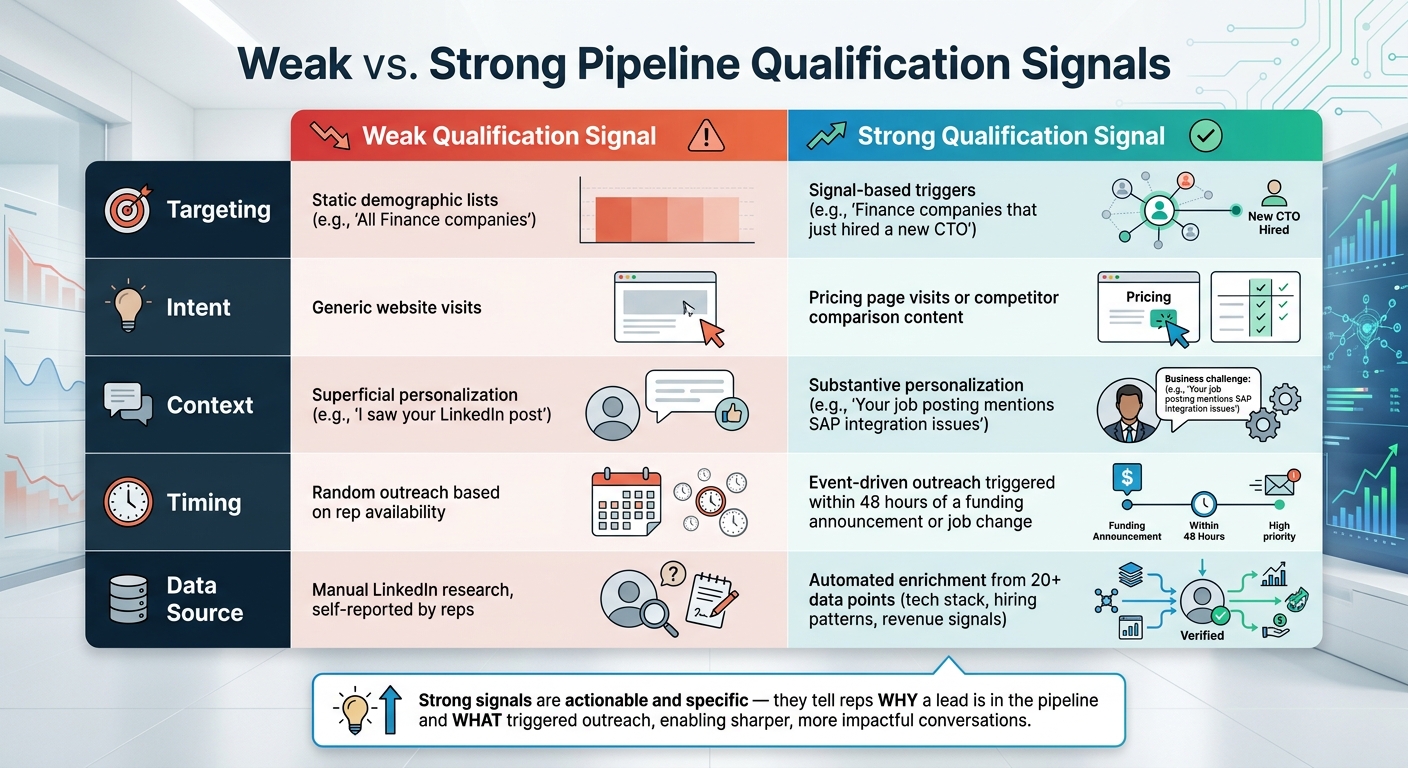
Weak vs. Strong Pipeline Qualification Signals: B2B Sales Guide
Standardizing qualification criteria is just as important as ensuring lead quality. Without clear documentation, reps often rely on gut feelings to make decisions. One rep might advance a deal because it "feels right", while another skips a similar opportunity for the opposite reason. This kind of subjective decision-making creates a pipeline with inconsistent quality, leaving leadership unable to pinpoint where things go wrong.
The ripple effects of this inconsistency are massive. For instance, about 45% of sales contacts never get logged in CRM systems. This makes it nearly impossible to confirm if qualification criteria were applied at all. Additionally, when SDRs hand off leads to AEs without a clear, standardized process, critical information often gets lost. The AE has to restart discovery, wasting valuable time and slowing down deal progress.
How to Standardize Your Qualification Framework
The solution lies in replacing gut-based decisions with a shared, well-documented standard. Frameworks like BANT (Budget, Authority, Need, Timeline), MEDDIC, or CHAMP provide reps with clear benchmarks for evaluating leads. However, a framework alone won’t cut it – it needs to be powered by data. By analyzing historical closed-won deals, you can identify patterns that predict success. Use this data to create a weighted scorecard that assigns points for specific attributes, like +10 for a matching tech stack or +5 for a recent Series B.
Equally crucial is standardizing the lead handoff process. Implement a Handoff Context Template in your CRM for every lead moving from SDR to AE. This template should include key details like the trigger for the opportunity, the prospect’s tech stack, pain points, and decision-makers. This ensures smooth transitions, prevents information loss, and keeps deals moving forward efficiently.
By setting these standards, you’ll create a foundation for identifying and acting on strong stakeholder signals later in the process.
Weak vs. Strong Qualification Signals: A Comparison
The difference between weak and strong signals highlights why standardization is so critical. The table below breaks down how these signals measure up across common qualification dimensions:
| Signal Category | Weak Qualification Signal | Strong Qualification Signal |
|---|---|---|
| Targeting | Static demographic lists (e.g., "All Finance companies") | Signal-based triggers (e.g., "Finance companies that just hired a new CTO") |
| Intent | Generic website visits | Pricing page visits or competitor comparison content |
| Context | Superficial personalization (e.g., "I saw your LinkedIn post") | Substantive personalization (e.g., "Your job posting mentions SAP integration issues") |
| Timing | Random outreach based on rep availability | Event-driven outreach triggered within 48 hours of a funding announcement or job change |
| Data Source | Manual LinkedIn research, self-reported by reps | Automated enrichment from 20+ data points (tech stack, hiring patterns, revenue signals) |
Strong signals stand out because they’re actionable and specific. When a rep understands why a lead is in the pipeline and what prompted their outreach, they can tailor their approach for a sharper, more impactful first conversation.
Mistake #3: Qualifying a Contact Instead of the Buying Process
One of the most expensive pipeline errors is mistaking a promising contact for a qualified deal. Here’s the challenge: in most enterprise sales, you’re not dealing with just one person. The average buying committee includes 6 to 10 stakeholders, each doing their own research – often before anyone even talks to your sales team. If a rep qualifies just one person without understanding the broader decision-making group, they’re essentially working with incomplete information.
This isn’t just about the number of people involved – it’s about their roles and influence. A contact who’s excited about your product might not have the authority to approve the budget or might only serve as a technical advisor. Without identifying the full committee – who controls the budget, who evaluates the product, and who champions the deal internally – it’s impossible to know if the deal is genuinely ready to move forward.
How to Map Stakeholders and Decision Paths
From the moment a lead enters your pipeline, the qualification process should go beyond focusing on a single contact. Tools that enrich account data can help reps uncover reporting structures and identify potential stakeholders before the first conversation. This allows reps to categorize contacts into roles like economic buyer (the one with budget authority), technical influencer, or internal champion. Once these roles are clear, reps can use signal-based triggers to refine their approach.
Signal-based triggers are game-changers here. For instance, if a new VP of Sales joins a target account within the last 90 days, that’s a strong indicator they’re likely reviewing vendors. Tracking these signals at the account level – not just focusing on individual contacts – helps reps align their efforts with the actual buying cycle instead of chasing one person’s interest. Ignoring this step can lead to pipeline problems down the line.
How Skipping This Step Causes False Pipeline Progression
When deals progress based on just one contact’s engagement, the CRM can give a false sense of security. Everything might look great – until the deal stalls because the rest of the buying committee wasn’t involved.
"The middle, the entire machinery of how a raw inbound response or outbound reply gets qualified, routed, scheduled, and converted into a pipeline opportunity, is a black box operating on institutional habit and tribal knowledge more often than anyone wants to admit." – JA Westenberg, The GTM Engineering Playbook
This "black box" problem gets worse during handoffs. If an Account Executive (AE) picks up a lead without full context and starts with, “So, tell me about your business,” the deal is already in trouble. JA Westenberg highlights this common issue: “The most common failure mode is information loss. The prospect told the SDR about their specific use case, the SDR noted it somewhere, and the first AE call starts with ‘so tell me about your business,’ which communicates to the prospect that nobody at your company actually listened to them.”
This disconnect is costly. In fact, 61% of B2B revenue leaders report pipeline leakage at these manual handoff points. And without a clear approval path mapped out, enterprise sales forecasting accuracy sits at just 45–55%.
The fix lies in preparation. Before a handoff happens, standardize a context template in your CRM. This template should capture essential details like the prospect’s use case, tech stack, pain points, and identified stakeholders. By ensuring this full picture moves with the deal – not just a contact’s name – you can avoid the pitfalls of incomplete information and keep your pipeline running smoothly.
Mistake #4: Letting Weak Deals Sit in the Pipeline
An overloaded pipeline can hide the fact that many deals are going nowhere. Stale opportunities not only skew revenue forecasts but also misdirect your sales team’s energy. Without AI-driven prediction models, enterprise sales forecast accuracy hovers between just 45–55%. When stagnant deals pile up, those numbers drop even further.
This inefficiency often leads reps to lose faith in the CRM, resorting to personal spreadsheets. The ripple effect? Data quality takes a nosedive, and the entire sales process suffers.
"Most pipeline problems aren’t people problems. They’re infrastructure problems." – demandDrive
Fixing this issue requires clear, enforceable criteria for regularly cleaning up the pipeline.
How to Set Clear Disqualification Rules
To regain focus and productivity, you need strict disqualification rules. Start by defining anti-ICP (ideal customer profile) criteria. For example, disqualify companies in restricted industries, those with fewer than 50 employees, or those with revenue under $1M ARR. If a deal doesn’t meet these minimum standards, it shouldn’t stay in the active pipeline – even if it shows occasional promise.
Activity thresholds are just as important. Deals with no engagement for 14 consecutive days should be flagged for review or removal. A weighted scorecard can simplify this process, rating opportunities on a 1-to-10 scale based on ICP fit and intent. Deals scoring below 5? Move them to a nurture sequence instead of keeping them in the active pipeline.
Pipeline Review Cadence and CRM Discipline
A weekly review cadence is key to keeping your pipeline healthy. Here’s an example schedule:
- Monday: Review performance metrics like emails sent, replies received, meetings booked, and close rates.
- Tuesday: Identify underperforming segments and pinpoint where deals are stalling.
- Midweek: Test new messaging or address conversion bottlenecks.
- Thursday: Analyze closed-won deals to uncover repeatable patterns.
- Friday: Update sequences and tweak ICP filters based on the week’s findings.
Don’t overlook CRM hygiene. Contact data decays at a rate of 25–30% annually, so an unmaintained CRM quickly becomes useless. Automated alerts can help – set them to trigger when a high-value deal goes 14 days without activity. This ensures no deal goes cold without notice. The goal? A CRM that reflects reality, not wishful thinking.
Decision States: Qualified, Needs Review, Disqualify
With refined qualification metrics in place, categorizing deals into clear decision states becomes much easier. These categories replace guesswork with shared standards:
| Decision State | Criteria | Recommended Action |
|---|---|---|
| Qualified | ICP score 8–10; active buying signals; clear next steps; 3+ stakeholders engaged | Assign to AE for high-touch closing; prioritize in forecast |
| Needs Review | ICP score 5–7; some intent signals but no direct engagement; stalled 14+ days | Re-engage via automated sequences; alert manager if no response |
| Disqualify | Meets anti-ICP criteria; no engagement for 30+ days; stale signal (>6 months); score <5 | Remove from pipeline; move to nurture sequence |
Mistake #5: Relying on Coaching Alone to Fix Qualification Problems
When qualification falters, the usual response is to ramp up training sessions or add more managerial oversight. But here’s the thing – coaching focuses on individual behavior, not the underlying systemic issues. As demandDrive aptly states:
"Most pipeline problems aren’t people problems. They’re infrastructure problems." – demandDrive
Sales reps already spend 60–80% of their time on manual tasks like research, data entry, and admin work. Coaching can’t magically create more hours in the day for better qualification. A data-driven scoring model, on the other hand, can process 15+ ICP signals simultaneously without fatigue. And no amount of coaching can fix the fact that CRM data decays at a rate of 25–30% per year.
How to Use Technology to Improve Qualification
The solution lies in building systems that make consistent qualification the norm, not the exception. Automated CRM workflows and signal-based triggers can activate the moment real-time buying signals appear, slashing lead response times by 3–5x and shifting qualification from a reactive process to a proactive one. Tools like Clay can automatically pull 20+ enriched data points per prospect, ensuring every lead is scored against your ICP with objective, up-to-date data.
Consider this example: a sales engagement platform refined its ICP from a broad "SaaS companies" category to targeting B2B SaaS firms that had recently hired an SDR manager or raised Series A/B funding. The result? Reply rates jumped from 2% to 11% in just one month.
This kind of technological upgrade not only streamlines qualification but also sets the stage for leveraging historical data to fine-tune your approach even further.
How Historical Data Can Sharpen Qualification Logic
Once automated scoring is in place, historical data can take your qualification strategy to the next level. Unlike anecdotal coaching, data-driven pattern recognition uncovers trends that are impossible to spot manually. By analyzing 12–24 months of closed-won deals, you can identify patterns in win rates, average contract value (ACV), and deal velocity – insights that can be encoded directly into your scoring model.
Equally revealing are the deals that don’t close. Accounts that enter the pipeline but fail to convert – or churn soon after – often highlight disqualifiers that simple firmographic data might overlook.
"The negative cases are usually more informative than the positive ones, because they reveal the hidden variables that firmographic data alone doesn’t capture." – JA Westenberg
By integrating these patterns into your CRM workflows as weighted scoring criteria, you create a system where every rep follows the same qualification standards – not because they’ve been coached to, but because the system enforces it.
How GTM Engineering Services Can Help
If you’re looking to build scalable qualification systems, GTM Engineering Services offers a full suite of tools to get you there. Their qualification stack includes AI-powered lead scoring, CRM automation for platforms like HubSpot and Salesforce, lead enrichment pipelines using tools like Clay and Apollo, and pipeline analytics dashboards that give revenue leaders clear, actionable insights.
It all starts with a free GTM Stack Audit – a 30-minute consultation to pinpoint gaps in your current system and map out a 90-day implementation plan. From there, their Build Phase handles the design and deployment of your revenue infrastructure, typically within 4–8 weeks. If your team is still relying on coaching alone to maintain qualification standards, it’s a clear sign that your system needs an overhaul.
Conclusion: How to Build a Qualification Process That Scales
The five major pitfalls – chasing volume, using unclear criteria, focusing solely on contacts, letting weak deals linger, and relying too much on coaching – often result from ignoring structural issues and placing blame on individuals instead of addressing the underlying system.
The real solution lies in creating infrastructure that ensures effective qualification happens naturally. This involves defining a clear ICP (Ideal Customer Profile) with specific firmographics and buying signals, implementing automated lead enrichment to score prospects before engagement, establishing standardized handoff protocols between SDRs and AEs, and enforcing disqualification rules through CRM automation. For startups, every deal matters. Investors are not just looking at your revenue – they want to see if your growth can be replicated. A pipeline built on inconsistent qualification leads to unreliable forecasts, inflated coverage ratios, and deals falling apart late in the process. Moving from patchwork fixes to well-designed systems is the foundation for scaling sustainably.
Fixing these errors is essential for building a system that grows alongside your company. The aim isn’t to have a flawless pipeline from day one but to create one that consistently improves. Over time, historical data will enhance your scoring models, feedback loops will refine your targeting, and every rep will qualify leads to the same standard because the system enforces it. This is what defines a scalable qualification process.
"The companies that… built real data infrastructure around their go-to-market motions instead of treating pipeline generation as a vibes-based exercise, started winning at rates that made their competitors nervous." – JA Westenberg
An integrated and automated qualification system doesn’t just improve forecasting – it accelerates growth and ensures your pipeline keeps pace with your business.
FAQs
How do I build a fit score and an intent score?
To build fit and intent scores, the first step is defining your Ideal Customer Profile (ICP). This involves analyzing firmographic data such as company size, industry, revenue, and the technology they use. For fit scores, assess 15–20 data points – think headcount, funding history, and similar metrics – and apply weighted logic to rank prospects effectively. Intent scores, on the other hand, measure real-time buying behaviors like website visits or key personnel changes. By automating these scores in your CRM, you can streamline lead prioritization and focus on the opportunities with the greatest potential.
Which qualification framework should my team use?
The most effective teams steer clear of one-size-fits-all frameworks. Instead, they build custom automated systems designed to address the specific challenges of their sales funnel. GTM Engineering Services specializes in crafting these systems, leveraging enriched account data, firmographics, and real-time buying signals to automatically score leads. This approach ensures your sales reps concentrate solely on accounts that align with your precise, data-driven criteria, boosting productivity and driving better sales results.
How do I spot and remove stale deals fast?
An automated pipeline health monitor helps your team spot stalled deals before they become a problem. These tools analyze signals like drops in engagement or churn risks, sending alerts so your team can act fast. GTM Engineering Services takes it a step further by creating workflows that eliminate the need for manual reviews. Instead, real-time CRM analytics highlight issues like disengaged prospects, delays in qualification, or handoff breakdowns – giving you the chance to address them before they start cutting into your revenue.