
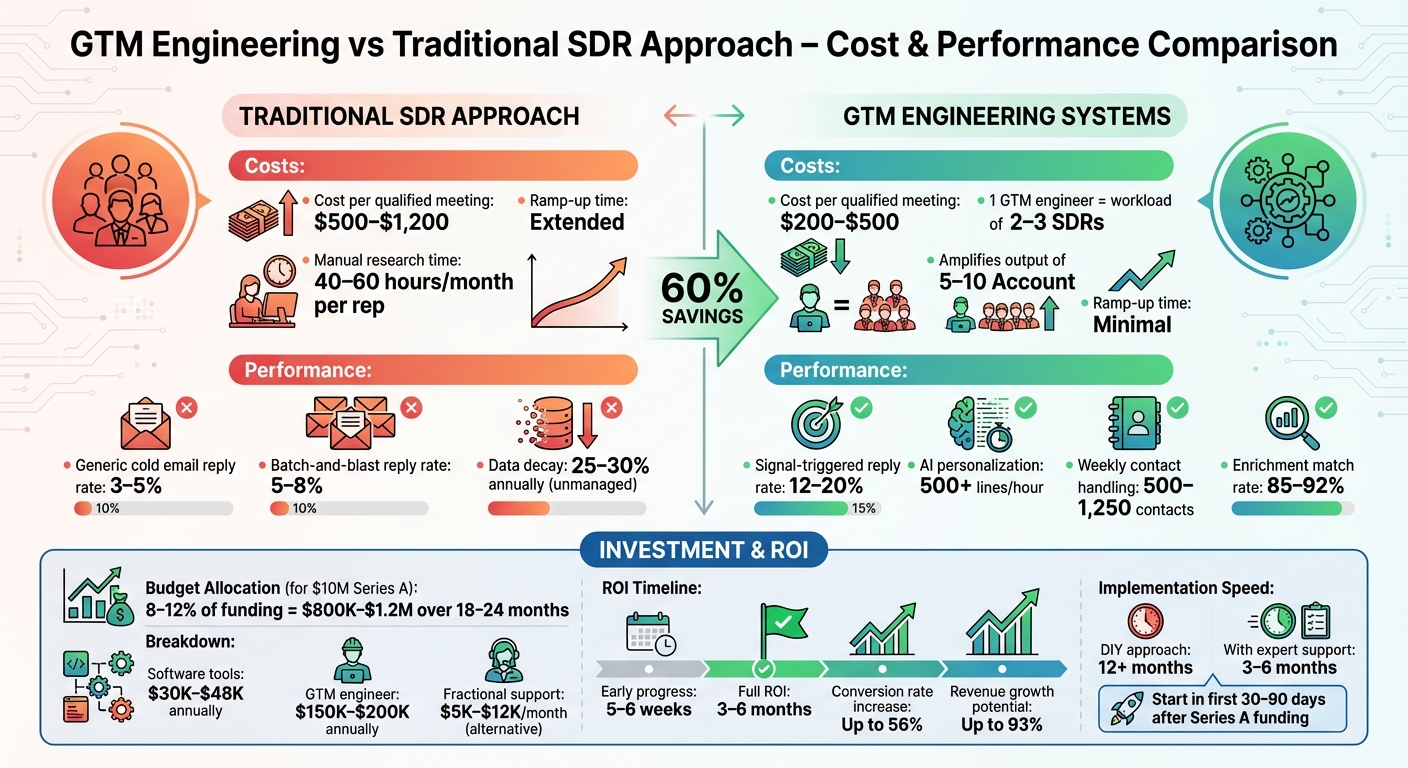
Series A startups often struggle because they rely on manual sales processes that can’t scale. GTM Engineering solves this by treating sales development as an engineering challenge, replacing repetitive tasks with automated systems. Instead of hiring more SDRs, you build workflows that handle lead enrichment, scoring, and outreach – cutting costs per meeting by up to 60% while increasing efficiency.
Key Takeaways:
- Why It Matters: Investors expect scalable, repeatable revenue systems by Series A. Manual processes inflate costs and slow growth.
- What to Do First: Build GTM systems (CRM, lead enrichment, signal-based outreach) within the first 90 days of funding.
- Budgeting: Allocate 8–12% of Series A funding ($800K–$1.2M for a $10M raise) for tools, a GTM engineer, and fractional support.
- ROI: Systems pay off in 3–6 months, cutting cost per meeting to $200–$500 vs. $500–$1,200 with SDRs.
Start early, focus on automation, and ensure every tool works together seamlessly. This approach delivers scalable growth, impresses investors, and sets you up for Series B success.
GTM Engineering ROI: Traditional SDR vs Automated Systems for Series A Startups
When to Build Your GTM Systems
Start in the First 30-90 Days
The first 30–90 days after securing your Series A funding are the perfect window to lay the groundwork for your GTM systems. At this stage, you have fresh capital, clear growth objectives, and the time to invest in building infrastructure that will drive results over the next 18–24 months.
Starting early helps you avoid the pitfall of hiring expensive sales reps for tasks that could – and should – be automated. Without automation, reps often spend 40–60 hours each month on manual research, inflating your cost per qualified meeting to $500–$1,200. With signal-based systems, that cost drops to a much more efficient $200–$500 range.
Another reason to act quickly is the lead time required to set up these systems. If you wait until month 4 or 5, you’ll face delays that could disrupt your growth plans. Worse, you’ll be trying to implement systems while onboarding new team members, which can lead to operational chaos.
Early action also protects your total addressable market (TAM). Without the right systems, you risk alienating your best prospects with poorly targeted outreach. Once a prospect receives a generic or irrelevant message, rebuilding that relationship becomes a steep uphill battle.
By prioritizing infrastructure in these early days, you create a solid foundation that will support efficient scaling when it’s time to grow your team.
Build Systems Before Hiring Reps
Getting your GTM systems in place before hiring sales reps is key to scaling efficiently. The best practice is to focus on building your infrastructure during months 1 through 6, ensuring it’s fully operational by the time you begin expanding your sales team in month 4 or later. This way, new hires step into a system that’s ready to go, rather than wasting time building from scratch.
Automating workflows not only reduces costs but also boosts productivity. For instance, one GTM engineer can handle the workload of 2–3 SDRs and significantly amplify the output of 5–10 Account Executives by delivering pre-qualified, signal-driven opportunities.
"We’re opting for one strong builder who can set up workflows that dozens of reps can optimize on – rather than adding more SDRs to the problem."
- Kushal Magar, SyncGTM
This approach also slashes ramp-up time for new hires. Instead of juggling manual tasks, new reps can focus on understanding your product and refining their pitch while the system takes care of the heavy lifting.
How to Budget for GTM Engineering
Once you’ve determined the right timing and approach for implementing GTM systems, the next critical step is budgeting. Effective allocation ensures your spending accelerates the development of scalable revenue infrastructure without unnecessary waste.
Allocate 8–12% of Your Series A Funding
Plan to reserve 8–12% of your Series A funding for GTM systems and expert support. For a $10M raise, this translates to setting aside $800K–$1.2M over the next 18–24 months. This allocation establishes the groundwork for a revenue engine that delivers consistent, predictable growth.
Balancing Tools and Talent
Your GTM budget generally covers three main areas: software tools, personnel, and external expertise. Here’s how those costs typically break down:
- Software tools: A complete enterprise stack – covering CRM, data enrichment, outreach, and analytics – runs between $2,500 and $4,000 per month, or $30K–$48K annually.
- GTM engineer: Hiring a GTM engineer costs $150K–$200K annually (fully loaded). This role can replace the workload of 2–3 SDRs or significantly enhance the productivity of 5–10 Account Executives.
- Fractional support: If a full-time GTM engineer isn’t feasible, you can opt for fractional support at $5K–$12K per month. This provides expert guidance during critical phases without the need for a long-term commitment.
When deciding where to allocate funds, consider whether short-term agency support or building long-term infrastructure is the better fit. For Series A companies, investing in permanent systems often yields stronger returns.
Expected ROI Timeline
Investments in GTM engineering typically pay off quickly. Early progress can be seen within 5–6 weeks, with full ROI achieved in 3–6 months. The impact can be dramatic: conversion rates can climb by as much as 56%, and revenue growth can approach 93%. Signal-based outreach methods, for example, can drive reply rates of 15–25%, far exceeding the standard 3–5% from traditional batch-and-blast tactics.
Building these systems independently often takes over 12 months of trial and error. However, working with experts can reduce that timeline to just 3–6 months, ensuring a steady pipeline of qualified leads much sooner.
What to Build First
Once your budget is set, it’s time to focus on creating scalable, integrated systems that consistently deliver qualified leads.
Set Up Your Core Revenue Systems
Start by choosing a CRM that fits your needs. Whether it’s a user-friendly tool like HubSpot or a more robust option like Salesforce, your CRM must act as your Single Source of Truth. Every customer interaction, data point, and pipeline stage should flow through this system.
To expand your reach, use a waterfall enrichment strategy. Sequentially query tools like Prospeo, Findymail, and Datagma to achieve email find rates of 85–92%. This approach significantly increases your ability to connect with the right people.
Next, integrate your CRM with an orchestration layer like n8n or Zapier. This connection allows your systems to work together seamlessly. For example, when a prospect visits your pricing page or a target company announces new funding, your system can automatically enrich the contact, score the lead, and trigger personalized outreach – all without manual effort. With these foundational systems in place, you’re ready to take the next step: automating lead enrichment and qualification.
Automate Lead Enrichment and Qualification
Once your CRM and enrichment tools are synchronized, automating lead qualification ensures maximum efficiency. A well-configured GTM system can handle 500–1,250 contacts weekly.
The real magic happens when you incorporate AI-powered personalization and signal-triggered outreach. Tools like Clay and Claygent can analyze a prospect’s LinkedIn profile, review recent company updates, and generate over 500 personalized opening lines per hour. For a human, this would take days to achieve at a fraction of the volume. Combine this with real-time buying signals – such as job changes, website visits, or funding announcements – and your reply rates can jump from 1–2% to 4–8%.
Take the example of ManpowerGroup’s Northern European marketing team. In January 2026, under the leadership of Project Manager Tina Hingston, they unified lead management across eight countries using HubSpot. By standardizing lead scoring and automating routing, they eliminated inconsistencies – like one branch labeling a lead "Sales Ready" while another called it an "MQL." This streamlined approach improved resource allocation and sped up follow-ups.
Build Your Pipeline Dashboards
After setting up automated lead handling, the next step is tracking your performance with real-time dashboards. These dashboards should monitor critical metrics like cost per qualified meeting, pipeline ratios, and conversion rates.
Start by focusing on the essentials: how many leads convert to Marketing Qualified Leads (MQLs), how many MQLs become Sales Qualified Leads (SQLs), and the average time it takes to close deals. From there, layer in attribution data to pinpoint which signals and channels generate the highest-quality pipeline. For instance, does a visit to your pricing page result in better conversions than LinkedIn engagement? Your dashboard should provide clear answers to such questions.
In March 2026, Clay’s internal GTM team created a custom Slack app that delivers pre-call research briefs to Account Executives whenever a deal stage advances in Salesforce. These briefs compile CRM data, Gong call summaries, and product usage insights, saving 15–20 minutes of manual research per call. This kind of automation transforms your dashboard from a static report into a dynamic tool for driving revenue.
With automated lead flows in place, your dashboards become the key to refining and scaling your systems. These systems can reduce the cost per qualified meeting to $200–$500, compared to $500–$1,200 with traditional SDR-driven outbound methods. As your operation grows, this efficiency becomes a powerful advantage, making early investment in dashboards one of the smartest moves you can make.
How to Scale and Improve Your Systems
As your revenue goals grow, scaling your GTM infrastructure requires constant attention and fine-tuning. The systems you’ve built to automate lead flows and dashboards need regular reviews to ensure they remain efficient and aligned with your targets.
Review and Fix Your GTM Stack
Make it a habit to audit your GTM stack every six months. This helps uncover data silos, redundant tools, and capacity bottlenecks that could slow you down.
One major issue to tackle is data decay. Did you know that B2B contact data deteriorates by about 30% each year? People change jobs, companies shut down, and contact details get updated. To stay ahead, set up automated re-enrichment in your CRM. For example, when an email bounces or outreach fails, trigger a refresh of that contact’s data. This keeps your sequences focused on active, reachable leads.
When refining your stack, aim for a system where data flows seamlessly from signal detection and enrichment to CRM orchestration and outbound execution. A well-connected system doesn’t just save time – it unlocks better insights for smarter decision-making.
Use Data to Scale Smarter
Your data holds the key to scaling effectively. Use performance metrics to identify what drives results and what drains resources. Attribution analysis, for instance, can pinpoint which signals, sequences, or touchpoints lead to replies and meetings. Focus your resources on what works and cut out what doesn’t.
One of the biggest opportunities for scaling lies in signal-based triggers. Instead of sending emails on a set schedule, configure your system to respond to real-time events – like funding announcements, executive job changes, or new job postings at target accounts. Outreach triggered by these signals can deliver reply rates of 12%–20%, far outpacing the 5%–8% typical of generic cold emails.
Feedback loops are another powerful tool. By feeding data from replies, meeting outcomes, and closed-won deals back into your Ideal Customer Profile models, you can refine lead scoring and improve targeting over time.
Metrics That Matter at Series A
At Series A, your GTM infrastructure must deliver predictable results. Set clear benchmarks to ensure your systems are aligned with your growth goals.
For pipeline coverage, aim for 4x–6x your revenue target. If you’re aiming to close $1 million this quarter, your pipeline should hold $4–$6 million in qualified opportunities. Additionally, maintain an enrichment match rate of at least 85% and email deliverability above 95%.
Operational efficiency is just as important. Top systems respond to high-intent signals in under five minutes and assign leads with over 95% accuracy.
| Metric | Target Benchmark | Why It Matters |
|---|---|---|
| Enrichment Match Rate | 85%+ | Ensures sequences have accurate data for personalization |
| Signal-Triggered Reply Rate | 12%–20% | Reflects the relevance and timing of outreach |
| Lead Response Time | < 5 minutes | Boosts conversion chances by acting quickly |
| Email Deliverability | 95%+ | Protects domain reputation and ensures emails land in inboxes |
| Pipeline Coverage | 4x–6x | Ensures enough opportunities to meet revenue goals |
| Routing Accuracy | > 95% | Minimizes friction by assigning leads correctly |
Lastly, keep an eye on your cost per qualified meeting (CPQM). Signal-based systems should deliver meetings at $200–$500 each, while traditional SDR-driven outbound can cost $500–$1,200. If your CPQM starts climbing, dig into your data. Is the issue with data quality, messaging, or targeting? Your dashboards should help you spot and fix these problems before they escalate.
Conclusion
What Series A Founders Should Remember
Scaling headcount without first building a strong GTM infrastructure often leads to stalled growth. Companies that approach revenue generation as an engineering challenge – rather than just hiring more people – set themselves up for exponential growth. By investing early in systems like signal detection, waterfall enrichment, automated routing, and real-time dashboards, you create a machine that consistently generates predictable pipeline and impresses investors.
The key lies in focusing on clean data, automation, and precise outreach. Start by maintaining accurate data and using signal-based triggers, as outdated B2B contact data can decay by 25–30% annually. Automated re-enrichment ensures your data stays actionable. Prioritize relevance over sheer volume – automated, signal-driven outreach consistently outperforms generic campaigns. A single GTM engineer, armed with the right tools, can dramatically boost productivity and lower the cost per meeting.
However, automation is only effective if the underlying processes are sound. Validate your ideal customer profile (ICP) and messaging manually with 50–100 contacts before automating. A well-designed, end-to-end system becomes the ultimate proof of your scalable revenue engine. These strategies form the foundation of scalable revenue operations, and expert guidance can help you implement them effectively.
Getting Help with Implementation
If you’re ready to build a production-ready revenue infrastructure but lack internal resources, GTM Engineering Services can help. We specialize in designing and implementing systems for Series A and Series B startups, including GTM stack audits, waterfall enrichment pipelines, CRM automation, signal-based outbound sequences, and pipeline analytics dashboards. Our team delivers a fully operational system in just 3–6 months, compared to the 12+ months it often takes to build internally.
Our clients use these systems to replace manual prospecting with automated, always-on pipeline generation, proving scalability to investors. Whether you need a complete build or optimization of your current stack, we work with funded B2B startups ready to transition from founder-led sales to repeatable, scalable go-to-market operations.
FAQs
What does a GTM engineer actually do day to day?
A GTM Engineer designs and fine-tunes automated systems that fuel scalable revenue growth. Instead of relying on manual workflows, they set up tools that handle tasks like signal detection, contact enrichment, CRM automation, and outbound processes. The goal? Build systems that work smarter and faster.
Beyond just creating these systems, GTM Engineers keep a close eye on how they perform. They troubleshoot problems, optimize workflows, and work closely with sales, marketing, and operations teams to ensure the infrastructure keeps the pipeline flowing predictably and aligns with broader business objectives.
How do I pick the right buying signals to trigger outreach?
When selecting buying signals, zero in on those that clearly indicate a prospect is actively considering a purchase. Examples include funding rounds, leadership changes, or new product launches. Start by refining your ideal customer profile (ICP) – this ensures you’re focusing on signals that truly align with your target audience.
Once you’ve identified the right signals, prioritize the ones that consistently reflect genuine purchasing intent. From there, integrate these signals into automated workflows. This step ensures your outreach is not only timely but also highly relevant, increasing the chances of meaningful engagement.
What should I automate first if my CRM data is messy?
The first step to building a reliable sales infrastructure is automating how you clean and enrich your contact records. By setting up systems that automatically detect and fix errors while filling in missing details, you ensure your data is accurate and complete. Tools like Clay or ZoomInfo can handle this process, transforming your CRM into a dependable source of truth.
Why does this matter? Clean data powers everything – effective lead routing, well-targeted outbound sequences, and a scalable pipeline. Without it, your entire sales process risks inefficiency and missed opportunities.