
Scaling revenue operations is one of the biggest challenges Series A startups face. Founders often spend over 20 hours a week on manual tasks like CRM updates and pipeline reports – time that should be spent on growth. Fractional RevOps solves this by providing senior-level expertise for $4,000–$6,000 per month, compared to the $180,000+ annual salary of a full-time hire.
Here’s what Fractional RevOps delivers:
- Faster results: Productive in weeks, not months.
- Lower cost: No benefits or equity, saving up to 70% vs. full-time roles.
- Scalable systems: CRM workflows, automated lead routing, and investor-ready dashboards.
- Improved metrics: 19% faster revenue growth, 15% higher profitability, and up to 28% better forecast accuracy.
If your team is bogged down by manual processes or struggling to align sales and marketing, Fractional RevOps builds the systems you need to scale efficiently without hiring prematurely.
What Is Fractional RevOps?
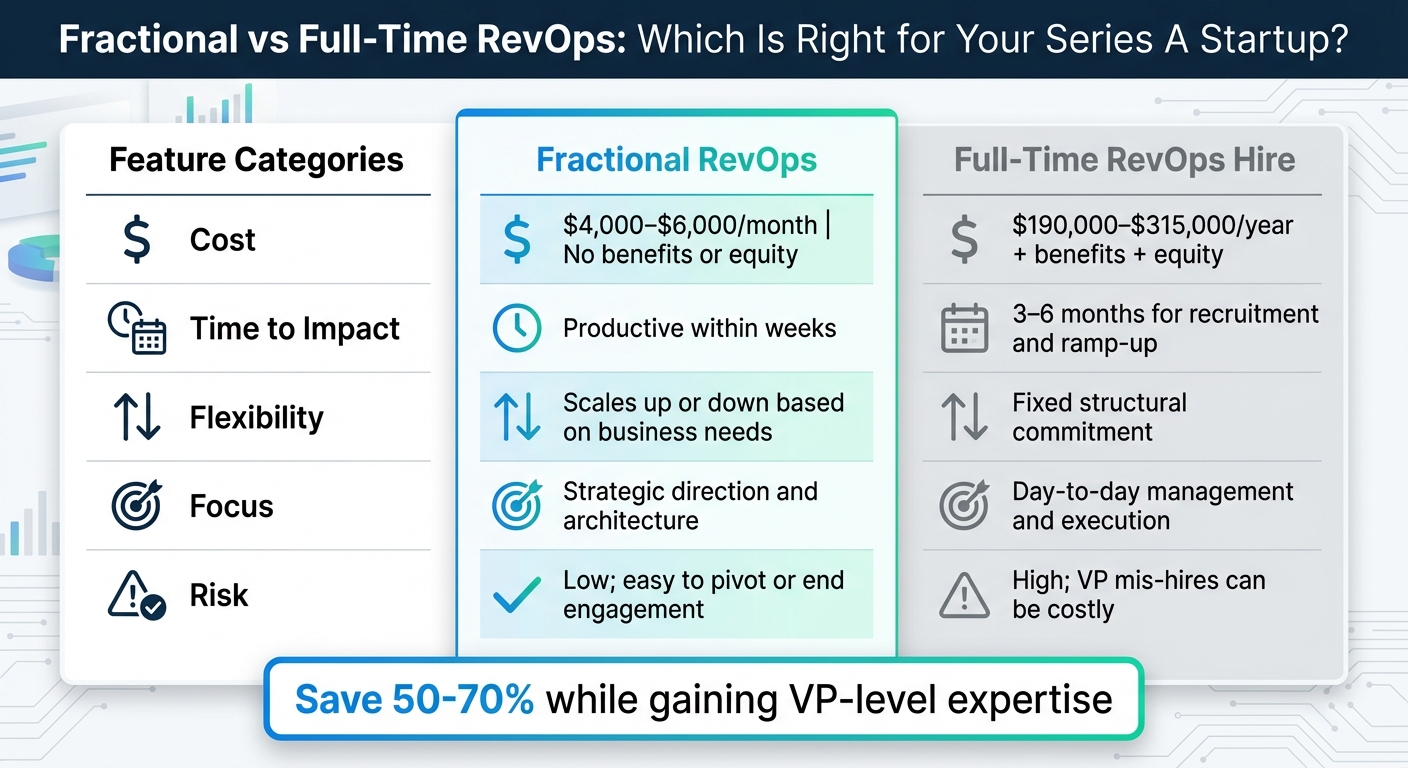
Fractional vs Full-Time RevOps: Cost, Timeline, and Impact Comparison
Fractional RevOps offers VP-level Revenue Operations leadership on a flexible, part-time basis. This isn’t about hiring someone to handle routine CRM updates or generate basic reports. Instead, it’s focused on strategic leadership: shaping your revenue architecture, implementing forecast governance, and aligning your GTM teams with clear processes and definitions. As Nicholas Gollop, Senior Revenue Operations Advisor, explains:
"Fractional revenue operations leadership is about owning the quality of revenue decisions. Not adding hands to the work."
This distinction is critical. If your needs revolve around tasks like cleaning up duplicate records or updating CRM fields, that’s operational support. But if you’re looking for someone to decide which tools to invest in, how to streamline lead routing between marketing and sales, or what criteria should define pipeline stages, that’s strategic leadership. It’s about solving directional challenges, not just adding capacity.
For Series A startups, fractional RevOps provides immediate access to expertise drawn from various industries without the delays of a lengthy hiring process. Typical retainers range from $4,000 to $6,000 per month, which is about the same cost as a junior SDR but with far greater strategic impact. Below, we’ll explore the core functions of fractional RevOps and how it compares to a full-time role.
Core Functions of Fractional RevOps
Fractional RevOps plays a key role in building scalable revenue operations. It involves designing lead flows, establishing pipeline and forecast governance, and integrating Sales, Marketing, and Customer Success teams to eliminate inefficiencies.
Key responsibilities include making critical build-versus-buy decisions for your tech stack, setting data governance standards to avoid creating "Franken-CRMs", and ensuring tools are integrated in a hub-and-spoke model rather than fragile point-to-point connections. In terms of forecast and pipeline governance, fractional RevOps defines what "qualified" means (often using frameworks like MEDDICC), standardizes sales stage definitions, and creates forecasting cadences that meet the expectations of both boards and investors.
They also align GTM teams by creating standardized KPIs, automating lead handoffs, and developing collaborative dashboards. For example:
- Marketing wants recognition for pipeline contributions.
- Sales prefers high-intent leads.
- Customer Success needs smooth handoffs.
Fractional RevOps ensures these teams work as a unified system rather than operating in silos.
The impact is measurable. Companies with aligned RevOps functions experience 19% faster revenue growth and 15% higher profitability. Forecast accuracy improves by up to 28%, and sales productivity can increase by 10–20% in the first year. These gains aren’t just minor improvements – they’re the difference between proving a scalable GTM motion and wasting resources on disjointed efforts.
Fractional vs Full-Time RevOps
Choosing between fractional and full-time RevOps depends on factors like timing, flexibility, and risk. A full-time VP of RevOps makes sense when you have the budget to support a significant salary, benefits, and equity package, and when you need someone embedded in daily operations. However, for most Series A startups, committing to a full-time hire at this stage can be premature and risky.
Here’s a comparison to highlight the differences:
| Feature | Fractional RevOps | Full-Time RevOps Hire |
|---|---|---|
| Cost | $4,000–$6,000/month; no benefits or equity | $190,000–$315,000/year + benefits + equity |
| Time to Impact | Productive within weeks | 3–6 months for recruitment and ramp-up |
| Flexibility | Scales up or down based on business needs | Fixed structural commitment |
| Focus | Strategic direction and architecture | Day-to-day management and execution |
| Risk | Low; easy to pivot or end engagement | High; VP mis-hires can be costly |
Fractional RevOps delivers immediate strategic value without the long-term commitment. You gain insights from someone who has built revenue systems across multiple companies, significantly reducing the trial-and-error period that often slows startups. Plus, as your needs change – whether scaling up during a growth phase or scaling down after a launch – fractional engagements can adapt accordingly.
The key lies in understanding your priorities. As Nicholas Gollop notes:
"If the engagement is measured in tasks completed, it’s operational support. If it’s measured in decisions improved, it’s leadership."
Why Series A Startups Need Fractional RevOps
Series A startups have already nailed down product-market fit and secured funding, but scaling revenue operations is the next big challenge. Founders often find themselves spending up to 20 hours a week on manual RevOps tasks that could easily be automated. This eats into time that could be better spent on strategy, investor relations, or other high-impact areas.
Common Challenges in Scaling Revenue Operations
Shifting from founder-led sales to a scalable go-to-market (GTM) approach brings its own set of problems. When teams operate in silos, data becomes inconsistent, strategies fall out of sync, and revenue opportunities slip through the cracks. On top of that, poor data hygiene is a major issue – sales reps spend just 30% of their time actually selling because they’re bogged down with manual data entry. The result? Unreliable CRM data, inaccurate forecasts, and potential revenue losses of 15% to 25%.
Then there’s the issue of "Frankenstein" systems – tool stacks that are cobbled together and don’t scale well. These setups rely on fragile, point-to-point integrations that leave startups stuck with vendor dependencies. When it’s time to pivot or grow, these systems often require a complete overhaul, adding unnecessary complexity and cost.
As Fifield and Bradburn from Scalewise put it:
"If you have not invested in proper revenue operations and have it up and running by Series A, you’re going to very quickly run into a mess. Your metrics will be difficult to uncover and there will be deep inefficiencies in your team."
This is where fractional RevOps can step in and make a big difference.
Benefits of Fractional RevOps
Fractional RevOps provides a cost-effective way to tackle these issues, offering high-level strategic guidance without the expense of a full-time hire. With monthly retainers ranging from $4,000 to $6,000, compared to full-time salaries that exceed $100,000, startups can save 50% to 70% while still gaining access to VP-level expertise. It’s a smart, scalable solution for startups looking to streamline operations without breaking the bank.
Key Components of Fractional RevOps Implementation
Building a scalable revenue system isn’t about hiring more people – it’s about creating systems that can grow with your company. Fractional RevOps implementation focuses on four key areas that turn manual processes into automated workflows, laying the groundwork for predictable growth. For Series A startups, mastering these areas is essential to move from founder-led operations to a revenue system that attracts investor confidence and supports scaling.
GTM Stack Audits and Optimization
Before you can fix anything, you need to know where the cracks are. A GTM stack audit dives into your existing tools – whether it’s HubSpot, Salesforce, or another platform – to pinpoint inefficiencies. Are leads getting stuck in the pipeline? Is data inconsistent? Are your teams bogged down with manual tasks? These audits also reveal fragile integrations that might break as you scale. The goal here is to create standardized processes across your teams, with clear field definitions, validation rules, and deduplication protocols. Once the stack is cleaned up, you’re ready to tackle CRM workflows.
CRM Automation and Workflow Design
With the pain points identified, the next step is building workflows that eliminate repetitive tasks. This isn’t just about tweaking CRM settings – it’s about designing systems that, for example, route leads based on real-time capacity and predictive scoring. Done right, CRM automation can improve forecast accuracy by up to 30% and boost sales productivity by 10–20%. It also enforces data governance, turning your CRM into a reliable "single source of truth." This is especially critical for startups transitioning from founder-led sales to a full team, as it ensures no leads fall through the cracks and keeps forecasts dependable. With automation in place, you can shift focus to scaling outreach.
Multi-Channel Outreach and Lead Intelligence
Manual prospecting will only take you so far. Automated data enrichment pipelines save your team from hours of research, letting them focus on closing deals. These systems combine multiple data sources to build detailed prospect profiles, pulling in firmographic and behavioral data automatically. When integrated with platforms like Instantly or Smartlead, this enriched data enables personalized messaging at scale – without needing to grow your team linearly. Companies using AI for sales have seen 50% more leads and appointments, while automated outreach can deliver 8x the meetings at a fraction of the cost compared to manual efforts. These systems also generate valuable pipeline data for your analytics.
Pipeline Analytics and Revenue Dashboards
If you’re planning to raise your next funding round, investor-ready dashboards are non-negotiable. Pipeline analytics shift your team’s focus from looking backward (e.g., what happened last quarter) to looking ahead (e.g., where to allocate resources). Real-time tracking of key metrics like pipeline velocity, win rates, and forecast accuracy allows you to spot bottlenecks and act quickly. Poor data quality can drain 15–25% of revenue, but improving CRM data hygiene can boost forecast accuracy by up to 30%. For a $10M ARR company, cutting data-related revenue losses by 75% through better analytics can deliver a 7.5x ROI. These dashboards also provide transparency with metrics like time-to-opportunity and stage conversion rates – key insights that prove your scalability to investors.
Sales and Marketing Alignment Systems
Once you’ve optimized your GTM stack and automated workflows, the next step is ensuring sales and marketing operate as a cohesive unit. Without alignment, even the most sophisticated pipeline analytics won’t deliver results. Aligned sales and marketing teams can achieve 32% higher growth, while misalignment could cost you a 4% revenue drop. For Series A startups, demonstrating to investors that your revenue engine is system-driven – not chaotic – is non-negotiable. The path forward focuses on three core areas: defining shared KPIs, automating lead handoffs, and creating joint dashboards for transparent insights.
Shared KPIs and Metrics
Before you even think about dashboards, sit both teams down and agree on what defines a "qualified lead" or "opportunity." If marketing considers a demo request a lead but sales doesn’t, pipeline reviews will quickly devolve into finger-pointing. Start simple with five to seven key metrics – like lead-to-opportunity rate, speed to lead, and attribution accuracy – and ensure everyone agrees on their definitions. When marketing alignment boosts its pipeline contribution from 10% to 29%, you’ll see the impact of shared KPIs. This clarity builds on your fractional RevOps groundwork, setting the stage for consistent growth.
Lead Handoff Automation
Manual lead handoffs are a recipe for delays and dropped opportunities. Instead of relying on subjective lead scoring, use behavior-based triggers – like multiple visits to your pricing page or downloading a competitor comparison guide – to signal readiness. Embed Service Level Agreements (SLAs) directly into your CRM to ensure no lead goes untouched. For instance, if an inbound lead isn’t contacted within 15 minutes, the system should automatically escalate it. One team reduced lead routing delays from two hours to 45 minutes, boosting contact rates by 18% and pipeline conversion by 12%. With sales reps spending only 30% of their week selling, automating these processes allows them to focus on closing deals instead of chasing leads.
Joint Dashboards for Collaboration
Once lead handoffs are running smoothly, the next step is creating joint dashboards that merge sales and marketing data into one unified view. Separate dashboards often lead to fragmented insights, while a shared CRM dashboard eliminates the need for endless spreadsheets and ensures accurate attribution. These dashboards let both teams monitor real-time metrics like conversion rates, lead quality, and follow-up speed. If something starts to slip – whether it’s lead quality or sales responsiveness – everyone sees it immediately. Regular KPI reviews using these dashboards transform decision-making from guesswork to data-driven strategy. Together, these alignment systems help you transition from founder-led chaos to a scalable, predictable growth engine.
Metrics for Success in Fractional RevOps
Measuring the impact of fractional RevOps is essential to confirm its value and effectiveness.
Key Metrics to Track
To gauge success, focus on metrics that reflect operational improvements. For example, revenue attainment should consistently hit 95–105% of target, showing your team is meeting goals without major fluctuations. Aim for forecast accuracy above 90%, with a variance of no more than 5%, to reassure investors that your revenue engine is predictable. Ensure CRM adoption surpasses 80%, as automation efforts fall flat without active user engagement. A sales cycle reduction of 10–20% signals faster deal closures and a pipeline with real momentum. Lastly, maintain data quality at over 95% accuracy to ensure your scaling systems remain reliable.
Before and After Fractional RevOps Metrics
The transformation fractional RevOps brings is clear when comparing metrics before and after implementation. Many Series A startups initially struggle with forecasts missing by over 20% and sales reps spending just 30% of their time on actual selling. Post-implementation, the improvements are striking: forecast accuracy often exceeds 90%, and sales productivity can rise by 10–20% within a year. Enhanced data quality, which previously caused 15–25% revenue leakage, can reach 95% accuracy or better. Even lead routing sees dramatic improvement – cutting delays from two hours to 45 minutes increases contact rates by 18% and pipeline conversions by 12%.
Here’s a snapshot of the measurable gains:
| Metric | Before Fractional RevOps | After Fractional RevOps |
|---|---|---|
| Revenue Growth | Stagnant or inconsistent | 15–20% increase |
| Forecast Accuracy | Off by >20% or no projections | >90% (within 5% variance) |
| Sales Productivity | Reps spend only 30% of time selling | 10–20% increase |
| Sales Cycle Length | Baseline | 10–20% reduction |
| Data Quality | 15–25% revenue leakage | >95% accuracy |
| Process Adoption | Inconsistent/siloed | >80% compliance |
| Lead Conversion | Baseline | 12% improvement |
When to Engage Fractional RevOps Providers
Signs Your Startup Needs Fractional RevOps
Fractional RevOps becomes essential when your startup’s ARR falls between $500,000 and $10 million. At this point, the manual processes that worked during your early days start to break down. You’ll notice it’s time when your team grows to three or more salespeople or you surpass 50 customers – managing operations manually starts to slow everything down.
Key signs include your founder spending over 20 hours a week on RevOps tasks that could be automated, or your sales team devoting just 30% of their time to selling because they’re bogged down by admin work. If you’re pouring $15,000–$30,000 a month into sales and marketing tools without a clear strategy, chances are your tech stack isn’t integrated or reliable. Another warning sign? Outbound reply rates dipping below 5%, even with heavy investment.
"Hiring salespeople before establishing a proven GTM architecture is like hiring construction workers without blueprints." – TF Business Solutions
Timing is everything. The transition from founder-led sales to hiring your first SDRs and AEs is a pivotal moment. Engaging fractional RevOps before these hires ensures you have documented, repeatable systems in place to set your new team up for success. Without this foundation, your sales team ends up trying to build the plane while flying it – an approach that rarely works for scaling.
These signals make it clear when it’s time to bring in experts to streamline your GTM operations.
How GTM Engineering Services Can Help
This is where GTM Engineering Services steps in, offering automated revenue infrastructure tailored for Series A and Series B startups navigating this critical stage. The process kicks off with a GTM Stack Audit to pinpoint system gaps and create a 90-day implementation roadmap. From there, they focus on building the infrastructure itself: CRM automation and workflows in HubSpot or Salesforce, multi-channel outbound systems powered by tools like Clay and AI enrichment, and pipeline analytics dashboards for real-time visibility into your funnel.
Unlike one-size-fits-all solutions, this approach is all about custom engineering. GTM Engineering Services works within your existing tech stack, using APIs, webhooks, and data pipelines to create systems that fit your needs. Plus, you retain full ownership of these systems once the engagement wraps – complete with documentation and training – so you’re not locked into a vendor.
Engagements typically last three to six months, costing $4,000–$6,000 per month. That’s about the same as a junior SDR’s salary, but the results deliver senior-level impact, giving you scalable systems to grow toward $10 million ARR.
Conclusion
Series A startups can’t rely on hustle alone – they need systems to scale effectively. The numbers speak for themselves: companies with aligned RevOps achieve 19% faster revenue growth and 15% higher profitability. Yet, many startups make the mistake of hiring sales reps before building a scalable GTM framework. The result? Sales teams spend just 30% of their time actually selling, and founders risk $330,000–$400,000 on hires who struggle without the right infrastructure.
This is where Fractional RevOps changes the game. For $4,000–$6,000 per month – the cost of a junior SDR – you get VP-level expertise that delivers automated CRM workflows, AI-powered multi-channel outreach, and real-time pipeline dashboards. It’s a strategic move that builds the foundation for predictable, scalable growth.
Instead of focusing on headcount, Fractional RevOps prioritizes creating documented, repeatable processes for every sales hire. This approach can boost sales productivity by 10–20% and improve forecast accuracy by up to 28% in just a year. By replacing chaotic, ad hoc methods with standardized systems, startups position themselves for long-term success.
GTM Engineering Services specializes in helping Series A and Series B startups at this critical juncture. When manual processes begin to fail but hiring full-time RevOps leadership isn’t feasible, they step in to deliver custom-built systems tailored to your existing tech stack. Their services include full documentation and training, so you maintain complete control over your revenue operations. Best of all, they deliver results fast – shipping a qualified pipeline in weeks, not months.
If your sales team is bogged down by manual tasks, you could be leaving significant revenue on the table. Fractional RevOps bridges that gap without the overhead of a full-time team, providing the scalable infrastructure needed to grow from $1M to $10M ARR. It transforms founder-driven chaos into a streamlined revenue engine – an essential upgrade for any Series A startup aiming for the next level.
FAQs
What should I do first in the first 30 days of fractional RevOps?
In the first 30 days of fractional RevOps, the focus should be on building a repeatable go-to-market (GTM) system before diving into scaling efforts. Resist the urge to hire sales reps or spend heavily on tools right away. Instead, dedicate this time to evaluating your GTM strategy, spotting any weak points, and documenting sales and marketing processes that can scale. This approach lays the groundwork for consistent revenue and sustainable growth.
Which RevOps tasks should stay in-house vs. be handled fractionally?
Some RevOps tasks are best managed internally to maintain control and alignment with company goals. These typically include CRM management, sales process optimization, data governance, and cross-team alignment. These areas are closely tied to the day-to-day operations and strategy of the business, making them essential to keep within the organization.
On the other hand, tasks like automation development, complex system integrations, and scalable infrastructure design are often outsourced to fractional experts. These require specialized technical skills and are geared toward building systems that can grow with the business. By striking this balance, startups can focus on their core functions while tapping into external expertise for more technical and scalable needs.
How do I know it’s time to switch from fractional to a full-time RevOps hire?
When your company’s growth surpasses what fractional RevOps support can handle, it’s time to make the leap. Signs that you’ve reached this point include hitting rapid growth milestones – like scaling from $3M to $10M ARR – or dealing with increasingly complex revenue systems that demand dedicated attention. If automation, data management, and system architecture require ongoing oversight, or if aligning sales, marketing, and customer success calls for consistent leadership, it’s clear that a full-time hire is the next step.