
The demand for GTM Engineers has surged by 205% from 2024 to 2025, making it one of the fastest-growing technical roles. With salaries ranging from $70,000 to over $250,000 depending on company stage, hiring a GTM Engineer is a critical investment for businesses looking to scale their revenue systems.
Key Insights:
- Median Pay: $225,000 annually.
- Entry-Level: $70,000–$120,000 at seed-stage startups.
- Experienced Roles: $200,000–$250,000+ at late-stage companies or enterprises.
- Skills in Demand: Python, SQL, AI, and data pipeline management.
- AI Expertise Premium: Salaries increased by 23% in 2025 for AI-focused roles.
For startups, hiring a full-time GTM Engineer ensures scalable revenue systems, while fractional GTM Engineers offer a cost-effective alternative for early-stage needs. Whether full-time or fractional, GTM Engineers deliver measurable ROI by automating workflows, reducing manual tasks, and improving lead conversion rates.
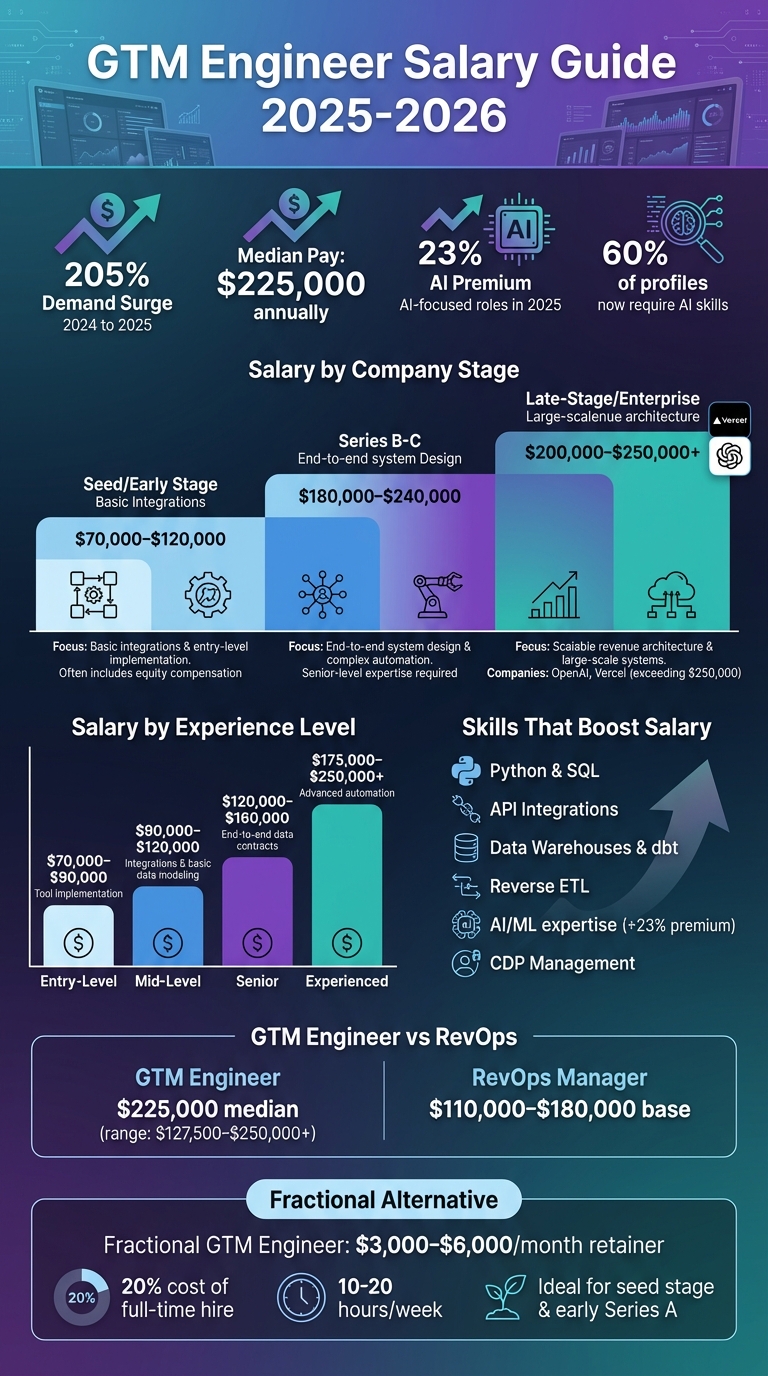
GTM Engineer Salary Ranges by Company Stage and Experience Level 2025-2026
GTM Engineer Salary by Company Stage
Salary Ranges by Stage
The compensation for GTM Engineers evolves as companies advance through funding stages. At the seed stage, salaries typically range from $70,000 to $120,000, with responsibilities centered on entry-level implementations and basic system integrations. Early hires at this stage often receive substantial equity as part of their compensation package.
As companies secure Series B or C funding, the pay scale rises to $180,000 to $240,000, reflecting the need for senior-level expertise. At this stage, GTM Engineers are tasked with designing comprehensive systems and automating complex workflows to support scalable revenue growth.
In late-stage companies and enterprise-level organizations, compensation climbs even higher, often reaching $200,000 to $250,000 or more. High-growth firms, such as OpenAI and Vercel, frequently offer packages exceeding $250,000 for experienced professionals who can manage large-scale systems. Across the board, the median compensation for the role is $225,000.
| Funding Stage | Compensation Range | Primary Focus |
|---|---|---|
| Seed/Early Stage | $70,000–$120,000 | Basic integrations |
| Series B-C | $180,000–$240,000 | End-to-end system design |
| Late-Stage/Enterprise | $200,000–$250,000+ | Scalable revenue architecture |
These compensation levels reflect both market demand and the measurable impact GTM Engineers bring to their organizations.
Return on Investment for Startups
GTM Engineers offer a clear return on investment (ROI) at every stage of growth. In early-stage startups, a single GTM Engineer can deliver the equivalent output of five SDRs by automating workflows, significantly lowering hiring costs while speeding up outbound operations.
For mid-stage companies, the ROI is even more pronounced. These engineers drive pipeline efficiency by enabling faster lead responses, securing more qualified meetings, and boosting conversion rates. In fact, a 2025 survey revealed that 64% of companies considered top-performing GTM Engineers to be a worthwhile investment, even during periods of budget constraints.
Additionally, for startups aiming to secure their next round of funding, having a skilled GTM Engineer in place can be pivotal. They establish the technical infrastructure that signals scalable growth potential to investors, making it easier to attract funding and sustain momentum.
What Top Companies Pay GTM Engineers
Salary Data by Company
Top tech companies are offering GTM Engineers compensation packages that can reach up to $252,000. Companies like Vercel and OpenAI are leading the way, with packages hovering around $250,000. This reflects the demand for GTM Engineers who manage a diverse range of technical responsibilities.
Ramp, a rapidly expanding fintech firm, provides competitive total compensation at $184,000. Mid-market companies show more variation; for instance, Clay reports a median package of $121,000, with a range from $92,000 to $159,000 depending on experience. In December 2025, a GTM Engineer at Cisco in San Jose with five years of experience reported earning a base salary of $120,000.
The difference between salaries at top-tier companies and mid-market firms is striking. High-growth AI and infrastructure companies often exceed the $225,000 median by 10–20%, while established enterprise firms typically fall within a range of $120,000 to $180,000. This disparity highlights the premium placed on roles within high-growth environments.
Equity and Total Compensation
Cash compensation is just one part of the equation. For example, in January 2026, a GTM Engineer in San Francisco with six years of experience earned a total of $132,000 – this included a $110,000 base salary and a 20% performance bonus worth $22,000.
Equity remains a valuable component at high-growth companies, though cash offers have become a priority. GTM Engineers with specialized expertise in areas like AI and lifecycle automation saw a 23% earnings boost in 2025. Additionally, roles requiring skills in CDPs, data warehouses, dbt, and reverse ETL command higher total compensation compared to more basic operational roles.
What Affects GTM Engineer Salary
Location and Cost of Living
Where you work plays a huge role in determining your salary as a GTM Engineer. In major tech hubs like San Francisco, San Jose, and New York City, senior positions often come with compensation packages exceeding $180,000. California, in particular, leads the way as the highest-paying state for roles closely tied to engineering in the U.S..
Salaries in the U.S. far outpace those in Europe, largely due to broader responsibilities and a more mature market. While the median salary in the U.S. is around $176,000, European GTM Engineers generally earn less, reflecting differences in role expectations and market size.
The growing trend of returning to office environments – up 12% in 2025 – has also influenced pay scales. Companies are increasingly linking compensation to specific office locations rather than adopting location-agnostic salary bands for remote roles. On top of that, technical expertise remains a key factor in determining pay.
Technical Skills and Tools
The evolution from managing tools to building revenue systems has reshaped salary structures. GTM Engineers who handle complex systems like CRMs, CDPs, data warehouses, dbt, and reverse ETL processes earn significantly more than those focused on individual tools. Skills in Python, SQL, and API integrations have become must-haves as the role shifts toward creating custom solutions rather than simply connecting existing software.
AI expertise has become a major factor in salary growth. By 2025, 60% of GTM Engineer profiles mention AI as a required skill, and those with specialized AI knowledge saw a 23% salary boost. For roles involving end-to-end data contracts and warehouse modeling, salaries typically range from $120,000 to $160,000, while entry-level positions focused on implementation fall between $70,000 and $90,000. Additionally, the stage of the company and its industry focus also play a role in shaping compensation.
Company Stage and Industry
The maturity of the company and its industry focus significantly affect GTM Engineer salaries. Startups, which once relied heavily on equity to attract talent, are now offering more structured cash packages and clear compensation structures to secure top-tier candidates in 2025.
Industry focus is another key factor. Companies in AI and Machine Learning sectors often offer much higher salaries due to the demand for specialized technical skills. As more organizations invest in permanent, in-house GTM infrastructure teams instead of relying on temporary automation projects, compensation structures have become more standardized across various company stages.
sbb-itb-662fce2
GTM Engineer vs RevOps Salary
As startups compete for top talent, understanding the differences in compensation and responsibilities between GTM Engineers and RevOps professionals is essential. Let’s take a closer look at how these roles stack up in terms of pay and focus.
Salary Comparison
In the U.S., GTM Engineers command higher salaries than RevOps professionals. Their median total compensation stands at $225,000, with a range from $127,500 to $250,000 or more, depending on experience and the company’s growth stage. In contrast, RevOps roles typically offer base salaries between $110,000 and $180,000.
This pay disparity reflects the advanced technical expertise GTM Engineers bring to the table. While RevOps professionals focus on optimizing and maintaining existing systems, GTM Engineers are tasked with building complex, automated revenue systems from scratch. The table below highlights the differences in compensation and primary responsibilities for these roles:
| Role | Typical Total Compensation | Primary Focus |
|---|---|---|
| RevOps Manager | $110,000–$180,000 (base) | CRM management and process optimization |
| Mid-Level GTM Engineer | $90,000–$120,000 | Integrations and basic data modeling |
| Senior GTM Engineer | $120,000–$160,000 | End-to-end design and management of data contracts |
| Experienced GTM Engineer | $175,000–$250,000+ | Advanced automation and revenue architecture |
Shared Responsibilities
Although both roles share some overlap – like working on automation and pipeline analytics – their day-to-day technical tasks differ significantly. RevOps professionals focus on what’s often referred to as "tool ops." This includes tasks like configuring Salesforce, creating workflows in HubSpot, and managing standard integrations.
GTM Engineers, on the other hand, operate deeper within the technical stack. They write code in Python and SQL, build custom API integrations, manage data contracts, and design reverse ETL workflows. As one expert puts it:
"The GTM Engineer is no longer an operator; they’re becoming a revenue systems architect".
This evolution – from maintaining existing systems to designing scalable infrastructure – explains why GTM Engineers typically earn more than their RevOps counterparts. Their ability to proactively build and optimize revenue systems sets them apart in both scope and compensation.
Fractional GTM Engineering as an Alternative
Fractional GTM engineering offers a flexible solution for startups navigating tight budgets and evolving needs. Let’s face it – not every startup can afford a $180,000+ full-time GTM Engineer. If you’re in the seed stage or early Series A and don’t have the volume to justify a permanent hire, fractional support provides a smart, cost-effective option. Here’s how it works and why it might be the right move for your company.
Benefits of Fractional GTM Engineers
Hiring a fractional GTM Engineer means you get top-tier expertise without committing to the full cost of a permanent role. Instead of paying a full salary, benefits, and equity, you can bring in an expert for just 10–20 hours a week. This approach is perfect for tackling specific projects while keeping overhead low.
With monthly retainers typically ranging from $3,000–$6,000+, you’re looking at about 20% of the cost of a full-time hire. Even better? You can start seeing results almost immediately – no long ramp-up period required. For startups with fewer than 1,000 outbound touches per month or sales teams of under five, this setup delivers senior-level expertise without overextending your budget.
Many experts recommend fractional support as a way to build your GTM playbook before committing to the expense of a full-time technical hire. It’s a chance to get the systems and processes in place now, so you’re ready to scale later.
Determining Your Needs
So, how do you know if fractional GTM engineering is the right fit? Start by evaluating your current situation. If your team is bogged down with manual data work instead of selling, or if your lead response times stretch into hours instead of minutes, it’s time to bring in technical expertise.
Curious about the cost or how fractional support could work for your business? Book a scoping call to discuss whether fractional help or a full implementation aligns with your revenue goals.
Conclusion
In 2026, GTM Engineer salaries vary widely, starting at $127,500 for seed-stage startups and exceeding $250,000 at leading AI firms. The median total compensation sits at $225,000, with job postings for this role showing a staggering 205% year-over-year increase.
When deciding between full-time and fractional GTM engineering support, consider your company’s growth stage. Early-stage startups can cut costs by around 20% with fractional hires, gaining senior-level expertise right away. On the other hand, companies dealing with tool sprawl across multiple disconnected systems or experiencing slow lead response times – measured in hours instead of minutes – often find that investing in a full-time GTM Engineer is the key to building a scalable revenue engine.
Several factors influence compensation: location, technical skill set, and company stage. Tech hubs like San Francisco typically command higher salaries, while expertise in SQL, Python, and data warehouse management can significantly boost pay. Additionally, well-funded AI startups generally offer higher compensation compared to early-stage companies. These benchmarks can help shape your hiring strategy to align with your organization’s needs.
As the role evolves, the best GTM Engineers are those who can integrate AI-driven insights with unified data pipelines to create systems that consistently convert leads. Whether you’re scaling with a full-time hire or leveraging fractional expertise during early growth, keeping pay aligned with market trends will ensure you attract the talent needed to drive revenue growth.
FAQs
What key skills help GTM Engineers earn higher salaries?
To command a higher salary as a GTM (Go-To-Market) Engineer, you’ll need a blend of technical know-how and strategic insight. Employers place a premium on expertise with tools like Salesforce, HubSpot, and automation platforms that enhance sales, marketing, and operational workflows. Skills in data integration, reverse ETL, and building automation workflows can make a big difference in your earning potential.
Proficiency in programming languages like Python or SQL is another key factor. These skills allow you to design scalable systems, establish data contracts, and manage service level objectives (SLOs) effectively. Experience in fast-paced industries like SaaS, coupled with the ability to implement systems that drive revenue efficiently, often leads to top-tier compensation. By combining technical depth with a strategic grasp of GTM processes, you position yourself as a standout candidate in this fast-evolving field.
How does the stage of a company impact a GTM Engineer’s salary?
The stage of a company has a big impact on what a GTM (Go-To-Market) Engineer can expect to earn. At early-stage startups, such as those in the seed or Series A phase, salaries usually fall between $70,000 and $120,000. These companies often offset lower pay with equity options, offering a chance to share in the company’s growth.
As businesses scale into Series B or enterprise-level operations, compensation sees a sharp rise. Salaries frequently surpass $160,000, with top-tier organizations offering $200,000 to $250,000 or more for these roles.
This jump in pay mirrors the increasing demands of the position. Mature companies require GTM Engineers to handle more complex responsibilities, manage larger budgets, and oversee advanced technical systems. While early-stage positions focus on potential and growth, later-stage roles reward experience and expertise in navigating sophisticated operations.
What are the advantages of hiring a fractional GTM Engineer for a startup?
Hiring a fractional GTM (Go-To-Market) Engineer gives startups access to top-tier expertise without the hefty price tag of a full-time hire, which often exceeds $180,000 annually. This option allows startups to tap into specialized skills for building and automating revenue systems – like data pipelines, workflow automation, and tool integrations – all essential for scaling growth effectively.
Beyond cost savings, fractional GTM Engineers bring immediate results with no need for lengthy onboarding. They help fast-track go-to-market strategies, adapt to shifting project needs, and fine-tune existing systems to enhance lead generation, sales insights, and customer acquisition. By minimizing overhead while maximizing impact, this model is perfect for startups aiming to scale quickly without stretching their resources too thin.
Want to see how a fractional GTM Engineer can help your startup? Schedule a scoping call to discuss customized solutions.