
If your forecast is under 80% accurate, leads sit for days, or leadership spends 4+ hours a week fixing CRM issues, I’d treat that as a hiring signal – not a tool problem. For many Series A and Series B startups, fractional RevOps fits best when ARR is around $2 million to $15 million, the team has 5 to 15 reps, and no one owns routing, data, and workflow end to end.
Here’s the short version:
- The problem: GTM tools exist, but the process between them does not.
- The cost: Series B startups can carry about $300,000 in revenue debt from wasted comp and weak attribution.
- The break point: This often shows up around $4 million to $5 million ARR or 10 to 15 reps.
- The fix: I’d bring in fractional RevOps when the stack needs an owner now, but a full-time hire is still too early.
- Typical cost: Fractional RevOps often runs $5,000 to $18,000 per month. A full-time RevOps leader can cost $180,000 to $427,000 per year.
- What gets fixed first: CRM cleanup, lead routing, enrichment, handoffs, stage rules, and shared dashboards.
- What good looks like: Better forecast accuracy, fewer routing gaps, faster lead follow-up, and one set of numbers the team can use.
The core idea is simple: when pipeline reviews turn into system repair meetings, I’d stop adding tools and start adding ownership.
| Option | Best fit | Cost | Start time | Main use |
|---|---|---|---|---|
| Fractional RevOps | $2M–$15M ARR, 5–15 reps, no internal owner | $5,000–$18,000/month | Days | Fix stack, build process, create handoffs |
| Full-time RevOps hire | Later-stage team with enough scale for a full seat | $180,000–$427,000/year | 3–6 months | Long-term in-house ownership |
If I saw routing gaps, messy data, slow onboarding, and forecast debates all at once, I’d read that as one issue: the GTM stack has outgrown part-time ownership.
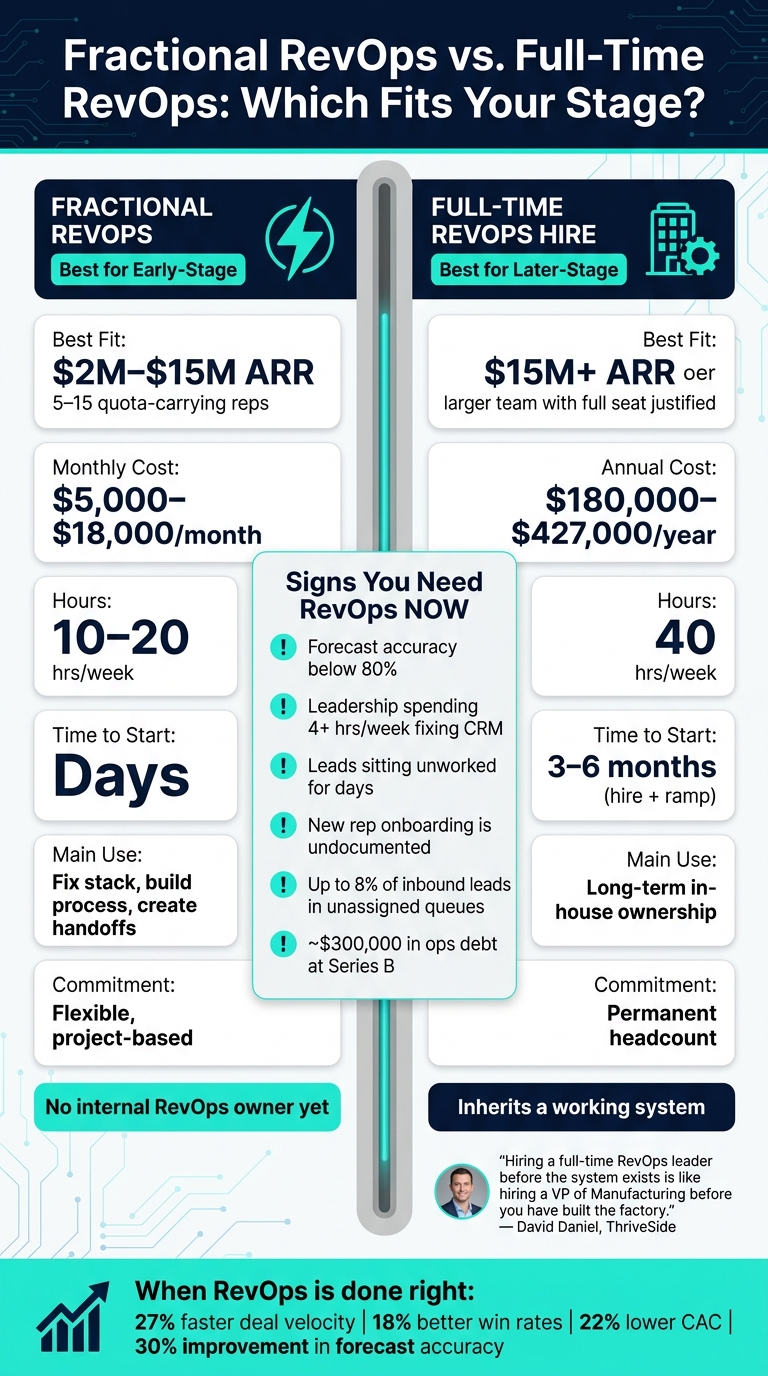
Fractional RevOps vs. Full-Time RevOps Hire: Cost, Speed & Fit
Common GTM Stack Problems That Signal a RevOps Gap
At Series A/B, GTM stack issues don’t look dramatic at first. They show up in the day-to-day: broken handoffs, messy data, and pipeline that slips away. Most of the time, the root issue is process and system design.
The First Warning Sign Is Disconnected Tools Without a Single Source of Truth
Most GTM stacks grow piece by piece. One tool gets added for enrichment, another for sequencing, another for CRM, and one more for reporting. On paper, that sounds fine. In practice, nobody mapped how those systems should work together.
That’s when the mess starts. You end up with three or more disconnected tools, manual data transfers, duplicate records, and field definitions that don’t match across systems. At that point, no report feels fully trustworthy.
The biggest red flag usually isn’t a broken integration. It’s mismatched core numbers. If marketing’s MQL count doesn’t line up with what sales sees in the CRM, something is off. If reps are copying data back and forth between HubSpot or Salesforce and outbound tools because sync logic was never set up, they’re doing admin work instead of selling. In fragmented setups, sales reps spend only 30% of their working week on actual selling.
Once Routing Breaks, the Next Symptom Is Unreliable Funnel Data
Manual routing is one of those quiet failures that drains pipeline without making much noise. When lead assignment depends on a person instead of automation, inbound leads sit in a queue until someone gets to them. Sometimes that takes days.
If there are no clear SLAs for lead response, up to 8% of inbound leads can land in unassigned queues and never get worked. That hits the business fast: slower speed-to-lead, weaker MQL-to-SQL conversion, and pipeline loss before the first conversation even happens.
Spreadsheet-based triage makes the problem worse. It creates uneven territory coverage and turns routing into a race based on who checks the sheet first. That’s not a system. That’s patchwork.
Forecasting Problems and Siloed Funnel Metrics
Forecasts fall apart when stage definitions change from rep to rep. Once that happens, pipeline reviews stop being about decisions and start turning into debates over whose numbers are right.
If five reps each use a different meaning for “Qualified,” then the forecast is built on five separate assumptions. That’s not a reporting issue. It’s a process issue. Forecast accuracy below 80% points to a structural gap in how the system is run, not just bad data hygiene.
Disconnected tools, broken routing, and weak forecasts all point to the same thing: an ownership gap. These aren’t minor ops headaches. When they start costing pipeline, the question shifts from whether there’s a RevOps problem to whether fractional RevOps should own the fix.
When Fractional RevOps Is the Right Hire
Stage Signals: Funded Startup, Growing Team, No Internal Owner
The clearest sign isn’t one broken tool. It’s the fact that no one owns how the whole revenue system works together. At this point, your stack has outgrown ad hoc ownership, but the business still may not need a full-time RevOps person.
That gap tends to show up in the Series A to Series B stage, usually around $2M to $15M ARR with 5 to 15 quota-carrying reps. This is the window where demand starts to repeat, sales hiring picks up, and the CRM is in place – but nobody owns the full revenue workflow. That’s when the problem stops being a tool issue and starts becoming an ownership issue.
Triggers That Mean the Cost of Waiting Is Rising
These signals usually mean it’s time to act:
- Leadership is spending 4+ hours a week fixing CRM issues or cleaning up spreadsheets.
- Forecast accuracy has dropped below 80%, and pipeline reviews keep turning into cleanup sessions instead of decision-making.
- New rep onboarding is slow because the process isn’t documented and there’s no steady system to hand off.
- Lead response times are measured in days, not hours, because routing is still manual or inconsistent.
None of this is just annoying admin work. It hits revenue. The average Series B startup carries about $300,000 in operations debt tied to wasted compensation and weak attribution. The longer the fix gets pushed, the more that cost stacks up.
Why Fractional Often Fits Better Before a Full-Time RevOps Hire
At this stage, the issue is usually speed and ownership, not headcount. Most startups here don’t need a full-time person sitting in the seat yet. They need someone senior enough to design the system the right way and hands-on enough to get it built fast.
"Hiring a full-time RevOps leader before the system exists is like hiring a VP of Manufacturing before you have built the factory." – David Daniel, Founder, ThriveSide
In the U.S., a full-time RevOps Director usually costs $180,000 to $280,000+ per year in total compensation and often takes 3 to 6 months to hire and ramp. Fractional RevOps usually runs $5,000 to $15,000 per month for 10 to 20 hours a week, and that person can start contributing within days.
That’s why fractional often makes more sense first. You get senior-level system design and execution now, without the full-time cost, the long hiring cycle, or the same level of commitment.
It also works as a bridge strategy. You steady the infrastructure now, document the process, and set up the next hire for success. When the company later brings on a full-time Director, that person inherits a working system instead of walking into a mess that needs to be untangled.
How Fractional RevOps Fixes GTM Stack Problems
These symptoms point to one fix: an owner who can rebuild the system, not just patch tools.
Once the gap is clear, fractional RevOps usually fixes it in three moves: audit the stack, rebuild lead infrastructure, and standardize pipeline visibility.
Stack Audit, Stack Cleanup, and CRM Workflow Design
A fractional RevOps leader starts with the stack audit. They map the actual sales process against the documented one, and that gap is often where the mess shows up. What looks fine on paper can break fast in practice.
From there, they standardize fields, rebuild automation so data moves cleanly between marketing, sales, and finance, and cut tool overlap that creates conflicting records. This is the part many teams skip, and it costs them. If two systems say two different things about the same account, which one does leadership trust?
When companies fix CRM data hygiene at this level, they can see up to a 30% improvement in forecast accuracy.
After the CRM is cleaned up, the next job is simple: stop leads from falling through the cracks.
Lead Enrichment, Routing, and Multi-Channel Outbound Infrastructure
Next, they automate enrichment, routing, and handoffs so inbound leads move right away. Manual triage gets replaced with routing rules and SLAs, and outbound sequences connect back to the CRM so activity data syncs automatically.
That matters more than most teams think. If lead handling depends on someone checking a spreadsheet, forwarding a form fill, or updating records by hand, speed drops and pipeline leaks. A clean intake system fixes that.
Implementing automated enrichment and outbound infrastructure has been shown to drive a 50% increase in leads and appointments while cutting manual research time by roughly 40%.
Pipeline Dashboards and Shared Operating Metrics
They also standardize lifecycle stages and build dashboards around one shared set of operating metrics. That gives sales, marketing, and leadership one trusted view of pipeline health instead of three different versions of the truth.
This is where RevOps starts to feel less like back-office cleanup and more like GTM control. Teams can spot stalls earlier, forecast with less guesswork, and make calls based on the same numbers.
Companies with properly implemented RevOps report 27% faster deal velocity, 18% better win rates, and 22% lower CAC.
Once these fixes are in place, the next step is deciding whether the company is ready for a fractional engagement.
How to Decide and What to Do Next
Once the stack is fixed, the next call is simple: who should own it? An internal hire, or fractional support.
Readiness Checklist for a Fractional RevOps Engagement
The clearest fit is usually a Series A or Series B company in the $2 million to $15 million ARR range with no internal RevOps owner. Below $2 million ARR, founders usually run ops themselves. Above $15 million ARR, a full-time hire is often easier to justify.
Before you commit, look for a few clear signals: a defined ICP, 30+ closed deals with repeatable patterns, disconnected GTM tools, a near-term pipeline goal, and a team that’s willing to standardize process.
If those signals are there, the stack is already dragging down pipeline and forecast accuracy. That’s the point where you start with an audit – not another tool.
A Simple Engagement Structure: Audit, Build, Scale
If the checklist fits, the next step is a short audit-led engagement.
- Weeks 1–4: audit
- Weeks 5–8: build
- Week 9+: scale
A GTM stack audit shows where the gaps are. The build and scale phases then turn those findings into working infrastructure.
Conclusion: Fix GTM Infrastructure Before Stack Friction Hurts Revenue
The clearest sign is a measurable problem: forecast accuracy below 80%, a CRO spending more than 4 hours a week fixing spreadsheets, or leads sitting untouched for days. At that point, the cost of waiting is already showing up in pipeline, forecast, or lead response time.
FAQs
How long should a fractional RevOps engagement last?
It depends on the scope. Initial engagements usually run 3 to 6 months, while defined, fixed-scope builds often take 6 to 12 weeks.
A lot of teams start with a 4- to 6-week discovery phase and then move into implementation or optimization. Bigger overhauls can last 6 months or more, but the point is usually the same: fill the gap until hiring a full-time person makes sense.
What should you fix first in a messy GTM stack?
Fix the process before the technology. Starting with tools first usually means your revenue architecture still isn’t defined.
Begin with a discovery and audit phase. Find where revenue stalls, where handoffs fail, and where deals break down in your actual sales process. Once the process is clear and repeatable, fix the infrastructure.
How do I know when to switch from fractional to full-time RevOps?
Make the switch when your operating load outgrows part-time support. Fractional RevOps works well when you’re building the first version of your GTM engine, but most teams need a full-time hire at around $15 million in ARR or once they’re managing 50+ sales reps.
That shift also makes sense when your core processes are already in place and now need day-to-day tuning. If forecasting has to stay tight, enablement spans multiple teams, or your motion includes several products or international markets, part-time coverage usually stops being enough. At that stage, RevOps isn’t a side function – it needs steady, daily ownership.