
Clay is a no-code platform that automates lead enrichment for B2B sales teams, connecting over 150 data providers and tools into one system. It helps teams find leads, verify contact details, and sync data into CRMs. While powerful, it has a steep learning curve, and mistakes during setup can waste time, credits, and resources.
Key takeaways:
- Challenges: Teams often struggle with configuration, credit waste, and incomplete data without expert help.
- Solution: Hiring a Clay expert ensures efficient workflows, accurate data, and better ROI.
- Impact: Expert setups can increase response rates to 15-25% and reduce manual work by hours.
If you’re scaling your sales operations, consider a Clay expert to build a system that saves time and drives results.
Why Most Teams Struggle to Implement Clay on Their Own
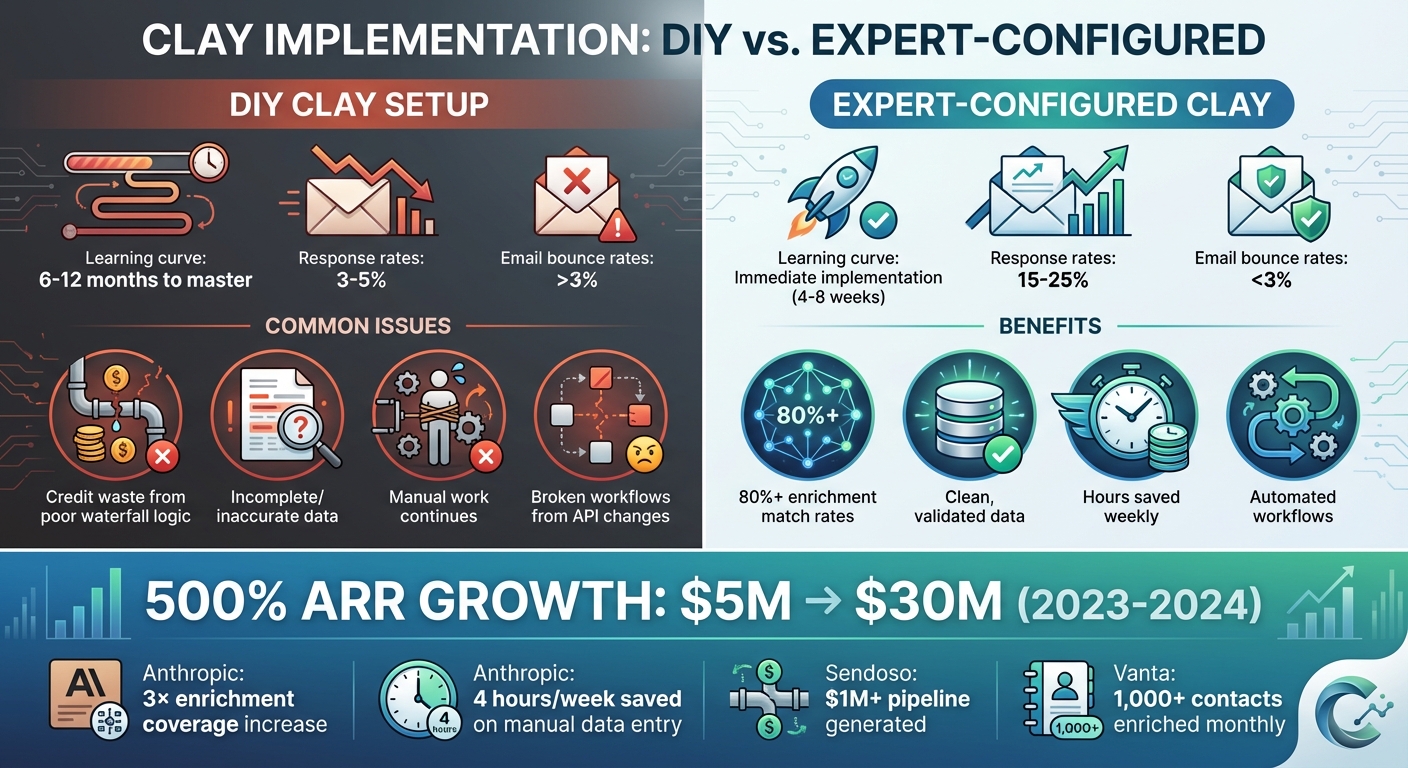
DIY Clay Setup vs Expert Implementation: Response Rates and ROI Comparison
Clay operates more like an IDE for GTM teams than a simple plug-and-play SaaS tool. This distinction creates a steep learning curve for many revenue operations professionals who lack the technical expertise to handle data APIs, webhook integrations, and the conditional logic required to make Clay run smoothly. Without this know-how, teams often encounter frustrating roadblocks, including wasted time, misused resources, and flawed configurations.
Clay Takes 6-12 Months to Master
For most teams, mastering Clay isn’t a quick process. One mid-market SaaS company spent a staggering six months training its team just to reach a functional level of proficiency. That’s six months of distractions, pulling SDR and RevOps teams away from critical revenue-driving activities.
Matthew Iovanni, CEO of FullFunnel, captures the challenge perfectly:
"DIY users might take months just to learn best practices (via trial and error or community help) and still only scratch the surface."
But the challenges don’t stop at setup. APIs and data schemas frequently change, which can break workflows and force teams into constant retraining cycles instead of focusing on scaling their outbound efforts. Add to this the inefficiencies of poorly optimized setups, and teams find themselves burning through credits with little to show for it.
Credit Burn During the Learning Phase
Clay’s credit-based pricing model can turn small mistakes into costly lessons. Beginners often fall into common traps like running multiple email finders at once instead of using waterfall logic, overusing expensive AI tools like Claygent without proper targeting, or forgetting to set guardrails to limit runaway credit consumption. These errors can drain an entire quarter’s data budget in just weeks.
Becca Eddleman from Skaled warns that without proper management of workflow logic and API connections, Clay’s learning curve can quickly become a bottleneck.
Budgeting becomes another headache. There’s no real-time spend tracker for all actions, and credit costs can vary wildly depending on the data provider and specific use case. This unpredictability makes it nearly impossible for teams to plan their spending effectively.
Poor Setup Leads to Incomplete Data and Weak Results
A poorly configured Clay workflow doesn’t just waste credits – it produces bad data that undermines outbound efforts. Common mistakes include pulling inaccurate contact details, exporting messy company names (e.g., "ACME CORP INTERNATIONAL LLC" instead of "Acme Corp"), or skipping email validation steps, which can lead to bounce rates exceeding 3%. High bounce rates don’t just hurt deliverability; they can damage your domain reputation, sending even your best-crafted emails straight to spam.
The difference between a DIY setup and an expert configuration is massive. Teams struggling with Clay often see cold outreach response rates of just 3-5%, while expert-configured workflows can boost those rates to 15-25%. The impact on growth is undeniable – one company saw its ARR skyrocket from $5 million to $30 million between 2023 and 2024, a 500% increase.
Without expert guidance, many teams abandon their projects after weeks of frustration, leaving behind incomplete setups and wasted potential. The time spent troubleshooting could have been used to refine account strategies or close deals. This underscores why having a dedicated Clay expert isn’t just helpful – it’s essential for achieving efficient workflows and strong results.
What a Clay Expert Actually Does
A Clay expert doesn’t just set up your account – they design and implement enrichment systems tailored to your revenue team’s needs. By aligning workflows with your Ideal Customer Profile (ICP), go-to-market strategy, and revenue goals, they help you find, qualify, and engage prospects more effectively.
Builds Custom Lead Enrichment Workflows
Clay experts take a strategic approach to building workflows, creating waterfall enrichment sequences that pull data from multiple providers in a prioritized order. This method ensures you get the necessary data without overspending. Instead of relying on a single provider that might only cover 40% of your prospects, a well-structured waterfall enrichment can push match rates above 80% for email discovery. For example, OpenAI boosted its enrichment coverage from 40% to over 80% by using this multi-provider technique.
They also use AI tools like Claygent to dig deeper than structured datasets. These tools can uncover pain points on a company’s website, spot leadership changes, or identify tech stacks. With advanced conditional logic, they ensure enterprise accounts get premium data enrichment while smaller accounts use more cost-efficient options.
"Chaining together Clay’s data waterfalls helped us translate personal emails to work emails, unlocking the ability to do custom company research with complex logic… Without Clay, this would’ve been an incredibly cumbersome process."
Adam Wall, Head of Revenue Operations at Anthropic, shared how this approach led to a 3× increase in enrichment coverage and saved 4 hours per week on manual data entry.
Minimizes Credit Waste Through Smart Configuration
Clay experts ensure your resources are used efficiently. They prevent credit waste by setting up stop rules in enrichment workflows – halting the process as soon as the required data is found. They also filter out junk leads and duplicates before enrichment begins and implement fallback logic, like searching for a mobile number only if a work email isn’t available. This level of precision counters the steep learning curve and credit waste often seen in DIY setups.
Connects Clay to Your CRM and Outreach Tools
Integration is another key area where Clay experts shine. They connect Clay with CRMs like HubSpot and Salesforce, enabling dynamic, self-updating lead records. Leads are automatically enriched, scored, and routed to the right representative, transforming static records into dynamic profiles.
Clay experts also link the platform to outreach tools like Apollo, Instantly, and Octave, enabling automated campaigns triggered by specific data signals. They ensure clean data entry into your CRM by setting up processes for email verification, domain matching, and deduplication. Additionally, they configure intent-based triggers, such as outreach launches when a lead changes jobs or a company is mentioned.
In 2024, Anthropic used Clay to automate multi-step data uploads into Salesforce, cutting a 3–4 hour manual process down to just 10 minutes. Sendoso generated over $1M in pipeline through personalized outreach and gifting automated by Clay integrations, while Vanta now enriches over 1,000 new contacts monthly using Clay-driven workflows.
"Clay should be an essential pillar of every company’s GTM stack, enabling outbound built on the highest quality data foundation possible. Now you can automate hours of manual research so sales teams can focus on selling."
Stevie Case, CRO at Vanta, highlighted the transformative impact of Clay.
How to Hire a Clay Expert: What to Look For
The success of your revenue engine often hinges on hiring the right Clay expert. Choose wisely, and you’ll unlock streamlined systems and efficient processes. Get it wrong, and you risk wasted credits and missed opportunities. A great starting point is the official Clay Solutions Partner Directory at clay.com/experts. Here’s a guide to identifying top-tier talent, spotting potential pitfalls, and understanding pricing.
What Sets Great Clay Experts Apart
Clay’s steep learning curve means expertise isn’t easy to come by. To find a qualified expert, start with the Clay Solutions Partner Directory, where experts are categorized into tiers like Elite Studio, Studio, Advanced Artisan, and Artisan. These tiers help you distinguish between large consultancies and niche specialists. Certification requires agencies to demonstrate hands-on experience, maintaining at least $11,000 in monthly recurring revenue and spending a minimum of $1,500 monthly on Clay credits.
Look for Clay University certifications in areas such as AI Skills, Automated Inbound, CRM Enrichment, and Automated Outbound. These certifications expire annually, so current credentials indicate that the expert stays updated on Clay’s evolving features. Beyond credentials, technical skills are essential. Top experts should be proficient in API basics, webhook integration, data transformation, and basic JavaScript for advanced automation.
Experience with GTM system integration is another must-have. The best experts have worked with major CRMs like Salesforce and HubSpot, as well as outreach tools that sync with Clay. For example, Growth Today, led by John Vrancsik, became a Clay Enterprise Partner in under a year, serving over 30 clients like ActiveCampaign and Tabnine by late 2024. Similarly, TAM Acceleration, founded by Matteo Fois, leveraged Clay for hyper-targeted AI campaigns, achieving $20,000 MRR.
"Clay wants you to demonstrate a strong reputation and financial success BEFORE giving their stamp of approval."
Nathan Lippi, CEO, Clay Bootcamp
Warning Signs When Choosing a Clay Agency
Not all agencies are created equal. Steer clear of those claiming to handle everything – they often lack the deep technical expertise needed for Clay. Another red flag is a "black box" process, where the agency fails to ask detailed questions or explain their workflow logic.
Be cautious of providers guaranteeing "100% success rates" or specific booking numbers without first auditing your data quality or total addressable market. Reputable agencies will offer clear, written contracts that outline the scope of work, credit usage, and replacement policies, avoiding hidden fees or vague terms. Frequent staff turnover is another issue, as it can disrupt service continuity and your GTM strategy.
"The cheapest option usually isn’t the best one. Especially when the challenge is fundamental for your company and its future."
Stef Hamerlinck, Founder, Olliebranding
Always verify that the agency provides at least two client testimonials, a core requirement for Clay certification. Additionally, check their documentation practices. An expert who doesn’t provide clear workflow documentation or error-handling protocols could leave you with broken systems.
Understanding Pricing Models
Expect to budget between $3,000 and $15,000 per month for skilled Clay implementation. Pricing typically falls into three engagement models: monthly retainers, project-based work, and fractional GTM engineering.
- Monthly retainers are ideal for startups needing continuous CRM enrichment, outbound systems, and workflow optimization as they scale.
- Project-based work suits one-time needs like setting up CRM workflows, migrating data, or initial system cleanups.
- Fractional GTM engineering offers strategic oversight and design without the cost of a full-time hire, often used by Seed to Series B startups building revenue infrastructure.
Clay-certified experts often charge premium rates due to the platform’s technical demands and its $3.1B valuation. Most agencies favor fixed-price or value-based billing, tying costs to business outcomes rather than hours worked. Be wary of providers offering unusually low rates – they may lack the expertise to handle critical challenges effectively.
Why GTM Engineering Services Is the Right Choice for Series A/B Startups
Most Clay agencies offer a quick setup and then step away. GTM Engineering Services takes a different approach: they create entire revenue systems where Clay becomes the central hub of your sales operations. For Series A and Series B startups, this isn’t just about installing a tool – it’s about building a scalable GTM motion that investors want to see. This level of integration ensures your revenue process is not only aligned but also ready to grow with your business.
Clay Implementation Within a Revenue System
Rather than focusing on isolated workflows, GTM Engineering Services builds fully integrated revenue infrastructures. While many Clay experts stop at enrichment workflows, GTM Engineering Services maps the entire customer journey, cutting manual prospecting time by 60%.
Their system connects Clay seamlessly with CRMs like HubSpot or Salesforce, outbound tools like Instantly and Smartlead, and automation platforms such as n8n or Make. This integration eliminates unnecessary manual work and drives pipeline growth.
One standout feature is their intent-based automation, which tracks real-time buying signals – think funding announcements, job postings, or new tech adoption. These signals trigger hyper-personalized outreach at the perfect moment. Additionally, they handle critical backend tasks like email deliverability, DNS configurations, and unifying CRM data to ensure your entire revenue operation runs smoothly.
Getting Started with GTM Engineering Services
It all begins with a 30-minute GTM Stack Audit, where they identify bottlenecks and outline a 90-day plan to automate your processes.
From there, the Build Phase (4–8 weeks) kicks off. This includes lead enrichment, multi-channel outbound sequences, CRM automation, and pipeline analytics dashboards. Once the system is live, the Scale Phase focuses on increasing outreach volume, improving conversions, and refining feedback loops. This step-by-step process doesn’t just implement Clay – it builds a scalable revenue engine that grows with your business and gives you a competitive edge that’s hard to match.
Conclusion
Mastering Clay on your own can be a costly and time-consuming process that drains your team’s resources. During the trial-and-error phase, your team may waste valuable credits on failed lookups – each enrichment potentially costing anywhere from 10 to 50 credits. Without expert guidance, inefficiencies pile up, and the learning curve becomes an expensive hurdle. This is why bringing in a Clay expert isn’t just helpful – it’s essential.
With expert guidance, you skip the wasteful trial-and-error phase and turn Clay into a high-performing revenue tool. A Clay expert ensures proper workflows, smart waterfalls, and accurate data validation, saving you from unnecessary quarterly expenses. Plus, you avoid the 50% markup on unexpected credit overages and the ongoing burden of training internal teams that slows down progress.
GTM Engineering Services goes beyond just setting up Clay. They create fully integrated revenue systems, where Clay serves as the backbone – seamlessly connecting your CRM, outreach tools, and intent data into one automated ecosystem. For Series A and Series B startups, this means building scalable systems that not only drive growth but also attract investor confidence.
Want to see what Clay can really do for your business? Start with a free 30-minute GTM Stack Audit and let an experienced Clay expert guide your team to success.
FAQs
When should I hire a Clay expert?
If your team is grappling with Clay’s steep learning curve, burning through credits during setup, or unsure how to tap into its full capabilities, it’s time to bring in a Clay expert. An experienced professional can streamline the implementation process, cut down on costly trial-and-error, and help your team use Clay to drive revenue growth effectively.
How do I prevent Clay credit waste?
To make the most of your Clay credits and avoid unnecessary expenses, focus on optimizing your data enrichment process. Avoid using expensive AI-driven columns or GPT features directly within Clay. Instead, integrate your own API key for GPT services, which can cut costs by as much as 16x. Keep a close eye on your credit usage and explore opportunities to negotiate for strategic add-ons or support to further minimize waste.
What should a Clay agency deliver?
A Clay agency should bring specialized knowledge in designing workflows, connecting data sources, streamlining processes, and setting up Clay for outbound efforts, marketing initiatives, and go-to-market automation. Their primary focus is to help your business turn Clay into a revenue-driving tool tailored to your specific needs.