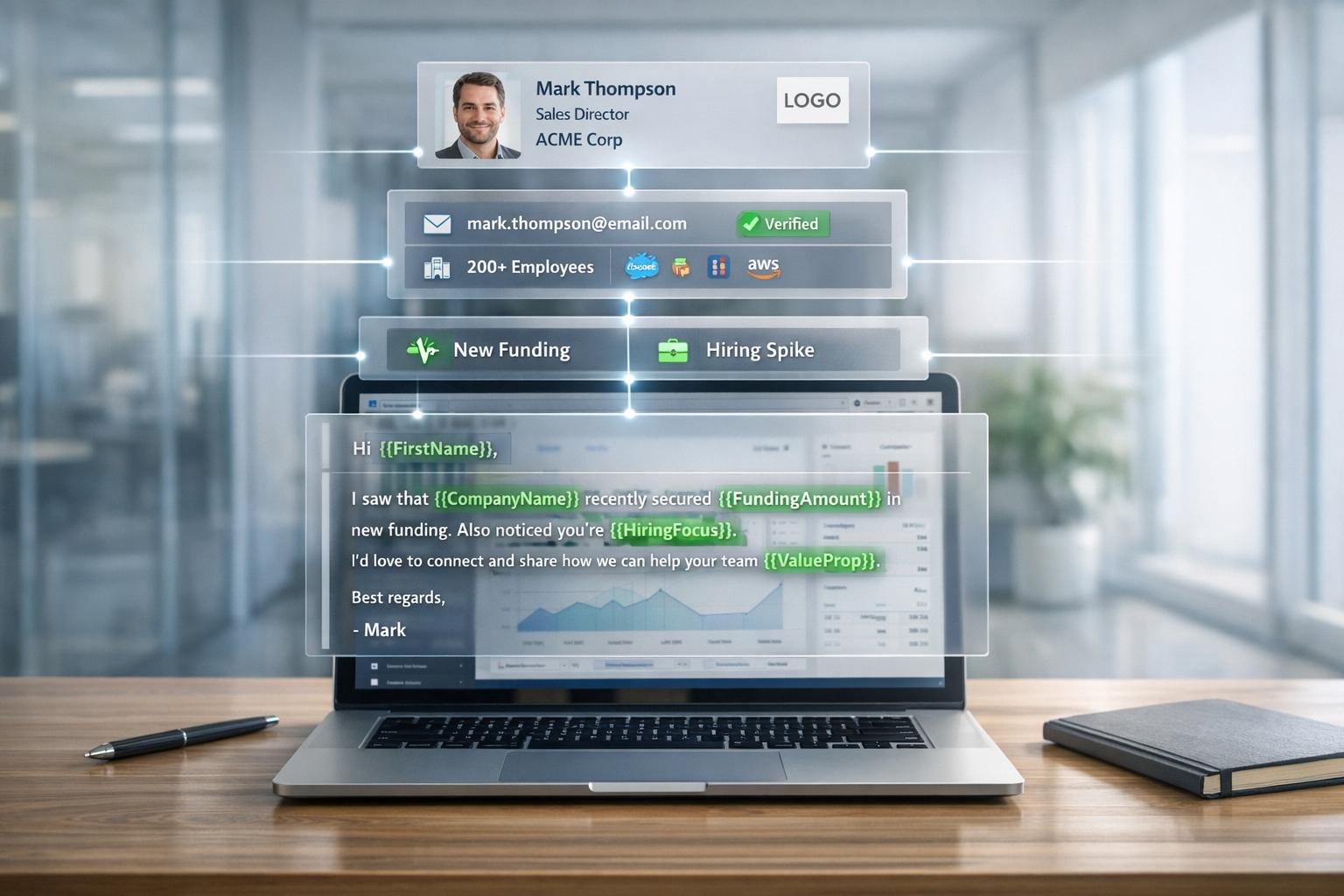
Sales teams waste up to 80% of their day on manual tasks like prospect research and data entry – time that could be spent selling. Clay eliminates this inefficiency by automating lead enrichment, research, and personalization, allowing teams to scale outreach without sacrificing relevance. Companies like Rippling and Oyster have doubled their email performance and reclaimed hours of productivity using Clay.
What You’ll Learn:
- Automate Prospect Research: Use Clay’s AI to pull data from 130+ sources and enrich leads in minutes.
- Personalize at Scale: Create dynamic email templates with AI-driven personalization.
- Speed Up Outreach: Respond to leads faster with automated workflows, boosting reply rates and conversions.
- Save Costs: Avoid expensive data subscriptions with Clay’s flexible credit system.
Key Stats:
- Sales conversions increase 391% when leads are contacted within one minute.
- Manual research consumes up to 72% of a sales rep’s time.
- Clay achieved $100M ARR and a $5B valuation by early 2025.
Clay’s "Find, Enrich, Transform, Export" framework integrates with CRMs like Salesforce and outreach tools like Instantly, enabling startups to build scalable, automated revenue systems. This article breaks down how to set up and optimize Clay for cold outreach success.
What Clay Does for Cold Outreach Personalization
Clay is a lead enrichment and automation platform designed to simplify and supercharge cold outreach. By pulling data from over 130 sources, using AI for research, and exporting personalized lead lists directly into your CRM or outbound sequencer, Clay eliminates the need for manual prospect research. The result? Your team can automate the entire process – from finding leads to crafting tailored messages – within one streamlined system.
At the heart of Clay is its "Find, Enrich, Transform, Export" (FETE) framework. This system enables users to source leads from multiple providers, enrich their profiles with real-time data, apply AI to create personalized messaging, and seamlessly push the results into tools like HubSpot, Salesforce, Instantly, or Outreach. Clay’s rapid success speaks volumes: it achieved $100M ARR in just two years and a $5B valuation by early 2025, with its AI research agent, Claygent, surpassing 1 billion runs.
This framework powers a suite of features that turn raw data into actionable insights for outreach.
Clay’s Core Personalization Features
What makes Clay stand out? Its waterfall enrichment system. Unlike traditional data providers that tie you to a single static database with costly annual contracts, Clay cross-checks multiple sources – like Apollo, Lusha, and HG Insights – until it finds the data you need. If one provider lacks a verified email, Clay automatically moves to the next, ensuring maximum data coverage without forcing you into redundant subscriptions. This feature is a game-changer for streamlining lead enrichment and cutting unnecessary costs.
Clay’s AI research agent, Claygent, takes automation to the next level. It gathers essential details from online profiles and websites, tackling the research tasks that typically consume up to 72% of a sales rep’s time. With Claygent, you can monitor real-time buying signals – like funding announcements, executive hires, job postings, or tech adoption – and trigger timely, personalized outreach based on these events.
Additionally, Clay integrates with over 100 tools, including major CRMs, sequencers, AI models, and productivity apps. This ensures a seamless flow of leads from discovery to enrichment to outreach, creating an efficient revenue infrastructure.
These features collectively set the stage for scaling revenue operations effectively.
How Clay Supports Scalable Revenue Operations
For startups moving from founder-led sales to scalable go-to-market (GTM) operations, Clay provides the infrastructure needed to automate and optimize revenue workflows. Instead of treating revenue operations as manual support tasks, Clay enables "GTM Engineering" – an approach where automation and systemized workflows replace repetitive tasks. This allows companies to scale their pipeline without proportionally increasing headcount, a critical factor when demonstrating a repeatable GTM strategy to investors.
Companies like Sendoso, Oyster, and Rippling have shown how Clay boosts scalability, improving outbound productivity, reply rates, and pipeline generation.
"Our ROI on Clay has already paid for itself 5-fold." – Ali Spinelli, VP Revenue Operations, PandaDoc
What makes Clay especially appealing to startups is its flexible credit system. You only pay for the data and AI runs you use, avoiding hefty upfront contracts. This flexibility allows teams to automate tasks like inbound lead scoring, quickly route high-priority prospects to tools like Slack or CRMs, and prioritize outbound efforts based on lead scores – all within one integrated platform.
How to Use Clay for Cold Outreach Personalization
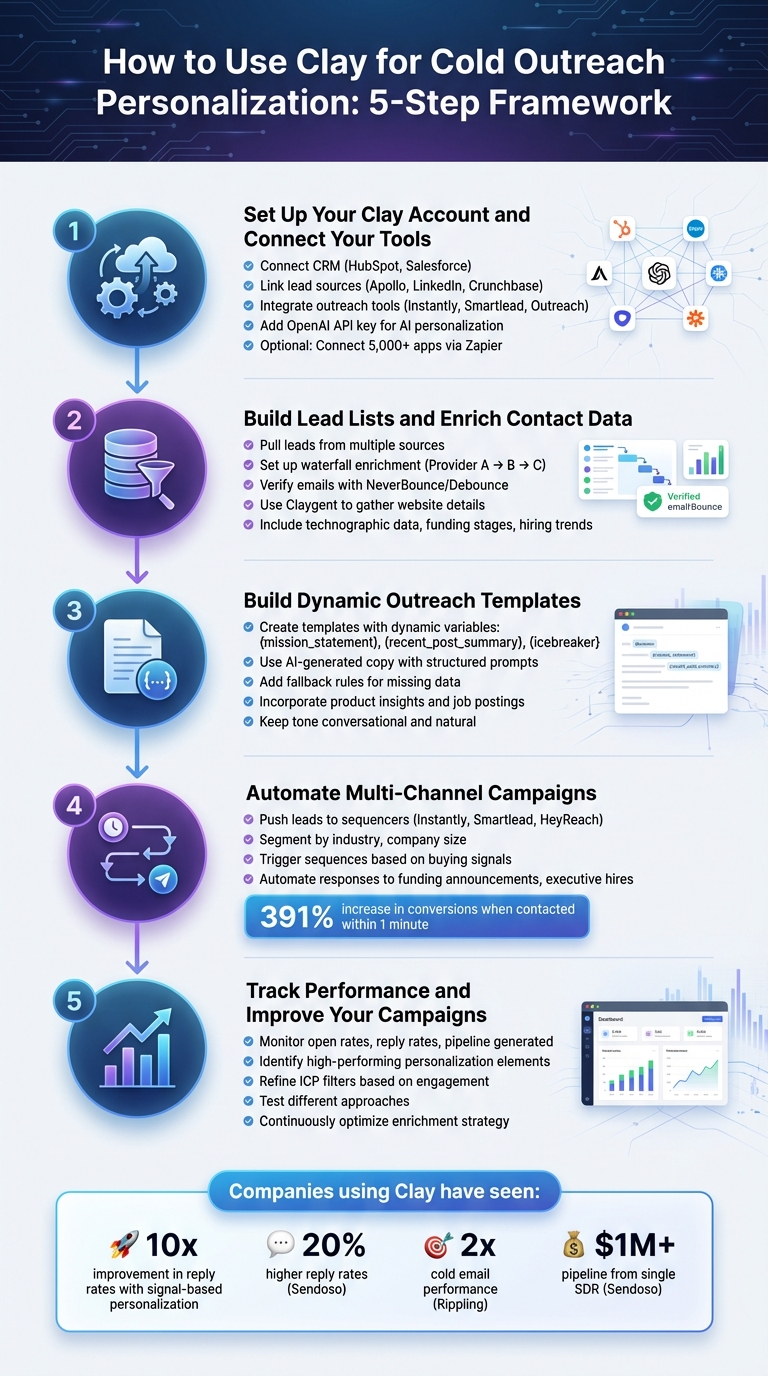
Clay’s 5-Step Cold Outreach Personalization Framework
Clay’s "Find, Enrich, Transform, Export" (FETE) framework simplifies the process of building personalized outreach campaigns. This structured approach connects your tools, enriches lead data, creates dynamic templates, automates sequences, and tracks results. Each step builds upon the last, creating a scalable system that minimizes manual work. Here’s how to set up, personalize, automate, and refine your outreach using Clay.
1. Set Up Your Clay Account and Connect Your Tools
Start by integrating Clay with your current tech stack. Link your CRM (like HubSpot or Salesforce), lead sources (such as Apollo, LinkedIn, or Crunchbase), and outreach tools (Instantly, Smartlead, Outreach, or HeyReach) through the integrations section. To unlock AI-powered personalization, navigate to the "Enrich Data" tab, search for "OpenAI", and input your API key. This enables large-scale personalization using details from prospect bios and company descriptions.
For added flexibility, use Zapier to connect Clay with over 5,000 apps, including Google Sheets for tracking campaign performance.
2. Build Lead Lists and Enrich Contact Data
Pull leads into Clay from multiple sources to ensure accuracy and depth. Combine data from LinkedIn, Apollo, and Crunchbase to create a well-rounded view of your prospects. Go beyond basic firmographics by factoring in technographic data, funding stages, and hiring trends – especially roles in revenue operations.
Set up waterfall enrichment logic, which uses a sequence of data providers (Provider A → Provider B → Provider C) to boost your chances of finding verified emails and phone numbers. Always include a final step to verify this data with tools like NeverBounce or Debounce to maintain your domain reputation and reduce bounce rates. Use Claygent to visit prospect websites and pull details like mission statements or recent announcements, which can fuel your personalization efforts.
Once your data is enriched, you’re ready to craft templates that feel tailored to each lead.
3. Build Dynamic Outreach Templates
Using the FETE framework, create email templates with dynamic variables like {mission_statement}, {recent_post_summary}, or {icebreaker} to make each message unique. Go further by incorporating product insights from technographics or job postings.
When working with AI-generated copy, follow a structured prompt: clearly define the input, include key details, set limits (e.g., "under 8 words"), and specify a prefix so the output fits naturally into your template. Add fallback rules – for example, if no recent LinkedIn post is found, default to referencing a funding announcement to maintain quality. AI can also help refine raw data, such as converting "SAN FRANCISCO, CA" into "the San Francisco area", for a more conversational tone.
4. Automate Multi-Channel Campaigns
Push your enriched lead lists and personalized templates into your sequencer to automate campaigns across email and LinkedIn. Clay integrates seamlessly with tools like Instantly, Smartlead, Outreach, and HeyReach. Segment leads by criteria like industry or company size to send tailored messages.
Automate workflows that respond to buying signals. For instance, if Claygent detects a funding announcement or a new executive hire, it can trigger a personalized sequence immediately. This kind of timing can boost reply rates significantly – personalized outreach tied to such signals can see a 10x improvement over generic campaigns. And with sales conversions increasing by 391% when leads are contacted within one minute, speed is critical.
5. Track Performance and Improve Your Campaigns
Keep an eye on metrics like open rates, reply rates, and the pipeline generated. Identify which personalization elements – such as references to LinkedIn posts or company news – are driving the most engagement, and adjust your enrichment strategy and templates accordingly.
Dive deeper into lead segments to refine your ICP filters and focus on prospects that show the highest engagement. This feedback loop helps you continuously improve your campaigns, aligning with scalable practices for B2B startups. Test different approaches, tweak your enrichment sequence, and refine your messaging based on real-world results. The goal is to consistently enhance your outreach system for better outcomes over time.
Connecting Clay to Your Revenue Infrastructure
Clay acts as a bridge between your data sources and execution tools, following its FETE framework to streamline operations. It integrates directly with CRMs like HubSpot and Salesforce, as well as sequencers such as Instantly, Smartlead, and Outreach. This ensures that enriched lead data flows seamlessly into and out of your CRM, giving sales, marketing, and operations teams real-time access to actionable insights. This constant flow of data fuels personalized outreach, supporting the scalable strategies discussed earlier.
Connect Clay to Your CRM for Lead Routing and Scoring
With Clay, you can automate CRM contact and company creation while assigning lead scores based on firmographic, technographic, and intent signals. For example, you might add +15 points for a prospect using a competitor’s tool or +30 for a recent funding event.
Once leads are scored, Clay can update their statuses or reassign ownership within your CRM based on qualification criteria. High-priority leads can then be enrolled in specific CRM sequences or trigger instant Slack alerts to sales reps, complete with suggested personalization tips. In 2023, Sendoso used this approach to enable a single SDR to match the output of an entire team, generating over $1 million in pipeline and achieving a 20% higher reply rate.
For enterprise teams managing vast Salesforce databases, Clay’s Bulk Enrichment feature is a game-changer. It refreshes CRM records at scale, keeping firmographic and technographic data up-to-date and preventing the decay that can slow down sales efforts.
Align Clay with Your Multi-Channel Outreach Tools
Clay allows you to export enriched data and personalized snippets directly to your preferred sequencer, whether that’s Apollo, Instantly, Smartlead, or HeyReach. To maintain sender reputation and reduce bounce rates, include an email verification step using tools like Debounce before pushing leads into your outreach platform.
You can also use Clay’s AI to segment leads into targeted campaigns based on factors like industry or company size, ensuring tailored messaging for every prospect. For example, Rippling leveraged Clay to inject personalized copy into their email system, doubling their cold email performance year-over-year in 2023.
"It’s easy to test new copy and personalization as we can quickly push updates into our email system." – Noah Adelstein, Manager of International Growth, Rippling
Clay’s Scheduling feature lets you create an always-on outbound system. This setup automatically pulls new leads from your CRM or data providers, enriches them, and sends them to your sequencer. Qualified leads are enrolled immediately, which is crucial when faster response times can boost conversions by as much as 391%.
Conclusion
Clay transforms manual cold outreach into an automated, scalable system that delivers hyper-personalized messaging at scale. By leveraging its structured framework, you can automate the detailed research that founders often handle manually, freeing your team to focus on meaningful conversations rather than tedious data entry. With features like waterfall enrichment, AI-driven insights through Claygent, and signal-based prospecting, the platform ensures every message reaches the right person at the perfect time with content tailored to their needs.
The impact is undeniable. Companies like Sendoso have seen their outbound productivity increase tenfold, generating over $1 million in new pipeline by utilizing Clay’s personalization tools. These results highlight how automated personalization can amplify the efforts of a single GTM specialist, turning them into a key driver of revenue growth for your entire team.
For funded B2B startups, building a strong revenue infrastructure means integrating Clay seamlessly into your CRM and multi-channel systems. This includes automating lead routing, scoring, and fallback processes within your CRM and outreach platforms. Such an approach forms the backbone of the scalable GTM strategies we’ve explored.
Key Takeaways
Automating personalization isn’t just a nice-to-have – it’s essential for scaling your outreach and pipeline. Sales reps lose up to 72% of their time to manual research and administrative tasks. Clay eliminates this inefficiency by automating data enrichment, research, and personalization, tasks that traditionally consumed hours of SDR time. Its ability to track real-time buying signals – like funding events, job postings, or tech stack updates – ensures your outreach aligns with moments of peak intent, driving conversion rates up by as much as 391%.
GTM Engineering Services specializes in helping Series A and Series B startups build these automated revenue systems from scratch. We design and implement the infrastructure that connects Clay to your CRM, outreach tools, and pipeline analytics. This turns your outbound efforts into a predictable and scalable pipeline. Our clients are growth-stage companies aiming to prove a repeatable GTM motion to secure their next funding round, and we focus on the technical execution that makes Clay an integral part of a complete revenue engine – not just another tool in the stack.
FAQs
How do I set up waterfall enrichment in Clay?
To create a robust waterfall enrichment process in Clay, you’ll need a structured, step-by-step approach that ensures your lead data is accurate and comprehensive. Here’s how to get started:
- Define Your Target Criteria: Start by identifying the specific data points you need, such as verified emails, phone numbers, or firmographic details. This clarity will guide the entire setup.
- Build Multi-Layered Enrichment: Set up multiple enrichment layers, prioritizing sources known for high accuracy. For example, use a trusted primary source for verification and add secondary layers to fill in missing details.
- Establish Fallback Rules: Create fallback rules to handle cases where certain data points aren’t available. This ensures every lead is enriched to the fullest extent possible, even if the primary source doesn’t have complete information.
- Automate Your Workflows: Configure workflows that automatically trigger enrichment whenever a lead is updated. This keeps your data fresh and consistently verified without manual intervention.
By implementing these steps, you’ll maintain a steady flow of accurate, enriched data, making it easier to engage leads with confidence and precision.
What data should I enrich for better personalization?
To make outreach more tailored, focus on enriching your data with details like company information (industry, size, funding status), contact specifics (emails, phone numbers), and behavioral insights such as recent hiring trends, funding announcements, or website activity. These details help craft messages that feel personalized and relevant.
How do I trigger outreach from buying signals?
To use Clay for triggering outreach based on buying signals, you’ll need to set up workflows that keep an eye on real-time events like funding announcements, hiring trends, website activity, or updates in your CRM. These workflows automatically kick off outreach sequences, ensuring your messages hit at just the right moment. By turning fragmented data into actionable insights, this method enables highly tailored and responsive communication that aligns perfectly with your buyers’ actions.