
If you’re a Series A startup aiming for Series B funding, your Ideal Customer Profile (ICP) is more than just a slide for investors – it’s the backbone of your revenue strategy. Without a clear, data-driven ICP, you’re wasting time and money chasing leads that won’t convert. Startups with a strong ICP report 340% better conversion rates and 60% lower acquisition costs. Here’s what you need to know:
- What an ICP Does: It identifies high-value customers, reduces sales cycles by up to 30%, and aligns your team with consistent messaging.
- Why It Matters: Investors evaluate your ability to scale. A mature ICP proves you’ve moved past founder-led sales to a repeatable revenue engine.
- How to Build It: Analyze your top customers, focus on firmographic, technographic, and behavioral data, and define both ideal and disqualifying traits.
Your ICP isn’t just a document – it’s a system that powers your go-to-market strategy, improves metrics like LTV:CAC, and builds investor confidence. The startups that scale fastest aren’t guessing – they’re engineering their growth with precision.
Why Series A Startups Need a Clear ICP
Series A startups face a critical moment: they’ve shown that the market exists, but now they need to prove they can scale. This shift from founder-led sales to a structured go-to-market system is where many stumble. Founders often rely on personal networks and intuition to close deals. Without a clear Ideal Customer Profile (ICP), new sales hires end up chasing unqualified prospects, leading to inconsistent metrics and scattered messaging.
A clearly defined ICP changes everything. It gives your sales team the same edge the founder had, but in a format they can replicate. Instead of wasting time on leads that won’t convert, your reps can focus on high-value opportunities that are more likely to close. Companies that define their ICP see better conversion rates and lower customer acquisition costs. Sales cycles also shrink – by as much as 30% – because reps know exactly who to target and what messaging will resonate.
An effective ICP is as much about exclusion as it is about inclusion. As Richard Thornton, Partner at J12 Ventures, explains:
"Narrow beats broad. A tight, and well-defined segment gives you faster feedback loops, higher win rates, and clearer positioning".
A strong ICP helps you zero in on the 20% of customers who generate the highest lifetime value while avoiding the ones that lead to long sales cycles or churn. This is where creating an "anti-ICP" comes into play – explicitly identifying traits that signal a poor fit, such as high service demands or low retention rates. Let’s dig deeper into how aligning your ICP with targeted growth objectives can transform your scaling efforts.
Matching ICP to Early-Stage Growth Goals
At the Series A stage, growth isn’t just about gaining more customers – it’s about finding the right customers. High-Lifetime Value (LTV) customers bring in more revenue through expansions, referrals, and lower support costs. Over time, these advantages compound, creating a stronger foundation for growth. A precise ICP ensures your entire team uses consistent messaging and sales tactics, which is critical for scaling beyond the founder.
A mature ICP incorporates multiple data points, including firmographic, technographic, situational, and behavioral signals, to drive scalable growth. For example, technographic signals reveal the tools a prospect uses, while situational signals highlight hiring patterns or funding events. Combine these with behavioral signals like buying triggers, and you’ve got a powerful system. Take Frontify as an example – they increased their sales velocity by 42% by aligning their ICP with signal-based engagement, such as targeting accounts after leadership changes or new funding rounds. This approach ensures your team reaches the right prospects at the perfect time, transforming outbound efforts into a precision-driven strategy. These tactics directly build investor confidence in your ability to scale.
Meeting Funding Milestones and Investor Requirements
By the time you’re seeking Series B funding, investors aren’t looking for experiments – they want a predictable revenue engine. A well-defined ICP signals that you’ve moved past sporadic wins and built a repeatable, scalable go-to-market model. Lisa Calhoun, Founder and Managing Partner at Valor VC, puts it simply:
"Simple companies appeal to VCs as the easiest way to make a lot of money fast".
A focused ICP makes your company "simple" in the best sense of the word: it clarifies how you win, streamlines hiring, and sharpens your KPIs.
Key metrics like LTV:CAC ratio, CAC payback period, and Net Revenue Retention all improve significantly when driven by a data-backed ICP. Startups that implement this approach see better conversion rates and lower acquisition costs. These aren’t minor improvements – they’re the difference between burning through your runway chasing bad leads and creating the 18- to 24-month runway you need to hit Series B milestones. When every account in your CRM is scored and routed based on your ICP, you’re not just selling – you’re proving you can scale.
How to Build an ICP for Series A Startups
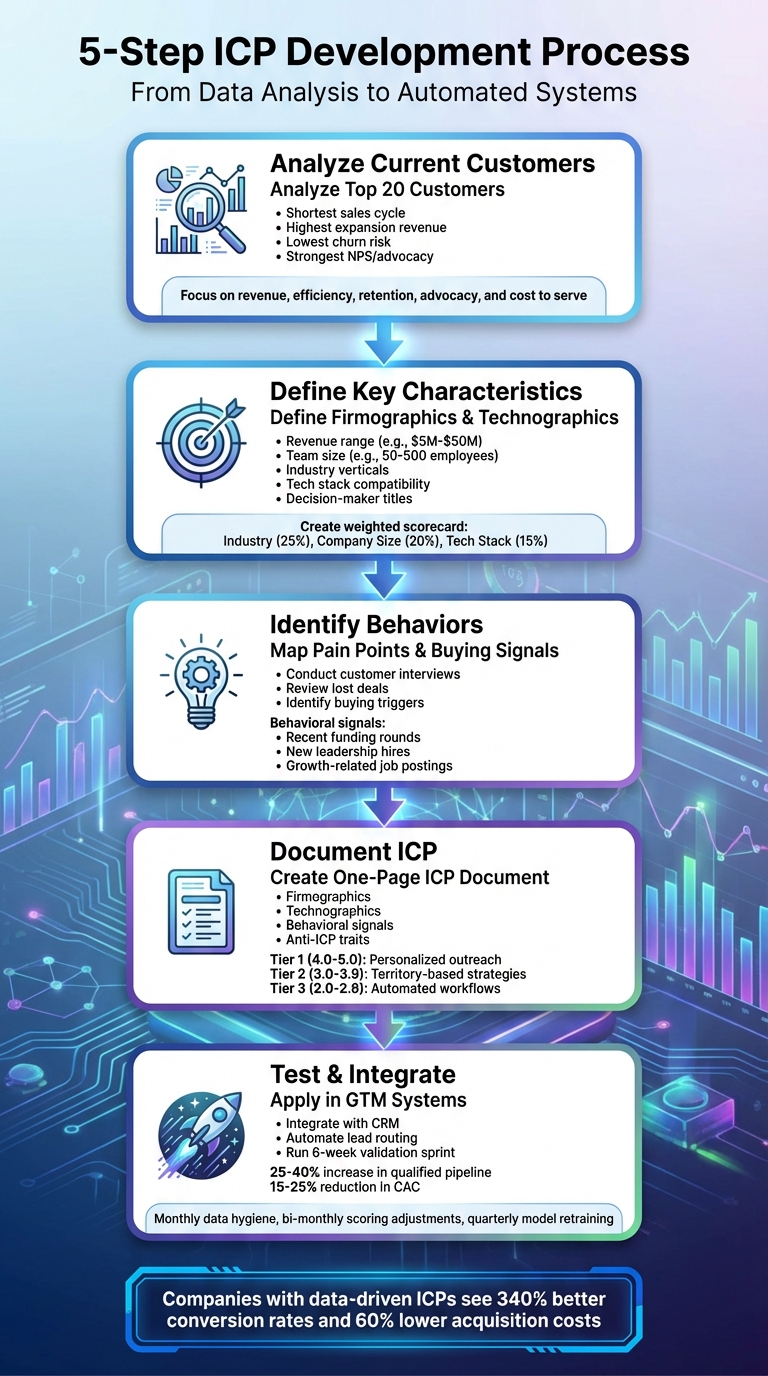
5-Step ICP Development Process for Series A Startups
Creating an Ideal Customer Profile (ICP) is all about turning customer data into a system that consistently identifies and targets the right prospects. Start by analyzing your top 20 customers using metrics like shortest sales cycle, highest expansion revenue, lowest churn risk, and strongest NPS or advocacy. This focused approach helps you avoid getting bogged down in irrelevant data. Look for patterns among customers who deliver strong revenue growth, fast purchase decisions, and high retention rates. Avoid being overly swayed by high Annual Contract Value (ACV) accounts that might not align long-term; instead, pinpoint the traits that predict sustainable success.
For each standout customer, document details such as firmographics (e.g., company size, industry), technographics (e.g., tools and platforms they use), and behavioral data (e.g., buying triggers, decision-making roles). Use this data to build an attribute matrix that highlights traits most commonly linked to high Lifetime Value (LTV) and quick sales cycles. Equally important is identifying anti-patterns – traits of churned customers or failed deals. This might include industries where your product struggles or deal sizes that don’t justify the effort.
Step 1: Analyze Current Customers and Find Patterns
Start by diving into your CRM data to identify trends across key metrics like Monthly Recurring Revenue (MRR), LTV, sales cycle duration, and retention. Use a table to organize your analysis:
| Metric Category | Data Points to Analyze | Purpose |
|---|---|---|
| Revenue | Total Contract Value (TCV), Expansion Revenue, LTV | Pinpoint the most profitable customer segments |
| Efficiency | Sales Cycle Length, Time to Value | Highlight profiles that close faster and generate higher margins |
| Retention | Churn Rate, Renewal Rate | Spot customers with long-term alignment |
| Advocacy | Referral Frequency, Case Study Participation | Identify customers who reduce CAC through social proof |
| Cost to Serve | Support Ticket Volume, Onboarding Complexity | Find resource-efficient customer profiles |
Focus on customers that show clustering across multiple categories. For instance, if your top-performing accounts are B2B SaaS companies with 50–200 employees using Salesforce, that’s a clear signal. When reviewing lost deals, distinguish between product misalignment (wrong ICP) and process issues (pricing, timing, or external factors). This prevents you from drawing the wrong conclusions.
Step 2: Define Firmographics, Technographics, and Decision-Makers
Outline the key characteristics of your ideal accounts, including firmographics like revenue range (e.g., $5M–$50M), team size (e.g., 50–500 employees), and specific industries such as B2B SaaS, fintech, or martech. Add technographics – the tools they use, like CRM platforms or cloud providers, to ensure compatibility with your product. Identify decision-makers by their titles, such as Chief Revenue Officers (CROs), VPs of Sales, or Heads of Growth, and specify the challenges your product solves for them.
To prioritize prospects, create a weighted scorecard. Assign weights to attributes like Industry (25%), Company Size (20%), and Tech Stack (15%), and score each on a 1–5 scale. Use this to rank accounts into tiers: Tier 1 for personalized outreach, Tier 2 for territory-based strategies, and Tier 3 for automated engagement. Don’t forget to define negative filters – traits that disqualify prospects, like incompatible tech stacks or industries where you consistently lose deals. Michael King, Partner at Andreessen Horowitz, emphasizes:
"Clarity becomes your competitive advantage. The more precisely you define [your ICP], the more efficiently you can sell, build, and scale".
Step 3: Identify Pain Points and Buying Behaviors
Validate your ICP by digging deeper into customer pain points and buying behaviors. Conduct customer interviews with your top 20 accounts to uncover the motivations behind their decisions. These conversations should be led by product or founder-level leaders to avoid the pressure of a sales pitch. Ask questions like: What triggered their search for a solution? What alternatives did they consider? What ultimately led them to choose your product? Review lost deals to identify common objections, whether related to pricing, timing, or product gaps.
Look for behavioral signals that indicate readiness to buy, such as recent funding rounds, new leadership hires (e.g., a VP of Sales), or job postings that suggest growth. Companies with dedicated RevOps teams often adopt new solutions more quickly because they have the infrastructure to implement them. Use these insights to refine your messaging and product positioning.
Step 4: Create ICP Documentation
Summarize your findings in a one-page ICP document. Include firmographics (e.g., industry, revenue, headcount), technographics (e.g., CRM, data warehouse), and behavioral signals (e.g., product signups, web activity). Don’t forget to document your anti-ICP – traits that disqualify prospects, such as incompatible tech stacks or industries where your product underperforms. To make it actionable, embed ICP scores directly into your CRM to automate lead routing and prioritize outreach.
Assign numerical scores based on your weighted criteria. Tier 1 accounts (scores of 4.0–5.0) get personalized outreach, Tier 2 accounts (3.0–3.9) are nurtured through territory-based strategies, and Tier 3 accounts (2.0–2.9) are managed through automated workflows. As Semir Jahic, CEO of Salesmotion, puts it:
"An ICP that isn’t embedded in your CRM and outreach workflows is an ICP that doesn’t exist".
This isn’t just a marketing tool – it’s a system that your sales, customer success, and product teams will use daily.
Step 5: Apply and Test the ICP in GTM Systems
Once your ICP is documented, integrate it into your GTM systems to maximize its impact. Use tools like Apollo or ZoomInfo to enrich lead data and automate scoring. Enrich firmographic and technographic data with platforms like Clay or Clearbit before it enters your CRM. Set up automated lead routing to ensure high-fit accounts go directly to your top reps, while lower-tier accounts are funneled into automated nurture campaigns.
Run a 6-week validation sprint to compare ICP-guided targeting against a control group. Track metrics like conversion rates, pipeline velocity, sales cycle length, and win rates. A successful pilot can boost qualified pipeline by 25–40% and cut CAC by 15–25%. Conduct a win/loss analysis of your last 50–100 deals to confirm that higher ICP scores correlate with better outcomes. Update your ICP quarterly based on performance data – review data hygiene monthly, adjust scoring weights bi-monthly, and retrain your model every quarter to stay aligned with market dynamics.
How GTM Engineering Services Supports ICP Development
Defining your Ideal Customer Profile (ICP) is just the starting point. The real challenge? Turning that profile into a dynamic, revenue-driving system. GTM Engineering Services bridges the gaps between sales, marketing, operations, and engineering to create systems that drive pipeline growth at scale. Instead of letting your ICP gather dust as a static document, we transform it into a living, breathing strategy. This approach integrates your ICP into automated systems that enrich leads, score accounts, route opportunities, and trigger personalized outreach – all in real-time. The result? A shift from guesswork to precision targeting, with workflows that sync seamlessly with your CRM, outbound sequences, and pipeline dashboards.
Automated Revenue Infrastructure for Series A Startups
Once your ICP is data-powered, we take it a step further by automating key processes like enrichment, scoring, and routing. Our approach builds five essential layers that translate your ICP into scalable go-to-market operations:
- Data infrastructure: Identity resolution and data enrichment.
- Audience intelligence: ICP modeling and scoring.
- Engagement automation: Multi-channel outreach workflows.
- Pipeline operations: Lead routing and qualification.
- Measurement: Attribution and analytics to track performance.
It starts with automated enrichment. By pulling firmographic and technographic data from providers like Clearbit, ZoomInfo, and Apollo, we ensure your lead database is complete and actionable. Using Reverse ETL tools, we sync ICP scores directly into your CRM – whether that’s Salesforce or HubSpot – so every lead is automatically tagged by fit and routed with precision.
But we don’t stop at static profiles. Our workflows prioritize leads based on real-time buying signals, such as job postings, funding events, or tech stack changes. For instance, if a prospect matches your ICP and undergoes a key organizational change, the system instantly alerts your top rep to act. Tools like n8n, Make, and Claude Skills make this level of automation accessible to a single operations professional. As JA Westenberg puts it:
"The infrastructure for building complex, automated go-to-market workflows went from ‘theoretically possible if you’re Salesforce’ to ‘achievable by a single ops person who can describe what they want in plain English’ in about a decade".
GTM Stack Audits and Optimization
Before diving into automation, a thorough audit of your GTM stack ensures everything is primed for success. We examine your tools, data, and workflows to identify inefficiencies and gaps. This starts with cleaning and normalizing your data to ensure accuracy across systems. Our free 30-minute GTM Stack Audit evaluates your data infrastructure, engagement platforms, and pipeline operations, delivering a 90-day implementation plan tailored to your ICP goals.
From there, we optimize your systems to embed ICP scores directly into lead routing and qualification processes. Tools like Chili Piper enable deterministic routing, ensuring high-fit accounts land with your best reps, while lower-priority leads are funneled into nurture campaigns. We also build analytics dashboards that break down metrics like conversion rates, sales cycle length, and win rates by ICP fit score. This level of visibility allows Series A startups to showcase scalable go-to-market strategies to investors, helping them hit critical funding milestones.
Conclusion
A well-defined ICP is the cornerstone of building a scalable revenue engine. The data speaks for itself: companies with data-driven ICPs see higher conversion rates and lower acquisition costs. For Series A startups, implementing these profiles effectively can lead to significantly better outcomes.
To make your ICP truly impactful, it needs to be embedded into your CRM, lead scoring, and routing workflows. This integration transforms raw data into a system that drives predictable growth. Without embedding your ICP into these processes, even the most thorough research falls flat. For Series A startups, moving beyond founder-led sales to a repeatable, scalable GTM motion is critical. Investors want to see metrics like lifetime value (LTV) and customer acquisition cost (CAC) that signal you’re ready for Series B growth.
By aligning your ICP with automated revenue systems, you can speed up deal velocity and shorten sales cycles. This involves regular reviews to adapt to market changes, weighted scoring models to focus on high-fit accounts, and leveraging real-time buying signals to deliver personalized outreach when it matters most. When done right, Series A startups often experience a 30–50% improvement in deal velocity.
A data-informed ICP, fully integrated into your systems, is key to proving scalability to investors. GTM Engineering Services can guide you through this process – from cleaning your data and analyzing your ICP to building automated systems that convert your profile into a steady pipeline.
The difference between struggling to meet your next milestone and confidently scaling toward Series B often boils down to this: an ICP that isn’t just a document but a living, breathing part of your systems. Start integrating your ICP today to pave the way for predictable growth and Series B success.
FAQs
How do I know if my ICP is too broad?
If your Ideal Customer Profile (ICP) casts too wide a net, you might be targeting companies with completely different needs. This mismatch can lead to wasted time and resources in both marketing and sales. A strong ICP zeroes in on high-value prospects by relying on precise criteria such as firmographics (company size, industry, location), technographics (the tools and software they use), and behavioral signals (actions that indicate buying intent).
Struggling with low conversion rates or soaring customer acquisition costs? That’s a clear sign your ICP needs a tighter focus. Refining it ensures you’re building a scalable growth engine that prioritizes quality over quantity.
What data do I need to build an ICP scorecard?
To build an ICP scorecard, start by collecting data that pinpoints your ideal customer. Focus on firmographics such as industry, company size, and location, as well as technographics, which detail the tools and technologies they use. Include behavioral signals like hiring patterns, recent funding, or growth indicators, and don’t forget to outline exclusion criteria – the types of accounts you want to avoid.
You’ll also want to consider critical factors like their pain points, budget capacity, and decision-making authority. By scoring accounts based on pain, budget, reachability, and fit, you can prioritize leads more effectively and focus your efforts where they’ll have the most impact.
How often should I update my ICP?
Keeping your Ideal Customer Profile (ICP) up-to-date is crucial, especially for Series A startups navigating rapid changes. Aim to revisit your ICP at least every quarter to stay in sync with shifting market conditions and growth goals. For early-stage companies, updating it even more frequently – monthly or quarterly – can be a smart move as new customer insights and market trends emerge. Regular adjustments help ensure your sales and marketing teams are focusing on the right accounts, driving better efficiency and higher conversion rates.