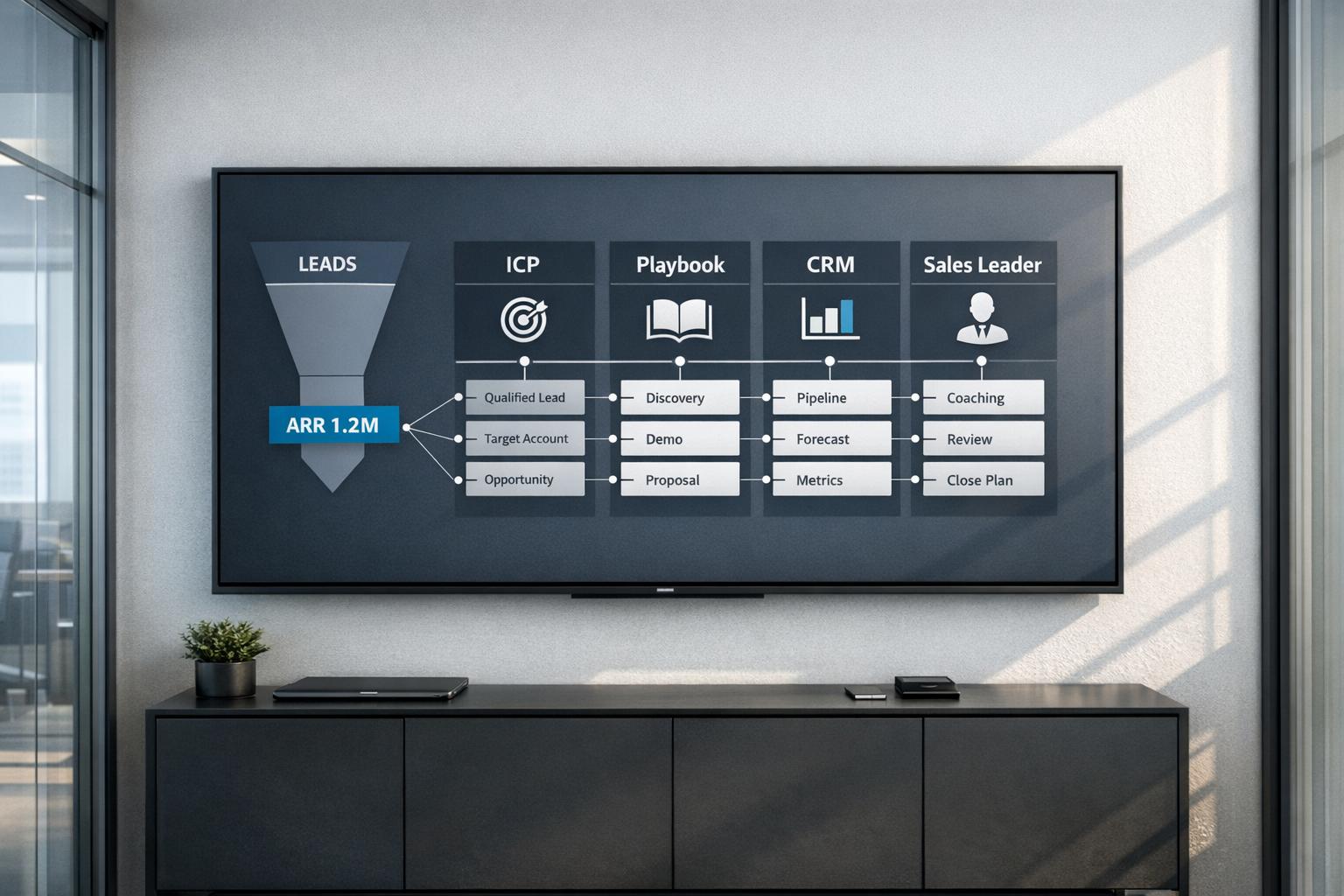
When your company hits $800K–$2M ARR, founder-led sales stop being an asset and start becoming a bottleneck. Investors at Series A expect scalable, predictable revenue systems – not a process dependent on the founder’s intuition, personal network, or availability. Without documented systems, win rates drop 15–25%, new sales hires fail within a year, and forecasting becomes guesswork.
To scale beyond founder-led chaos, you need:
- A documented sales process: Capture discovery questions, objection handling, and deal flows.
- Defined Ideal Customer Profile (ICP): Focus on high-converting segments.
- CRM and pipeline tracking: Standardize deal stages and improve forecasting.
- A skilled sales leader: Transition from founder-led to team-led sales.
The goal is simple: build a repeatable sales machine that works without you. If your pipeline stalls when you step away, your system isn’t ready for Series A growth.
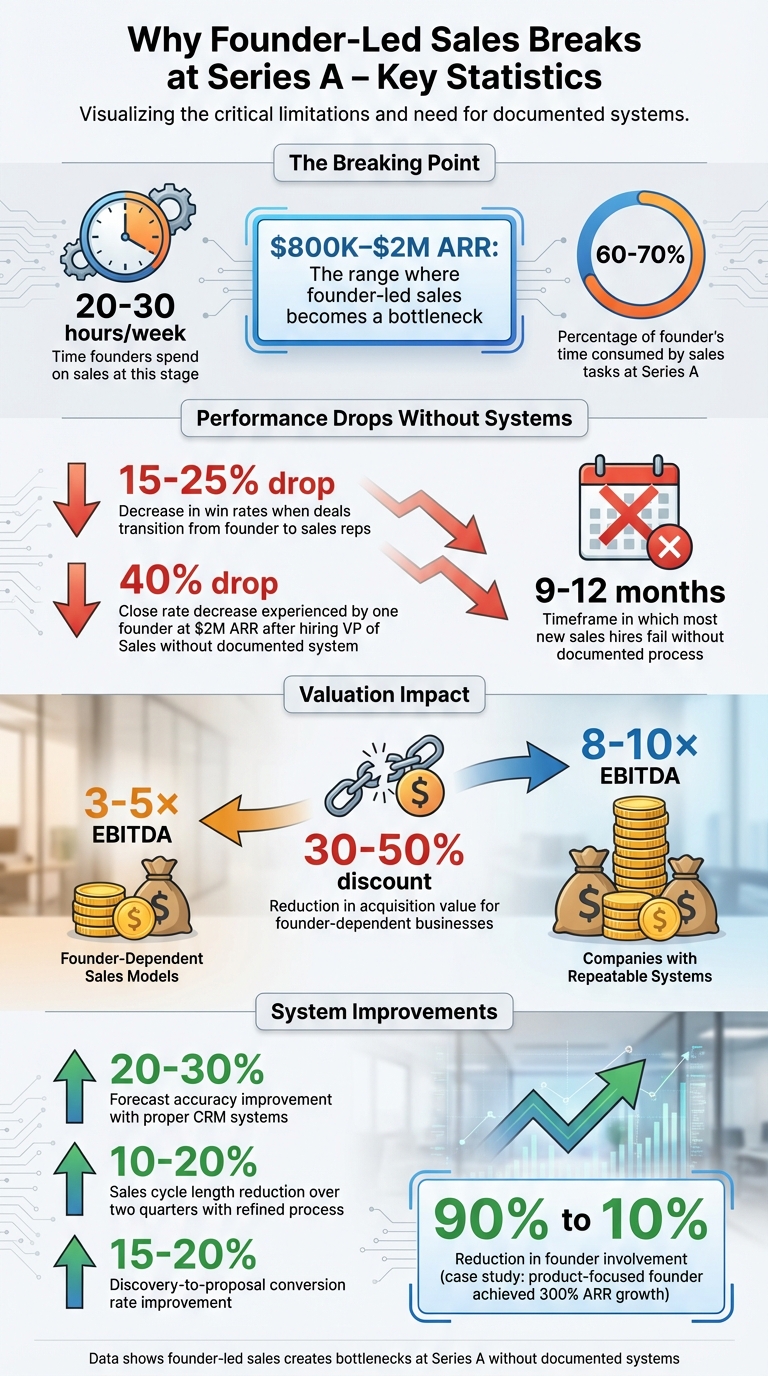
The Cost of Founder-Led Sales: Key Metrics for Series A Readiness
Why Founder-Led Sales Fails at Series A
Scaling a business beyond the early stages means addressing the limitations of founder-led sales. While effective at first, this approach hits a wall as the company grows.
Founder Expertise Doesn’t Scale
Your personal network, product knowledge, and credibility can drive warm leads that convert 3–5× better than cold outreach. But when these deals are handed off to sales reps, win rates often drop by 15–25 percentage points. Most founders hit their limit between $800K and $2M ARR, as dedicating 20–30 hours per week to sales becomes unsustainable. Without a structured process, this reliance on founder expertise creates gaps that hinder scaling.
Missing Sales Documentation
When your sales process exists only in your head, it disappears the moment you step away. New hires are left guessing on critical aspects like discovery questions, handling objections, or qualifying leads in the CRM. This lack of a playbook forces them to improvise, reducing their effectiveness and increasing turnover.
One founder at $2M ARR experienced a 40% drop in close rates after hiring a VP of Sales without first creating a documented sales system. Without clear guidelines, new hires struggle to replicate your process, and many don’t last beyond their first year.
Forecasting also takes a hit. Mark C. Ward, Founder of Revenue Arc, describes the result as a "hope strategy". Investors quickly notice when deals rely solely on undocumented founder intuition, flagging it as a scalability issue. Without a formal playbook, you remain stuck in the weeds, managing every detail yourself and deepening the time crunch.
Founders Run Out of Time
At the Series A stage, founders often spend 60–70% of their time on sales tasks. This heavy involvement leaves little room for critical responsibilities like fundraising, hiring, and steering product strategy. Discovery calls and proposal reviews turn into bottlenecks, slowing growth.
"If you’re still the one chasing every deal at this stage, you don’t have a sales leader, you just have support. You can’t scale if all the revenue still depends on you."
- Jess Schultz, Fractional GTM Executive
When you’re buried in sales, other priorities suffer. Product roadmaps get delayed, key hires take longer, and revenue growth becomes tied to your availability. As lead volume increases, your team may falter while waiting for your input. Owen Van Syckle puts it bluntly: "You’re not building a company – you’re building a sales job with a fancy title". This lack of time also undermines accurate revenue forecasting.
Poor Revenue Visibility and Forecasting
Manual processes and inconsistent CRM practices make forecasting a guessing game. Without clear criteria for each pipeline stage – like confirming budget and timeline during discovery – your pipeline risks becoming a repository of unqualified opportunities.
This lack of clarity can be costly. Founder-dependent businesses often face a 30–50% discount during acquisition due to transition risks. Companies with a founder-led sales model typically sell for 3–5× EBITDA, while those with repeatable systems command 8–10× EBITDA. Series A investors aren’t just looking for growth – they expect scalable, predictable revenue systems that don’t rely on the founder to function.
Why Sales Hires Fail Without Systems
When startups try to scale their sales teams without a clear process in place, they often set their new hires up for failure. Statistics show that without a documented sales process, most new hires fail within 9–12 months. The problem isn’t the talent – it’s the lack of structure. Expecting someone to scale an undocumented, founder-led process is like asking them to build a house without a blueprint.
Founder Selling vs. Team Selling
Founders have a natural edge when it comes to selling. Experts often refer to this as "heroic selling" – a combination of deep product knowledge, personal connections, and the authority to make decisions on the fly, whether that’s adjusting pricing or tweaking the product roadmap. This unique mix gives founders a kind of "magic" that professional sales hires simply can’t replicate.
Professional sales reps, on the other hand, don’t come with this built-in advantage. They lack the founder’s network, can’t make instant decisions, and don’t carry the same credibility. Without a documented process to guide them – covering key areas like discovery frameworks, objection handling, and pricing guidelines – they’re left to guess their way through deals. The result? A steep drop in performance. Win rates often fall by 15–25 percentage points when deals transition from founder-led to rep-led.
Onboarding Without Process
When your sales strategy only exists in your head, onboarding becomes a chaotic experience. New hires are thrown into a disorganized system and expected to figure it out. They don’t know which discovery questions to ask, how to qualify leads in the CRM, or what steps move a deal from "Discovery" to "Proposal".
Without a clear playbook, every rep ends up inventing their own approach. One might focus too much on technical demos, while another skips discovery entirely and jumps straight to pricing discussions. This kind of "organized chaos" leads to unpredictable revenue and makes coaching nearly impossible. Frustration builds quickly as new hires struggle to meet aggressive targets with little guidance, and many don’t make it past their first year.
Misaligned Expectations
Founders often think hiring an experienced "rainmaker" will solve their scaling challenges. These hires come with impressive résumés and large networks, but without a defined sales process, even the most seasoned professionals can’t succeed. They end up defaulting to tactics from their previous roles, which rarely align with your market or ideal customer profile (ICP).
The hard truth is this: you can’t delegate what you haven’t defined. Without a replicable process, these hires are set up to fail, leaving founders frustrated and back at square one.
How to Build a Repeatable Sales System
Scaling a sales operation isn’t about hiring more people – it’s about transforming what works into a system anyone can follow. Founder-led sales and undocumented processes might get you started, but they won’t take you far. Without a clear, repeatable foundation, every new hire turns into an expensive gamble. Here’s how to build a system that scales.
Document Your Sales Process
Your sales process already exists – it’s just locked in your head. The first step is to get it out. Start by capturing the discovery questions you ask, the stories that resonate, and the language that connects with prospects. Record sales calls to identify what drives deals forward versus what causes them to stall. Pay attention to the analogies you use, the objections you handle, and the triggers that create urgency.
For instance, between September 2024 and January 2025, a product-focused founder working with Richard Washington (Founder of Tick Talent) documented their sales playbook. This reduced their involvement in sales calls from 90% to under 10%. Over the next year, the company saw a 300% increase in annual recurring revenue.
Your sales playbook should include everything from messaging frameworks and objection-handling scripts to demo structures and follow-up sequences. Focus on mapping successful deal flows rather than creating a generic script.
"Founder-led sales aren’t just about closing deals – they’re about building the entire foundation of your go-to-market strategy." – Jason Lemkin, Founder of SaaStr
One way to kickstart this documentation is by delegating admin tasks. Hiring an assistant to handle CRM updates or schedule meetings forces you to define lead screening criteria and follow-up processes. After all, you can’t hand off what you haven’t written down.
Once your process is documented, the next step is to pinpoint exactly who you’re selling to.
Define Your ICP and Target Segments
Trying to sell to everyone is a recipe for chaos. A well-defined Ideal Customer Profile (ICP) creates focus and makes your sales system predictable. Go beyond surface-level details like company size or industry. Instead, identify specific buying triggers that create urgency and list disqualifiers that help your team avoid chasing unqualified leads.
"Broad markets kill repeatability. Focus creates it." – LvlUp Ventures
Shift your messaging to focus on outcomes rather than features. Buyers care about the problem your product solves, not the technical specs. If most of your deals rely on personal networks or referrals, your sales model is still too dependent on relationships. A solid ICP helps you transition to a repeatable, outbound-driven growth strategy.
With your ICP nailed down, it’s time to set up the infrastructure to track and refine your pipeline.
Set Up CRM and Pipeline Tracking
Your CRM isn’t just a database – it’s the backbone of your sales system. It turns the intuition behind founder-led sales into a clear, data-driven process anyone can follow. The goal? A single source of truth that lets you see the health of your business without being in every meeting.
Choose a CRM that fits your stage. Tools like HubSpot or Attio often work well for early-stage startups. The key is to pick a system that reinforces your process, not one that overwhelms your team. Define clear exit criteria for every deal stage – such as confirming budgets or aligning stakeholders – so your team knows when to move forward.
To refine your system further, use tools like Gong to analyze sales calls. This helps identify where reps struggle and improves talk tracks without requiring your constant oversight.
"It’s not about a better CRM, it’s about making the CRM the source of truth so you can see the health of the business without being in every meeting." – Heath Barnett, VP Revenue at Mixmax
Your CRM should standardize deal stages, track sales cycle lengths, monitor deal size evolution, and produce accurate revenue forecasts. Without this structure, you’re just organizing chaos.
Track Sales Metrics and KPIs
Metrics are the heartbeat of your sales system. Start by monitoring key performance indicators like win rates and sales cycle lengths. These numbers reveal whether your process is truly scalable or still relies too much on founder intuition.
Expect some drop-off when transitioning deals from the founder to the sales team. Win rates can fall by 15–25 percentage points if there’s no documented system in place. If this gap persists, it’s a sign your process needs work.
Measure pipeline velocity by tracking how long it takes leads to move from discovery to closed-won. Analyze whether deal sizes affect closing timelines, and pinpoint where deals are stalling by monitoring conversion rates at each pipeline stage. Test your system by stepping away – if a two-week break causes a drop in pipeline velocity, your system is still too dependent on you.
The ultimate goal is to create a system that generates predictable revenue, whether you’re in the room or not. By addressing founder dependency and building a team-driven process, you lay the groundwork for scalable growth.
How to Hand Off Sales to a Sales Leader
Transitioning from founder-led sales to a scalable model is a pivotal moment for any startup. It’s not just about building a repeatable sales system; it’s about finding the right person to run it independently. This step often determines whether your company accelerates growth or hits a plateau. Many founders either delay this handoff too long or rush into it, both of which can drain resources and slow progress.
Hire the Right Sales Leader
At the Series A stage, you need someone who can both execute and strategize – a "player-coach." Avoid hiring executives from large corporations who are used to extensive support systems like SDR teams, robust marketing engines, and strong brand recognition. Startups at this stage simply don’t have those luxuries.
"The best first Heads of Sales are almost always stretch hires. They’ve done some of it before, and recruited a small group of reps under them. But they’re still a stretch. A director of sales ready for their shot at VP." – Jason Lemkin, Founder of SaaStr
Seek out candidates with C.O.R.E. traits: Collaboration, Ownership, Resourcefulness, and Execution. If your strength lies in storytelling and personal selling, balance that by hiring someone with strong operational skills.
Before making this hire, validate your sales process by testing it with an initial AE team. If the team struggles to hit quota, the problem might be in the system, not the talent. Keep in mind that hiring a senior sales leader is a major investment – expect costs of at least $250,000 annually – and many don’t make it past their first year. Choosing the right person here sets the tone for a successful transition.
Set Clear Ownership and Communication
Handing off sales doesn’t mean stepping away entirely. Instead, it’s about defining when and how you’ll stay involved. For example, create clear escalation criteria so you only step into high-value or strategically important deals. Shift from managing deals informally (via email or memory) to using your CRM as the central source of truth. Regular one-on-one pipeline reviews with your sales leader will keep you informed about progress and challenges without requiring you to micromanage.
Document your sales approach in a detailed playbook before stepping back. Without this, your new leader will struggle to replicate the strategies that worked for you. A well-documented process ensures consistency and sets your team up for success.
Build Team Alignment
A successful sales leader needs strong collaboration across departments. They should have open feedback loops with Product, Marketing, and Customer Success. For example:
- Sales needs to know about upcoming product features to avoid overpromising.
- Marketing should understand which leads convert best to refine targeting efforts.
- Customer Success requires visibility into what was sold to ensure smooth onboarding.
Start by defining a shared Minimally Viable Customer (MVC) so Sales and Marketing are aligned on which leads to prioritize. Establish regular communication rhythms, such as weekly sales meetings, call reviews, and monthly metric reviews, to identify trends in conversion rates and sales cycle lengths.
Give your sales leader the freedom to structure their team based on their strengths. They might hire different types of reps – consultative for complex deals or transactional for high-volume sales – to tackle various market segments. Your role shifts from being the top closer to becoming the architect of a system that empowers the team to close deals consistently.
"Stepping back is not about doing less. It is about making space for the team to operate at their best." – Richard Washington, Founder of Tick Talent
Metrics That Show Your Sales System Works
Handing off sales to a leader is a big step, but how do you know if your system is actually working? By focusing on specific metrics, you can tell whether you’ve built a reliable engine or just added costly support.
Pipeline Predictability and Forecast Accuracy
A well-oiled sales system delivers steady, predictable revenue. When conversion rates stabilize at every funnel stage – discovery, proposal, and close – it’s a sign your process works beyond just your involvement. You should also see forecast accuracy improve by 20–30%, as your CRM becomes the go-to source for insights rather than relying on gut instinct or memory.
Here’s a test: take a two-week sales vacation. If your pipeline slows down or deals stall without you, your system is still too dependent on your presence. Beyond steady revenue, you’ll also want to measure efficiency metrics to confirm your system can scale.
Sales Efficiency Metrics
To ensure your expertise is baked into the system, monitor individual win rates. Without a solid process, win rates can drop 15–25 percentage points when deals transition from the founder to a rep.
Another key metric is sales cycle length. A refined process should shorten cycles by 10–20% over two quarters. Keep an eye on discovery-to-proposal conversion rates – these should improve by 15–20% as your team gets better at qualifying leads early. If more than 80% of your deals still come from personal connections or referrals, it’s a sign your system isn’t scalable yet. These numbers not only measure team performance but also highlight how much less reliant the process is on the founder.
Founder Time Freed Up
In 2025, a product-focused founder working with Amplify Scales reduced their involvement in sales calls from 90% to under 10% in just four months. With a new sales leader and a repeatable system, they achieved 300% ARR growth in the next 12 months.
Your ultimate goal is to shift from being the "top closer" to the "strategic architect." That means stepping in only for high-value deals or major accounts. If you’re still attending most discovery calls, the handoff isn’t complete yet. This transition – from being the closer to overseeing the system – is what defines a scalable sales operation.
For startups looking to scale, tracking these metrics is essential to move from founder-led sales to a data-driven, repeatable process. At GTM Engineering Services, we specialize in building automated revenue systems to help you measure and optimize these critical indicators.
Conclusion
Founder-led sales are a crucial starting point, but they hit a wall when your ARR climbs to $800K–$2M. Beyond this point, the approach creates bottlenecks and chaos. Your network reaches its limits, your calendar overflows, and your pipeline becomes inconsistent. As mentioned earlier, founder-led sales should only be a short-term strategy – stretching it too far leads to burnout and, often, failure.
The game changes when you shift to a model built on documented, repeatable systems. Companies with these systems enjoy valuations of 8–10× EBITDA, compared to just 3–5× EBITDA for those stuck in founder-dependent setups. Investors look for reliable engines, not individual heroics. If your revenue hinges entirely on your involvement, you’re not scaling a business – you’re running a one-person show.
To build a scalable engine, focus on documenting your sales process, defining your ideal customer profile (ICP), implementing robust CRM tracking, and hiring a capable sales leader. These steps eliminate unpredictability and lay the groundwork for consistent growth.
"The goal isn’t to remove yourself from sales. It’s to make yourself optional."
The real test? Taking a two-week vacation without your pipeline grinding to a halt. That’s when you know you’ve built a sales engine that can stand on its own.
At GTM Engineering Services, we help Series A and Series B startups make this leap. From lead intelligence and automated outbound systems to CRM optimization and pipeline analytics, we create the infrastructure for predictable, scalable growth. If you’re ready to move beyond founder-led chaos and secure your next funding round, let us help you build systems that deliver results.
FAQs
How do I know it’s time to stop founder-led sales?
When the founder’s role in sales starts to slow things down, it’s time to shift gears. Watch for these red flags: revenue hitting a plateau, sales results that are all over the place, or a constant need for the founder to step in and close deals. If new team members can’t seem to replicate the founder’s success or the entire process feels like it hinges on their availability, it’s a clear indicator. What’s needed is a scalable, repeatable sales system – one that doesn’t rely on the founder to keep things moving.
What should be in my first sales playbook?
A solid sales playbook is your team’s roadmap for navigating the sales process as you grow beyond founder-led efforts. It should clearly outline your ideal customer profile (ICP), tailored messaging for different buyer personas, and a well-defined sales process. Don’t forget to include scripts and strategies for handling objections effectively.
Make sure to document essential workflows, such as outreach methods, lead qualification criteria, and follow-up tactics. Additionally, incorporate guidelines for pipeline management and CRM usage. This ensures your team operates consistently, tracks performance accurately, and sets the foundation for scalable growth.
When should I hire my first Head of Sales?
Hiring your first Head of Sales is a pivotal step once founder-led sales hit their limits and growth starts to stagnate. Telltale signs include flatlining revenue, unpredictable sales performance, or the founder needing to personally oversee every deal. Many experts advise waiting until your business reaches a level of market validation and revenue – typically around $10M ARR. At that point, the new hire can focus on creating a structured, scalable sales process without risking the progress you’ve already made.