
Most startups hit a growth plateau after their initial success. The problem? Scaling revenue systems isn’t about hiring more people – it’s about creating infrastructure. That’s where GTM Engineers come in.
What they do:
- Automate lead sourcing, enrichment, and scoring.
- Build workflows that act on buying signals in real time.
- Streamline CRM processes to eliminate manual tasks.
- Set up dashboards to track and improve pipeline performance.
The impact:
- One GTM Engineer can generate 5–10x the pipeline of a typical SDR team.
- Signal-based outreach delivers reply rates of 15–25%, compared to 3–5% for generic cold outreach.
- Systems detect buying signals and act within 90 seconds, saving time and boosting efficiency.
If your startup is ready to move beyond manual sales processes and founder-led growth, GTM Engineers build the systems that make scalable, repeatable revenue possible.
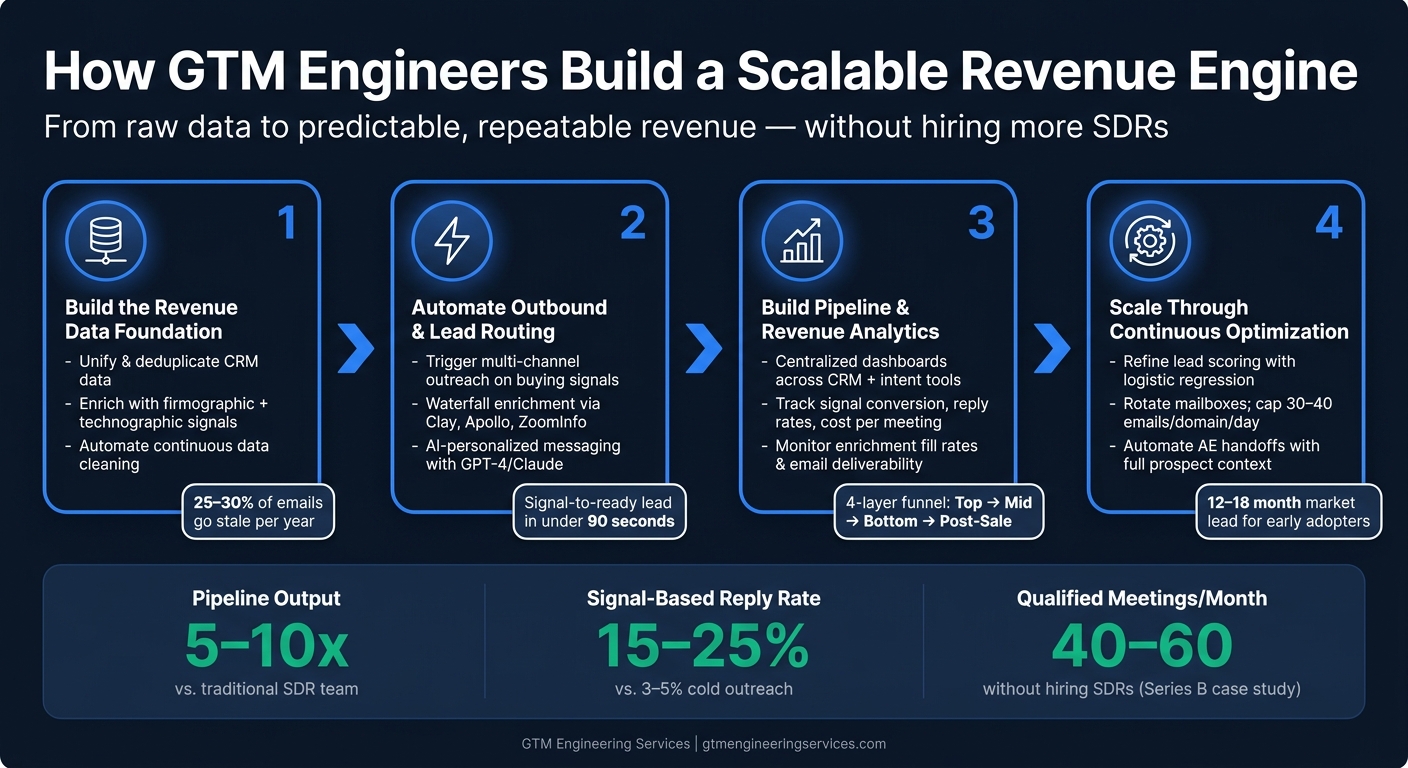
How GTM Engineers Build a Scalable Revenue Engine: 4-Step Framework
What GTM Engineers Do
GTM Engineers focus on crafting scalable revenue systems, transforming raw signals into actionable sales opportunities through technical expertise.
Defining GTM Engineering
At its core, GTM Engineering combines raw data, CRM workflows, and outbound strategies into a single, automated revenue system. This role came about to close the costly gap between strategy and execution in go-to-market (GTM) processes.
"The GTM engineer role did not emerge because companies wanted another job title. It emerged because the gap between GTM strategy and GTM execution became too expensive to ignore." – Kushal Magar, SyncGTM
In essence, GTM Engineers build an automation layer that turns buying signals into enriched, sales-ready leads. Unlike RevOps, which focuses on refining existing workflows, GTM Engineers design entirely new revenue systems from scratch.
What GTM Engineers Work On
The responsibilities of GTM Engineers revolve around building scalable systems that fuel revenue growth. Each task contributes to a cohesive engine rather than a patchwork of disconnected tools.
| Responsibility | What It Involves |
|---|---|
| Lead Sourcing & Enrichment | Developing pipelines that pull in firmographic and contact data from multiple sources. |
| Signal Detection | Monitoring real-time triggers like job changes, funding events, and tech stack updates. |
| Lead Scoring & Routing | Creating logic to prioritize and assign leads efficiently. |
| Outbound Infrastructure | Crafting multi-channel outbound sequences with AI-driven personalization. |
| CRM Orchestration | Automating data flow into platforms like HubSpot or Salesforce, including deduplication and lifecycle management. |
| Pipeline Analytics | Setting up dashboards to track conversion rates by signal type and cost per meeting. |
What sets this role apart is its ability to scale non-linearly. Traditional SDR teams require more hires to grow pipeline output, but GTM Engineers build systems that amplify results without needing proportional headcount increases.
As Patrick Spychalski, Co-founder of The Kiln, explains:
"GTM engineers know how to combine 4–5 core tools into workflows that actually move the needle. That’s the skill gap most companies are hiring to fill."
The market demand for this expertise is undeniable. Job postings for "GTM Engineer" saw a 340% year-over-year increase through 2025, and 72% of GTM Engineers report directly contributing to measurable revenue gains. For Series A and Series B startups aiming to demonstrate a repeatable GTM motion, this kind of leverage is exactly what investors are looking for. These responsibilities come together to create a system that drives exponential revenue growth.
Step 1: Build the Revenue Data Foundation
Scalable go-to-market (GTM) systems depend on clean, trustworthy data. Without a strong data foundation, efforts to automate workflows or target prospects can fall apart, leading to unreliable insights and wasted effort.
"Garbage in, garbage out… remains possibly the single most important principle in all of computing."
Unifying and Cleaning Data
For many early-stage startups, lead and account data is scattered across CRMs, spreadsheets, marketing platforms, and other tools. GTM Engineers tackle this chaos by consolidating everything into a single, reliable source. This involves deduplicating records, standardizing field formats, and resolving identity conflicts.
B2B contact data has a short shelf life – email addresses alone can go stale at a rate of 25–30% per year. Automating outreach on outdated or inaccurate data doesn’t scale; it just creates more noise. That’s why 67% of GTM Engineers oversee CRM data quality directly.
The solution isn’t manual cleanup. Instead, GTM Engineers design automated cleaning workflows that continuously detect job changes, verify email addresses, and standardize firmographic fields like company size and industry. These workflows ensure the data stays accurate over time without relying on sales reps to manually update it. This frees reps from spending a staggering 70% of their week on administrative tasks. With a clean and dynamic data layer in place, teams can move confidently into automating outbound processes and analytics.
Enriching Data for Better Targeting
Once the data is clean, the next step is enrichment. GTM Engineers add layers of firmographic and technographic context, turning basic records into detailed, actionable profiles. This is achieved through sequential enrichment pipelines that pull verified information from multiple data providers.
This enriched data enables far more precise targeting. Instead of relying on surface-level details like a LinkedIn post, enriched data might reveal that a target account recently hired three SDRs, switched off a legacy CRM, or secured Series B funding in the last 90 days. These are the kinds of insights that make outreach resonate. For instance, a Series B SaaS company replaced its manual SDR workflows with an automated enrichment system, resulting in 40–60 qualified meetings per month and an 18% reply rate.
Using Signals to Inform Outreach
Enriched data identifies who to target, but signals reveal when to engage. High-value signals include leadership changes, funding announcements, technology adoption, and active hiring. These events highlight moments of relevance that static lead lists miss entirely.
GTM Engineers integrate these signals into automated outreach workflows. For example, when a target account advertises a job opening tied to your product or a key executive joins a company that fits your ICP, the system immediately detects it. It then enriches the record, scores the opportunity, and routes it into the appropriate sequence – all without human intervention. Signal-based selling has been shown to boost reply rates by 3–5x compared to traditional list-based outreach. This automation ensures opportunities are acted upon in real time, maximizing impact.
Step 2: Automate Outbound and Lead Routing
Once the data foundation is clean and enriched, it’s time to make that data work for you. GTM Engineers transition from organizing data to driving revenue by creating automated systems that turn key signals into targeted, action-ready conversations.
Designing Multi-Channel Outbound Systems
A common pitfall in outbound strategies is treating them as generic mass outreach. GTM Engineers take a smarter approach, using "detect and act" logic. Here’s how it works: outreach is triggered by specific events, such as a company announcing new funding, hiring a key executive, or adopting a new technology.
When a trigger occurs, the system springs into action. It coordinates outreach across multiple channels – email, LinkedIn, and phone – while employing waterfall enrichment. This involves sequentially verifying contact details through trusted tools like Clay, Apollo, and ZoomInfo before a sales rep gets involved. Large language models (LLMs) like GPT-4 or Claude then take over, synthesizing research into tailored messaging that references relevant details instead of relying on generic templates.
"GTM engineers know how to combine 4–5 core tools into workflows that actually move the needle. That’s the skill gap most companies are hiring to fill." – Patrick Spychalski, Co-founder at The Kiln
But effective messaging is only half the battle. The technical setup is equally important. Before launching any campaign, GTM Engineers configure dedicated sending domains with proper DNS settings (SPF, DKIM, DMARC) and run mailbox warmup cycles. Skipping these steps can tank deliverability and undo all the hard work put into data preparation.
Setting Up CRM Automation
Once outbound messaging is structured, the next move is streamlining CRM workflows. GTM Engineers take the manual effort out of CRM updates by automating every stage – from deduplication and scoring to task assignments and stage transitions. For example, when a lead enters the system, it’s checked against existing records, filtered to exclude companies outside the ideal customer profile (like those with fewer than 50 employees), and scored based on firmographic and behavioral data.
In early 2026, OneAway applied this strategy for a Series B SaaS client managing over 1,200 leads monthly. Using HubSpot, they built a system that routed leads based on the type of signal. Job changes triggered one sequence, while funding announcements triggered another. High-scoring leads (8–10) were assigned to AEs for personalized outreach, while mid-range scores (5–7) entered automated sequences. The result? A self-sufficient pipeline that eliminated manual data entry for sales reps.
It’s worth noting that 88% of GTM Engineers rely on Salesforce or HubSpot as their CRM backbone. These platforms provide the advanced logic and automation capabilities needed to scale these systems efficiently.
Connecting Signals to Actions
With automated routing and CRM updates in place, GTM Engineers create pipelines that process intent signals via webhooks or APIs. These pipelines immediately trigger enrichment, scoring, and enrollment, ensuring no time is wasted.
Speed is everything. Well-designed systems cut the time from detecting a buying signal to having a lead ready for follow-up to under 90 seconds. This is crucial, especially when 52% of sales reps fail to make even a second follow-up.
The results speak for themselves: signal-based campaigns deliver reply rates of 15–25%, compared to just 3–5% for generic cold outreach. This boost comes from a combination of personalized messaging, precise timing, and a solid infrastructure. These automated workflows lay the groundwork for deeper pipeline analytics and ongoing revenue improvements in later stages.
Step 3: Build Pipeline and Revenue Analytics
Once outbound and CRM workflows are automated, GTM Engineers shift gears to focus on performance measurement. The goal is to transform the vast amounts of data generated by these workflows into actionable insights that refine and scale revenue systems. Without clear visibility, this data remains untapped potential. This step is all about moving from simply building systems to measuring their effectiveness, ensuring every part of the pipeline contributes to predictable growth.
Building Pipeline Visibility Dashboards
To gain a clear understanding of pipeline performance, GTM Engineers consolidate data from various tools – like CRM platforms, enrichment systems, and intent data sources – into centralized dashboards. These dashboards don’t just track metrics; they spotlight inefficiencies and pinpoint where the system needs attention. Kushal Magar of SyncGTM explains the purpose succinctly:
"GTM engineers build dashboards that surface what matters: pipeline coverage, sequence performance, enrichment fill rates, and buying signals by account."
A well-designed dashboard doesn’t just measure activity; it tracks the entire funnel – from the first buying signal to closed-won deals. It also includes signal-specific conversion tracking, helping teams identify which triggers (like job changes or funding announcements) lead to qualified meetings versus dead ends. Beyond pipeline activity, these dashboards monitor infrastructure health – tracking metrics like enrichment fill rates, email bounce rates, and data freshness. Outdated or incomplete data can cripple decision-making, so staying on top of these indicators is key.
| Dashboard Layer | Key Metrics | Why It Matters |
|---|---|---|
| Top of Funnel | Signal conversion rate, enrichment fill rate, cost per qualified meeting | Assesses lead quality and sourcing efficiency |
| Middle of Funnel | Meeting-to-pipeline ratio, sequence reply rates, booking rates | Highlights follow-up and messaging bottlenecks |
| Bottom of Funnel | Pipeline coverage, cost per opportunity, win/loss by signal | Evaluates ROI and system predictability |
| Post-Sale | Customer health score, upsell/cross-sell signals, churn risk | Focuses on retention and account growth |
Armed with these dashboards, GTM Engineers can quickly identify and address bottlenecks, ensuring the pipeline operates smoothly.
Using Metrics to Fix Bottlenecks
Dashboards are only as valuable as the actions they inspire. GTM Engineers use the data to zero in on specific issues, solving root problems instead of just symptoms. For example, one critical metric is signal-to-meeting speed – how quickly a detected buying signal translates into a confirmed meeting. A slow response often points to follow-up inefficiencies rather than messaging flaws.
Kunal Singh of SpurIQ emphasizes this approach:
"The framework treats pipeline generation as an engineering problem, not a volume problem. Every workflow feeds data back into the system."
This shift also moves away from traditional activity metrics like email opens, clicks, or send volume. These numbers don’t tell the full story. As Thibault Garcia, Founder of Reachly, explains:
"If the weekly report only shows activity, the system is optimizing for the wrong thing."
Instead, the focus is on metrics that directly impact revenue: qualified meetings booked, pipeline generated per rep, and stage conversion rates. These indicators reveal whether the system is driving revenue forward and highlight where to concentrate efforts to maintain scalability. By addressing these metrics, GTM Engineers ensure the revenue engine stays efficient and repeatable.
Step 4: Scale Through Continuous Optimization
Building a system is just the starting point – its true potential emerges through ongoing refinement. Every cycle of improvement boosts performance, following principles often seen in software engineering. GTM Engineers take a similar approach, continuously iterating, testing, and fine-tuning revenue systems. As Thibault Garcia, Founder of Reachly, explains:
"It takes one good builder to replace five decent operators. The companies that figure this out first get a 12 to 18 month lead on their market because building the system takes time, but once it runs, it compounds."
Refining Scoring and Automation Logic
Lead scoring models aren’t static – they shift as markets evolve and ideal customer profiles (ICPs) change. GTM Engineers regularly fine-tune these models by analyzing historical closed-won data. Techniques like logistic regression are applied across around 15 behavioral and firmographic factors to keep scoring relevant. On the automation side, they ensure email deliverability remains high by monitoring SPF, DKIM, and DMARC settings, rotating mailboxes, and capping each sending domain to 30–40 emails daily, spread across 3–5 domains per client. This vigilance counters issues like data decay and shifting market conditions. Automated Slack alerts flag potential problems early – like a 15% drop in deliverability – so they can be addressed before escalating.
Scaling for Higher Outreach Volume
Increasing outreach volume without sacrificing quality is no small feat. Signal-based outbound campaigns often achieve reply rates between 15% and 25%, far outperforming the 3% to 5% typical of generic cold outreach. To maintain this edge while scaling, GTM Engineers design modular workflows, enabling underperforming elements to be swapped out quickly. Weekly optimization cycles identify weak points – whether it’s a specific segment or messaging variant – so ineffective strategies can be eliminated, and successful ones amplified. As outreach scales, smooth internal communication becomes even more critical to sustain progress.
Improving Team Handoffs and Coordination
Automation doesn’t stop with outreach. GTM Engineers also improve team handoffs by automating the transfer of critical context alongside the lead itself. CRM-integrated templates auto-fill details like the prospect’s problem, current solution, and key decision-makers, ensuring account executives (AEs) have all the information they need upfront, rather than starting from scratch.
On a broader level, GTM Engineers streamline the connections between sales, marketing, and RevOps. By automating data flows that would otherwise require manual effort, they eliminate time-consuming "glue work." This ensures sales reps spend less time on administrative tasks and more time closing deals. Leads, complete with full context, are delivered to reps within minutes of qualification, not hours, saving valuable time and maintaining momentum.
Conclusion: Building Predictable Revenue Growth with GTM Engineers
Predictable revenue is built on systems, not just by adding more salespeople. GTM Engineers focus on creating those systems by mastering data, automation, analytics, and continuous improvement. The four steps outlined here – cleaning up your data, automating outbound and lead routing, improving pipeline visibility, and ongoing optimization – form a self-reinforcing growth engine that strengthens over time.
One Series B sales enablement company, for example, achieved 40–60 qualified meetings per month with an 18% reply rate – all without hiring SDRs – within just 90 days of implementing these systems. Results like this simply aren’t possible with manual processes; they require a strong, automated revenue infrastructure.
What makes GTM Engineering so impactful is its ability to deliver exponential returns. Automated systems built by GTM Engineers can generate 5x to 10x the pipeline at a fraction of the cost of traditional methods. These systems work around the clock, capturing and acting on buying signals in under 90 seconds.
For Series A and Series B founders aiming to demonstrate a scalable go-to-market motion before their next funding round, this kind of infrastructure is a game-changer. If you’re ready to transition from founder-led sales to a system that operates independently, GTM Engineering Services is ready to build it for you. Shift to scalable systems and set the stage for predictable, repeatable revenue growth.
FAQs
When should a startup hire a GTM Engineer?
Startups should consider hiring a GTM Engineer or partnering with GTM Engineering Services once they’ve validated their outbound sales channel and are ready to scale beyond founder-led efforts. This is typically the right move for companies that meet some of these benchmarks:
- Annual Recurring Revenue (ARR): Between $500,000 and $10,000,000.
- Sales Team Size: More than five reps on the team.
- Outbound Activity: Over 1,000 outbound touches per month.
- Tech Stack: Managing 10 or more tools.
- SDR Budget: Spending $135,000+ annually on SDRs but seeing inconsistent results.
If you’re hitting these thresholds, it’s likely time to invest in building systems that can support sustainable growth.
What tools and data sources do GTM Engineers typically connect?
GTM Engineers bring together a variety of tools to create systems that drive revenue automatically. Here’s how they do it:
- Data Enrichment: Platforms like Clay, Apollo, and ZoomInfo feed CRMs with enriched data for better targeting.
- CRM Integration: Tools such as Salesforce and HubSpot serve as the backbone for managing customer relationships.
- Multi-Channel Outreach: Sequencing tools like Instantly and Smartlead streamline outreach across multiple channels.
- Buying Signal Detection: Platforms like Albacross and LinkedIn Sales Navigator help identify when prospects are ready to engage.
- Automation: Tools like Zapier or custom APIs ensure seamless workflows and eliminate manual tasks.
By connecting these tools, GTM Engineers design systems that scale outreach, improve targeting, and increase efficiency – all with less manual effort.
How do you measure ROI from GTM engineering efforts?
To gauge ROI from GTM engineering, focus on metrics that reveal the true impact of your efforts. Key indicators include meetings booked per month, total pipeline generated, conversion rates by signal type, and cost per qualified meeting. Beyond these, look at how much manual work has been reduced and whether lead enrichment processes are more accurate.
Think of this as a cycle of constant testing and refinement. By iterating on your systems, you can drive consistent, scalable pipeline growth – without depending solely on adding more headcount.