
Scaling sales at Series A or B often hits a wall. Founder-led efforts don’t scale, and manual processes waste time. Sales reps spend only 2 hours a day selling, with the rest lost to admin tasks. A modular outbound system solves this by automating workflows across five layers: Data, Enrichment, Segmentation, Personalization, and Sequencing.
Key insights:
- Automated outreach improves free-trial-to-paid conversion rates to 56% (vs. 32% for manual approaches).
- Bad data costs $12.9M annually, but waterfall enrichment keeps match rates at 85–92%.
- Acting on buying signals in 24 hours increases reply rates by 40%.
- Automation saves sales teams over 56 hours per week, redirecting time to selling.
A modular setup connects tools via APIs, eliminates manual handoffs, and enables dynamic outreach. This system grows with your startup, reducing errors and creating a scalable pipeline. Start small: test your Ideal Customer Profile (ICP) with 100 contacts, automate enrichment, and build from there.
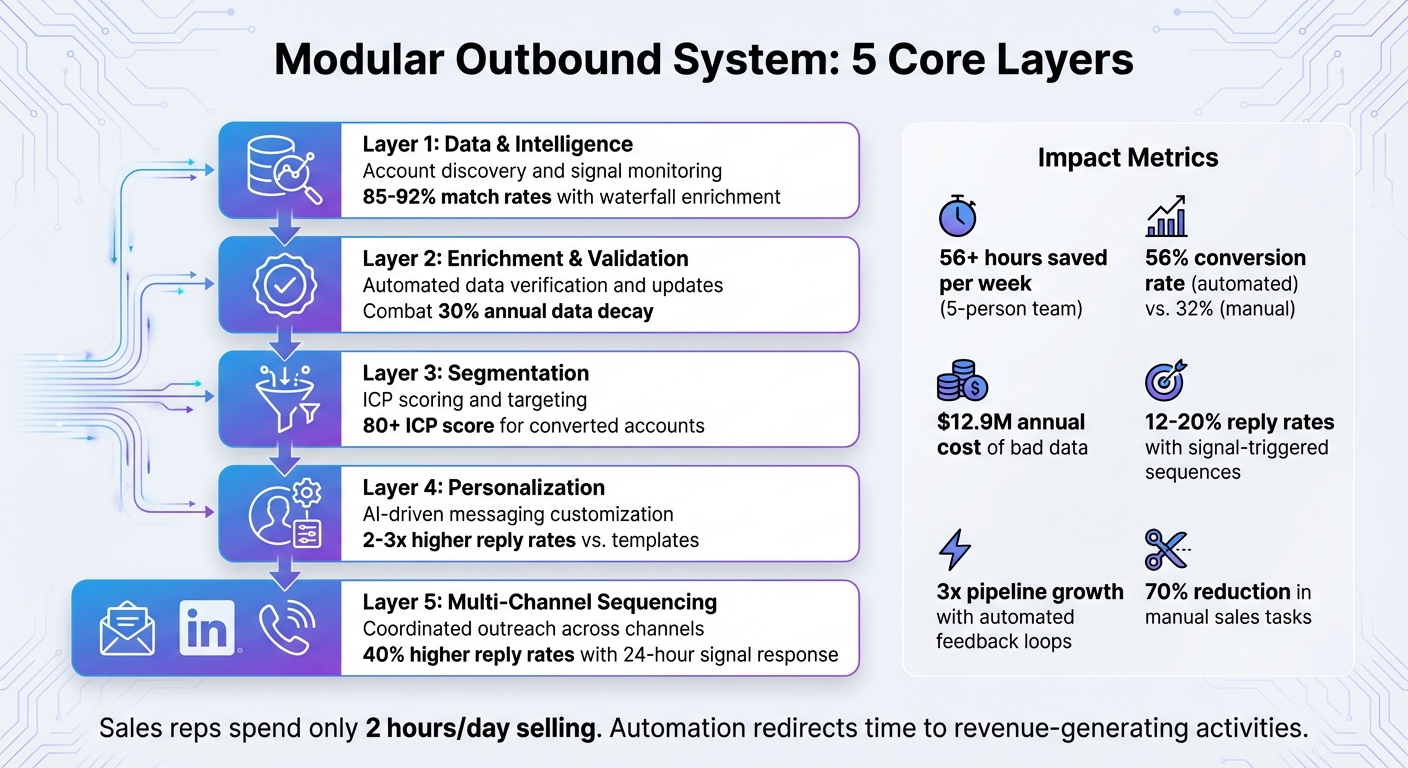
Five-Layer Modular Outbound System Architecture for Startups
What Modularity Means for Outbound Systems
Defining a Modular Outbound System
A modular outbound system is a connected framework where data, automation, and technology come together in independent, scalable layers. Unlike traditional setups that depend on static spreadsheets or disconnected tools, modular systems are designed with flexibility in mind. Each layer operates independently but works in harmony to create a seamless flow from identifying prospects to closing deals.
Here’s how these layers typically break down:
- Data & Intelligence: Handles account discovery and monitors signals.
- Enrichment & Validation: Ensures data is automatically verified and updated.
- Multi-Channel Sequencing: Supports outreach across email, LinkedIn, and phone in a coordinated way.
- CRM Automation: Acts as the central hub for managing records and workflows.
Traditional outbound systems often require manual data transfers between tools, which slows processes and introduces errors. Modular systems, however, rely on APIs and orchestration layers to automate these connections. This approach eliminates bottlenecks, streamlines data flow, and allows for quick adjustments – an essential feature for startups navigating rapid changes.
Why Modularity Works for Startups
For startups, modular systems tackle key challenges like speed, cost-efficiency, and adaptability. When a company needs to explore new market segments or tweak its ideal customer profile, a modular setup allows for quick swaps – such as changing a data provider – without disrupting the entire system. This flexibility minimizes vendor dependency and accelerates operational shifts.
The time savings are undeniable. Sales teams using automation save an average of 2 hours and 15 minutes daily on tasks like data entry and scheduling. For a five-person team, that’s over 56 hours a week redirected to selling. Companies that implement automated feedback loops report a 3x increase in pipeline growth and cut manual sales tasks by 70%.
Modularity also strengthens operational resilience. B2B contact data tends to decay at a rate of 30% annually, but a well-designed waterfall enrichment process can maintain 85–92% match rates by pulling from multiple data sources when one provider falls short. Additionally, the system’s stateless design ensures uninterrupted activity – even if one email domain gets flagged for spam, backup domains can take over without missing a beat. These built-in advantages make modular systems a game-changer for startups aiming to build scalable, adaptable outbound engines.
Core Components of a Modular Outbound System
A modular outbound system is built to move prospects smoothly from discovery to closed deals by automating key processes. It eliminates manual tasks and creates a scalable pipeline that grows with your startup. Each component works independently but connects seamlessly through standardized interfaces, ensuring efficiency at every stage.
Lead Intelligence and Enrichment
This layer focuses on two main tasks: identifying the right accounts and filling in any missing contact details. Instead of relying on a single data provider, a method called waterfall enrichment is used. This process queries multiple sources, such as Apollo, Lusha, and Clay, in sequence until verified contact information is found. Systems configured this way can achieve match rates of 85–92% for B2B contacts. To maintain domain deliverability, it’s crucial to enforce an 85% confidence threshold for data accuracy.
Modern systems also track real-time signals, like funding announcements or executive changes, that suggest a prospect is ready to buy. Acting on these signals within 24 hours can boost reply rates by 40%. For example, in 2024, ServiceBell used Clay to automate lead identification and outreach, booking 10 meetings in one day and 30 meetings with just an hour of manual effort.
Once enriched, the data – email addresses, phone numbers, job titles, and company details – is automatically pushed into the sequencing engine through APIs. This eliminates manual data transfers, ensuring consistency and accuracy across your outbound process.
Multi-Channel Sequencing
The sequencing engine manages outreach across multiple channels – email, LinkedIn, phone, and SMS – without disrupting workflows. By using conditional logic, it adapts to prospect behavior. For instance, if a prospect opens an email twice but doesn’t reply, the system might trigger a LinkedIn connection request. This creates a dynamic, multi-touch cadence tailored to engagement.
To protect your domain reputation, the system follows strict guidelines, such as limiting outreach to 50 new contacts per domain daily and using separate sending domains for outbound campaigns. These practices keep your primary domain safe from blacklisting.
CRM Automation and Pipeline Tracking
Your CRM serves as the central hub for all outbound activities, automatically logging every interaction. Automation ensures smooth lead routing, scoring, and reporting. For example, when a prospect replies or books a meeting, the system assigns them to the right representative based on factors like territory or deal size. Lead scoring also updates in real time.
In January 2026, ManpowerGroup‘s Northern European team streamlined its CRM processes using HubSpot, which improved lead qualification consistency and enhanced dashboard visibility.
Advanced CRMs use closed-loop feedback to refine Ideal Customer Profile (ICP) scoring and initiate lookalike prospecting. When a deal closes, data flows back into the intelligence layer to identify similar accounts. Back-testing your ICP model against the past year’s closed-won deals can verify its accuracy – every converted account should score 80+ in your model. These automated updates feed directly into analytics, creating a system that continuously improves.
Analytics and Observability
Analytics focuses on tracking meaningful metrics like reply rates, pipeline conversion, and revenue attribution. It measures every stage of the funnel, from account enrichment to replies, ensuring the system is driving results rather than just creating busy work.
With automated feedback loops, some companies have seen pipeline growth triple and manual sales tasks drop by 70%. Metrics like Pipeline Velocity and Win Rate by Source offer clear insights into whether your system is delivering revenue. AI-native companies that automate their go-to-market processes report free-trial-to-paid conversion rates of 56%, compared to 32% for others.
Insights from analytics also inform other components. For instance, if personalized sequences outperform templated ones by 2–3x in reply rates, this data can guide the creation of more effective, AI-driven copy. This optimization loop helps minimize manual work while scaling your outbound efforts.
GTM Engineering Services uses these components to build scalable systems that help startups move beyond founder-led sales. To learn more about designing and implementing such systems, visit GTM Engineering Services.
Designing for Scale and Resilience
Creating an outbound system that can expand without breaking hinges on two key ideas: stateless design and resilience patterns. These principles ensure your system can handle increased demand while bouncing back from setbacks.
Stateless Modules and Horizontal Scaling
Stateless design means storing all state information – like a prospect’s status or engagement history – in an external system (such as a CRM). This allows any server to handle any request without needing to retain context internally.
For example, if a prospect opens an email several times without responding, the system can consult the CRM to determine their current status and trigger the next step, such as sending a LinkedIn connection request. If one server fails, another can step in seamlessly since all the context is stored centrally, not tied to a specific server.
This approach supports horizontal scaling, meaning you can add more servers to manage increased demand instead of upgrading to a larger, more expensive one. As Muhammad Raza from Splunk puts it:
"Stateless systems are inherently faster as they don’t rely on external systems that may respond slowly and can parallelize sessions efficiently".
By avoiding session affinity – where requests are tied to a specific server – load balancers can distribute traffic evenly across all available servers. This ensures the system can grow smoothly as outbound volume increases.
Scaling, however, is only half the challenge; your system also needs to withstand inevitable failures.
Graceful Degradation and Resilience Patterns
Even the best systems encounter failures – whether it’s an enrichment API outage or a CRM hitting rate limits. Resilience patterns are the safety nets that keep your operations running smoothly during these disruptions.
Take the circuit breaker pattern, for instance. It works like an electrical breaker in your home. If a service, like an enrichment provider, fails repeatedly, the breaker trips, halting further requests to that service. This prevents overwhelming the failing system and allows the operation to reroute unmatched records to a manual review queue or switch to a backup provider.
Retry logic with exponential backoff (e.g., waiting 2 seconds, then 4 seconds, then 8 seconds) is another essential tool to handle temporary CRM timeouts.
The bulkhead pattern adds another layer of protection by isolating resources into separate pools. Think of it like watertight compartments in a ship – if one module, like lead enrichment, consumes too many resources, other modules, such as email sending, can continue unaffected. Adding idempotency keys (like a unique lead_request_id) to API calls ensures that even if a request is retried due to a timeout, the action – like creating a lead in the CRM – happens only once. Patrick Kearns highlights this well:
"Modern distributed systems rarely fail because the core business logic is too hard. They fail because the vulnerable components are unpredictable".
These resilience patterns help your system degrade gracefully rather than collapse entirely. For example, if AI-powered personalization fails, the system can default to generic templates and keep sending messages, ensuring operations continue despite temporary setbacks.
Best Practices for Deploying Modular Outbound Systems
Containerization and Orchestration
Using OCI-compatible containers like Docker ensures your outbound modules perform consistently across different environments. This eliminates the classic "it works on my machine" headache that often plagues startups during deployment.
For startups running on tight budgets, you don’t need enterprise-level infrastructure to get started. A modest setup – think a Quad Xeon processor, 12GB RAM, and SSD storage – can cost around $130–$140 per month from providers like Codero. For simpler needs, tools like systemd can handle essential tasks such as process restarts, logging, and keep-alive mechanisms without diving into the complexities of full orchestration platforms.
As your outbound efforts expand, containerization makes scaling smoother. It allows you to scale specific modules – like email sequencing or CRM syncs – independently during peak demand. NVIDIA’s Triton Server is a great example of this approach, enabling scalable deployment of AI models or data modules without disrupting other parts of the system.
Monitoring and Observability
Once your modules are containerized and orchestrated, monitoring becomes critical. Real-time tracking ensures small glitches don’t snowball into major pipeline failures. Set up alerts for API errors, data quality issues, and performance dips so you can address problems the moment they arise.
Pay close attention to deliverability monitoring. Keep your bounce rate under 3% and aim for inbox placement above 90%. If these metrics falter, pause your campaigns immediately to investigate and resolve any reputation issues. Regularly check domain health to avoid blacklisting, which could bring your outbound operations to a halt.
Monitor performance across four key layers:
- Data: Maintain enrichment match rates at 85% or higher.
- System of Record: Watch for CRM sync errors.
- Orchestration: Address workflow failures promptly.
- Intelligence: Ensure AI accuracy remains high.
Set clear benchmarks for success. For instance, signal-triggered sequences should generate 12–20% reply rates, and time-to-first-touch should stay under 24 hours, as this can boost reply rates by up to 40%. Given that bad data costs companies approximately $12.9 million annually, prioritizing data quality monitoring isn’t optional – it’s essential.
Iterative Implementation and Continuous Improvement
Instead of jumping into a full-scale launch, roll out your system in three phases. Start with the Initial Setup, testing your messaging and channels with a small batch of 100 contacts. Move to Quality Enhancement, where you integrate enrichment tools and trigger-based workflows. Finally, scale with Advanced Integration, adding features like domain rotation and account-based enrichment.
Before scaling any sequence, validate it with control groups. Test one signal and one segment for 30 days to establish a baseline. This ensures you don’t burn through your prospect list with untested messaging. Automate your lead flow – from data sourcing to enrichment, sequencing, and CRM updates – to eliminate the inefficiencies of manual spreadsheet management. Companies leveraging AI for these processes see free-trial-to-paid conversion rates of 56%, compared to 32% for those that don’t.
Keep in mind that B2B contact data degrades at about 30% per year, so make re-enrichment a continuous process from day one. By focusing on a solid system architecture before adding complexity, you set the stage for sustainable growth. Over time, refining data quality, improving messaging, and optimizing workflows will strengthen your pipeline and ensure your modular outbound system scales effectively. These practices lay the groundwork for a system that grows alongside your startup.
Conclusion
Building a modular outbound system isn’t just about technical preferences – it’s about creating a foundation for scalable revenue as startups move beyond founder-led sales. By structuring outbound efforts into a five-layer stack – Data/Intelligence, Enrichment, Segmentation, Personalization, and Sequencing – you ensure your architecture can grow without breaking down under pressure.
Skipping modular design leads to costly scaling issues. Problems like data decay and declining quality create technical debt that only grows over time. As Raul Sfat pointed out, the real challenge is in the system’s architecture, not just the tools.
A modular approach doesn’t just address these challenges – it also simplifies tool integration and boosts efficiency. With this setup, you can swap tools seamlessly, automate enrichment to hit 85–92% match rates, enable real-time outreach for 40% higher reply rates, and codify decision-making to help new hires ramp up faster.
Start with the basics: validate your Ideal Customer Profile (ICP) and messaging with 50–100 contacts before diving into full automation. Make your CRM the core source of truth, then gradually add orchestration, enrichment, and intelligence layers. This step-by-step process ensures you’re scaling a solid system rather than amplifying existing problems.
For Series A or Series B startups aiming to prove a scalable go-to-market motion, GTM Engineering Services can help. We specialize in building modular revenue systems that turn outbound strategies into reliable pipelines, ensuring your growth doesn’t come with unnecessary technical debt. Transform your outbound sales into a scalable, automated operation with the right systems in place.
FAQs
What should I build first in a modular outbound system?
The first step is to define your Ideal Customer Profile (ICP). Break this down into smaller, more specific segments or personas. Why? Because targeting everyone is the same as targeting no one. When you know exactly who you’re reaching out to, your outbound efforts become sharper and much more relevant.
Once your ICP is locked in, it’s time to set up your core tech stack. You’ll need tools for data enrichment, outreach sequencing, and CRM automation. These aren’t just nice-to-haves – they’re the backbone of a system that can scale. With these steps in place, you’re building a modular framework that supports your outbound strategy efficiently and grows with your needs.
How do I connect my tools without creating messy handoffs?
To keep things running smoothly, build a system where data moves effortlessly between platforms. Automation should handle tasks like enriching, scoring, and routing leads, cutting down on manual mistakes. Make sure your CRM works seamlessly with outreach tools through APIs or workflow automation. This setup triggers actions based on lead status, creating a streamlined pipeline that removes manual handoffs and keeps everything consistent.
How can I scale outbound without hurting deliverability?
To grow your outbound strategy without tanking deliverability, you need to lean on a data-first approach that blends personalization, smart automation, and precise timing. Here’s how:
- Personalized Outreach at Scale: Use workflows to enrich your data and tailor messages so that every touch feels relevant, even when you’re reaching thousands.
- AI-Powered Targeting: Tap into AI-driven lead scoring to zero in on your best prospects. Trigger outreach based on real buying signals, not guesswork.
- Protect Your Sender Reputation: Keep an eye on engagement metrics and tweak your sequences regularly. Avoid overloading your lists to prevent fatigue and maintain a strong sender reputation.
Scaling outbound isn’t just about sending more emails – it’s about sending the right emails to the right people at the right time.