
A GTM Engineer builds automated systems that turn your go-to-market strategy into scalable revenue operations. If your team is stuck with manual processes – like SDRs spending hours on data entry, leads sitting idle, or tools not syncing – you’re likely losing time and deals. In our experience, most Series A and B startups are leaking 30-40% of their pipeline to exactly these infrastructure failures — and they don’t even know it.
A GTM Engineer solves these bottlenecks by automating workflows, integrating tools, and creating efficient systems that multiply your team’s output without adding headcount.
Signs it’s time to hire a GTM Engineer:
- SDRs spend 20%+ of their time on manual tasks.
- Leads take more than 2 hours to reach reps (vs. the 5-minute benchmark for 9x higher conversion rates).
- CRM data is incomplete or inaccurate, impacting decision-making.
- Your tools don’t integrate, leading to disconnected workflows.
- Reporting relies on error-prone spreadsheets.
- Sales and marketing can’t agree on what defines a qualified lead.
- You’re scaling headcount, but pipeline growth isn’t keeping pace.
Next steps: Start with a GTM Systems Audit to identify inefficiencies before committing to a full-time hire. This helps map out the biggest bottlenecks in your revenue process and determine whether you need a full-time GTM Engineer, fractional support, or internal fixes. Addressing these gaps can reduce manual work by 20–40%, improve lead response times, and drive faster pipeline growth.
7 Signs You Need to Hire a GTM Engineer
Your revenue team is putting in the hours, but the pipeline isn’t growing like it should. The problem likely isn’t effort – it’s operational bottlenecks caused by manual processes that can’t keep up with your scaling needs. Here are seven clear indicators that bringing in a GTM Engineer could transform your revenue infrastructure. Each one highlights a specific gap that a GTM Engineer can address.
1. SDRs Spend 20%+ of Their Time on Manual List Building and Data Entry
If your SDRs are stuck cleaning up leads, entering data, and fixing sequences instead of engaging prospects, the issue is with your systems, not your team’s performance. As campaigns increase, so does the manual workload.
A GTM Engineer can automate these repetitive tasks by integrating tools like Clay or Apollo directly with your CRM. This frees up your SDRs to focus on outreach – the activities that actually drive pipeline growth.
2. Leads Take 2+ Hours to Reach Reps (vs. 5-Minute Benchmark)
Speed matters. Leads contacted within five minutes are 9x more likely to convert than those reached later. When leads sit idle for hours, their interest fades, or worse, they end up with competitors. Even cutting lead routing delays from two hours to 45 minutes can boost contact rates by 18% and improve pipeline conversion by 12%.
According to Leadle, "If inbound leads take more than 2 hours to reach a rep, fix that before anything else."
3. CRM Data Is Less Than 90% Complete or Accurate
Messy CRM data can cost companies between 15% and 25% of their revenue. Duplicate records, missing fields, and outdated information make decision-making unreliable. A GTM Engineer can solve this by connecting enrichment APIs to your CRM and setting up real-time validation rules, ensuring data stays over 90% accurate. The result? Conversion rates improve by 20% to 30%.
4. Tools Aren’t Integrated – Data Lives in Disconnected Silos
When your tools – like your CRM, sequencer, and enrichment platforms – don’t talk to each other, your team ends up wasting time transferring information manually. This often leads to outdated "shadow" spreadsheets that only add to the chaos. A GTM Engineer can integrate these tools through APIs, creating a seamless flow of data and a single source of truth.
5. Reporting Is Stitched Together in Spreadsheets
Manual reporting slows everything down, introduces errors, and leaves you without real-time visibility into your pipeline. A GTM Engineer can build automated dashboards that pull live data from your CRM and other systems, giving revenue leaders instant insights to spot opportunities or address problems right when they arise.
6. Sales and Marketing Disagree on What a Qualified Lead Means
When sales and marketing can’t agree on what makes a lead "qualified", valuable prospects slip through the cracks while teams argue over definitions. This misalignment wastes time and creates operational headaches. A GTM Engineer can set up shared lead scoring models and workflows to ensure both teams are aligned from the start.
7. You’re Scaling Headcount but Pipeline Isn’t Scaling
Adding more SDRs should lead to proportional pipeline growth, but if it doesn’t, that’s a red flag. As Clay puts it, "Your GTM motion isn’t under-staffed – it’s under-engineered".
This is the chicken-and-egg problem we see constantly: founders hire reps before building the infrastructure to support them, then scramble to generate leads while their new hires sit idle. The fix is counterintuitive — accelerate before you innovate. Build the systems first.
By automating repetitive tasks, a single GTM Engineer can achieve the output of multiple SDRs. Companies experiencing high growth are also 67% more likely to have technical resources dedicated to managing these automated workflows, allowing them to scale revenue without endlessly increasing headcount.
GTM Engineer vs. More SDRs vs. RevOps Hire
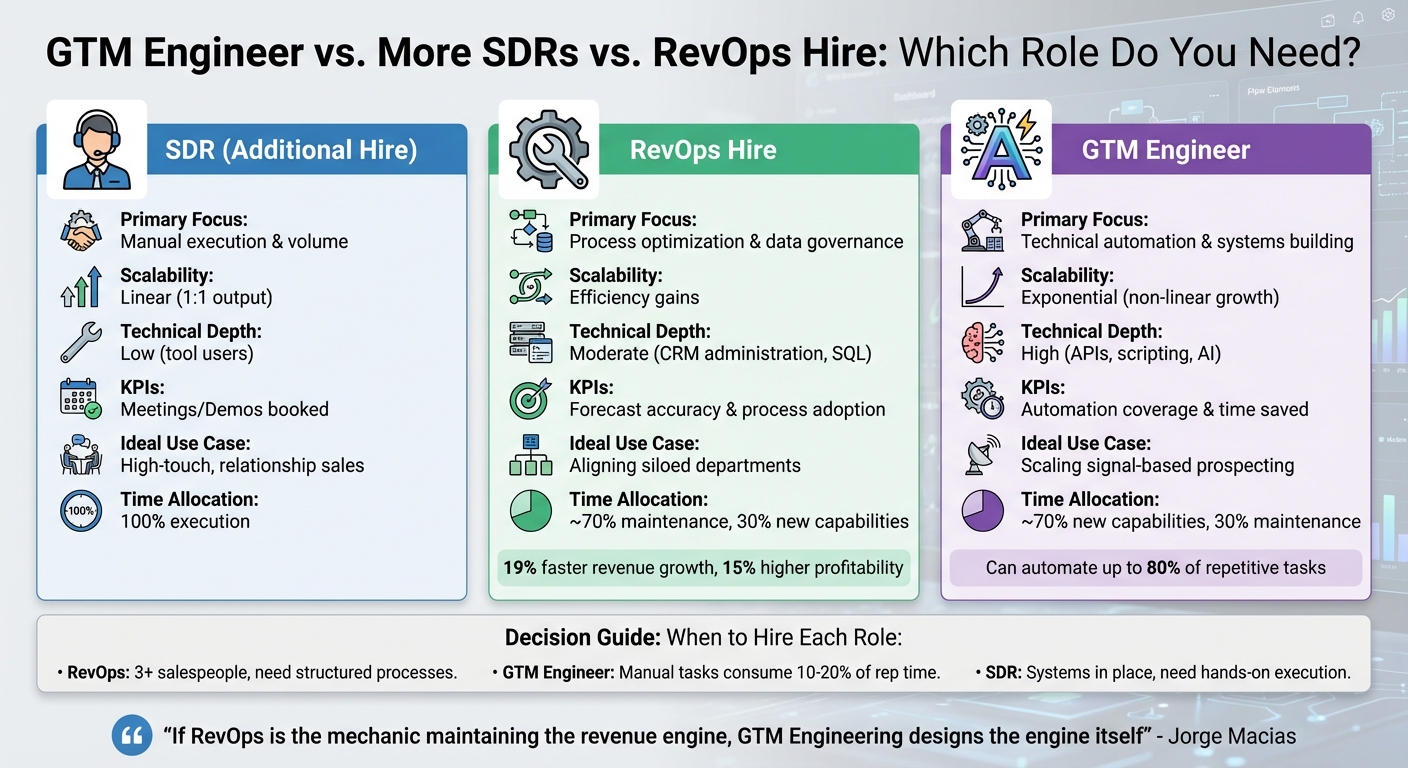
GTM Engineer vs RevOps vs SDR: Role Comparison Guide
When your go-to-market (GTM) motion hits a roadblock, the key is figuring out which role can best address the issue. Each option – SDRs, RevOps, or GTM Engineers – brings a distinct approach to solving GTM challenges.
SDRs focus on manual outreach and relationship-building. Scaling with SDRs follows a straightforward formula: more pipeline requires more people. However, if SDRs are bogged down with repetitive tasks, adding more of them only amplifies inefficiencies rather than solving the root problem.
RevOps acts as the mechanic, ensuring processes run smoothly by optimizing workflows, managing data, and aligning teams. They also define the "rules of the game" for your revenue operations. Companies with strong RevOps functions report 19% faster revenue growth and 15% higher profitability. That said, RevOps teams typically spend about 70% of their time maintaining existing systems rather than creating new ones.
GTM Engineers are the builders. They design and construct the systems that drive your revenue engine. Using automation, API integrations, and custom workflows, a GTM Engineer can automate up to 80% of repetitive tasks, delivering the output of multiple SDRs. When we implement these systems for clients, the first thing we focus on is plugging the leaks — the leads that fall through cracks, the follow-ups that never happen, the data that never syncs. That’s where the immediate ROI lives. Jorge Macias captures the distinction perfectly:
"If RevOps is the mechanic maintaining the revenue engine, GTM Engineering designs the engine itself".
Businesses that embrace GTM engineering see pipeline growth at 2.3x the rate of those relying on manual outbound processes.
Comparison Table
| Feature | SDR (Additional Hire) | RevOps Hire | GTM Engineer |
|---|---|---|---|
| Primary Focus | Manual execution & volume | Process optimization & data governance | Technical automation & systems building |
| Scalability | Linear (1:1 output) | Efficiency gains | Exponential (non-linear growth) |
| Technical Depth | Low (tool users) | Moderate (CRM administration, SQL) | High (APIs, scripting, AI) |
| KPIs | Meetings/Demos booked | Forecast accuracy & process adoption | Automation coverage & time saved |
| Ideal Use Case | High-touch, relationship sales | Aligning siloed departments | Scaling signal-based prospecting |
| Time Allocation | 100% execution | ~70% maintenance, 30% new capabilities | ~70% new capabilities, 30% maintenance |
Choosing the Right Role
The best hire depends on your current GTM bottlenecks:
- RevOps is ideal if you have three or more salespeople and need structured processes or CRM hygiene.
- GTM Engineers are the right choice when manual tasks consume 10%-20% of rep time or if you’re aiming for growth that doesn’t require proportionally increasing headcount.
- SDRs make sense once your systems are in place and you need more hands-on execution to drive outreach and relationships.
What to Do Next
If three or more of the signals mentioned earlier feel familiar, it’s a sign that manual processes might be holding you back. But don’t rush to hire a full-time GTM Engineer just yet – there’s a smarter first step.
Start with a GTM Systems Audit. Before committing $110,000–$160,000 for a full-time hire or diving into a major tech overhaul, take the time to evaluate where your revenue processes are breaking down. A diagnostic audit maps out your entire lead journey – from initial capture and enrichment to routing, handoff, and follow-up. This helps pinpoint the 3–5 biggest bottlenecks that are draining your time and stalling your pipeline. Think of it as a blueprint for smarter decisions.
The audit uncovers critical inefficiencies: Are your SDRs losing 20%–40% of their time on repetitive admin tasks? Is your CRM data strong enough to support automation? Are your tools integrated, or are you stuck with manual data transfers? As one founder, Runnel, put it:
"If you’re inside HubSpot more than 15 minutes a day, you’re doing GTM Engineering instead of founder work."
With these insights, you can determine your next move. Do you need a full-time GTM Engineer, fractional support (at just 10%–30% of a full-time salary), or simple internal fixes?
Take TruckX, for example. This FreightTech company partnered with a GTM consulting firm in 2025 to build interconnected systems. By shifting away from scattered tactics and embracing a structured approach, they scaled their ARR from $2 million to $16 million.
Ready to take action? Book a 30-minute GTM Stack Audit to get a clear picture of your current systems, identify the most impactful fixes, and lay out a 90-day implementation plan. You’ll leave knowing exactly when to bring in a GTM Engineer – and what they should tackle first.
Conclusion: When to Hire a GTM Engineer
Deciding when to bring on a GTM Engineer boils down to identifying key pain points. Are your SDRs bogged down with repetitive tasks? Are leads sitting idle for hours before follow-up? Is your CRM riddled with gaps, your tools disconnected, or your reporting process still manual? Maybe your lead qualification feels off, or you’re adding headcount without seeing a proportional boost in pipeline. If any of this sounds familiar, it’s a clear sign you’ve outgrown your current setup.
You don’t have to tackle every issue overnight. Spotting these challenges is your cue to focus on working smarter instead of simply scaling harder. As Clay aptly said, "GTM Engineers build revenue engines using AI and automation. Instead of coding software, they’re coding revenue". They can reclaim 20–40% of SDRs’ time lost to admin work, ensure leads are contacted within 5 minutes (when conversion rates skyrocket by 9x), and create scalable systems that don’t require constant hiring.
The results speak for themselves. Companies addressing these bottlenecks often see sales cycles shorten by 25% and demo-to-customer conversion rates rise by 40%. Pipeline velocity can also improve by 15–20%. The difference between struggling to grow and building a scalable revenue engine often hinges on one decision: stop trying to outwork your infrastructure problems and start fixing them. A GTM Engineer transforms your strategy into automated, scalable systems — but more importantly, they stop the bleeding before you try to scale.
Still unsure? Schedule a 30-minute GTM Audit to pinpoint the bottlenecks in your current setup and get actionable advice on whether it’s time to hire. Start with a clear game plan.
FAQs
What does a GTM Engineer do to help scale revenue operations?
A GTM (Go-To-Market) Engineer builds the systems that power your revenue operations, turning your strategy into action. They focus on automating workflows across tools like CRMs and sequencing platforms, taking care of repetitive tasks such as lead routing and scoring. By doing this, they ensure your data stays accurate, which helps refine and segment your ideal customer profiles (ICPs).
Their work eliminates time-consuming manual processes and connects fragmented data, creating systems that can grow with your business. The result? Greater efficiency, better reporting, and the ability to scale without needing to expand your team. Think of them as the bridge between planning and doing – making sure your revenue operations are ready to handle growth.
How can a GTM Systems Audit help you decide if you need a GTM Engineer?
A GTM Systems Audit pinpoints inefficiencies and gaps in your revenue operations and tech setup, helping you determine if bringing on a GTM Engineer makes sense. By diving into areas like manual workflows, disconnected tools, and messy or incomplete data, the audit lays out exactly where your systems are underperforming.
If your team is bogged down by slow lead routing, tedious data entry, or poorly aligned sales and marketing workflows, this audit can uncover whether these problems need the specialized skills of a GTM Engineer. It provides specific recommendations on how automation, better integrations, or redesigned workflows could boost your scalability and streamline operations.
Think of it as a diagnostic check for your go-to-market systems – giving founders and revenue leaders the clarity they need to decide if a GTM Engineer is the missing piece for optimizing their growth engine.
What are the advantages of automating manual tasks with a GTM Engineer?
Automating repetitive tasks with a GTM Engineer transforms how your go-to-market (GTM) operations function. By automating workflows in areas like CRM updates, lead routing, data enrichment, and reporting, they remove the burden of manual processes. This not only saves time but also reduces errors, ensuring your data is precise and dependable – key for making smarter business decisions.
Beyond just saving time, automation allows your team to shift their focus to activities that drive results: strategic planning, tailored outreach, and closing deals. The result? Faster pipeline growth and the ability to scale without constantly expanding your team. A GTM Engineer doesn’t just optimize your operations – they build a system that drives efficiency and revenue growth.