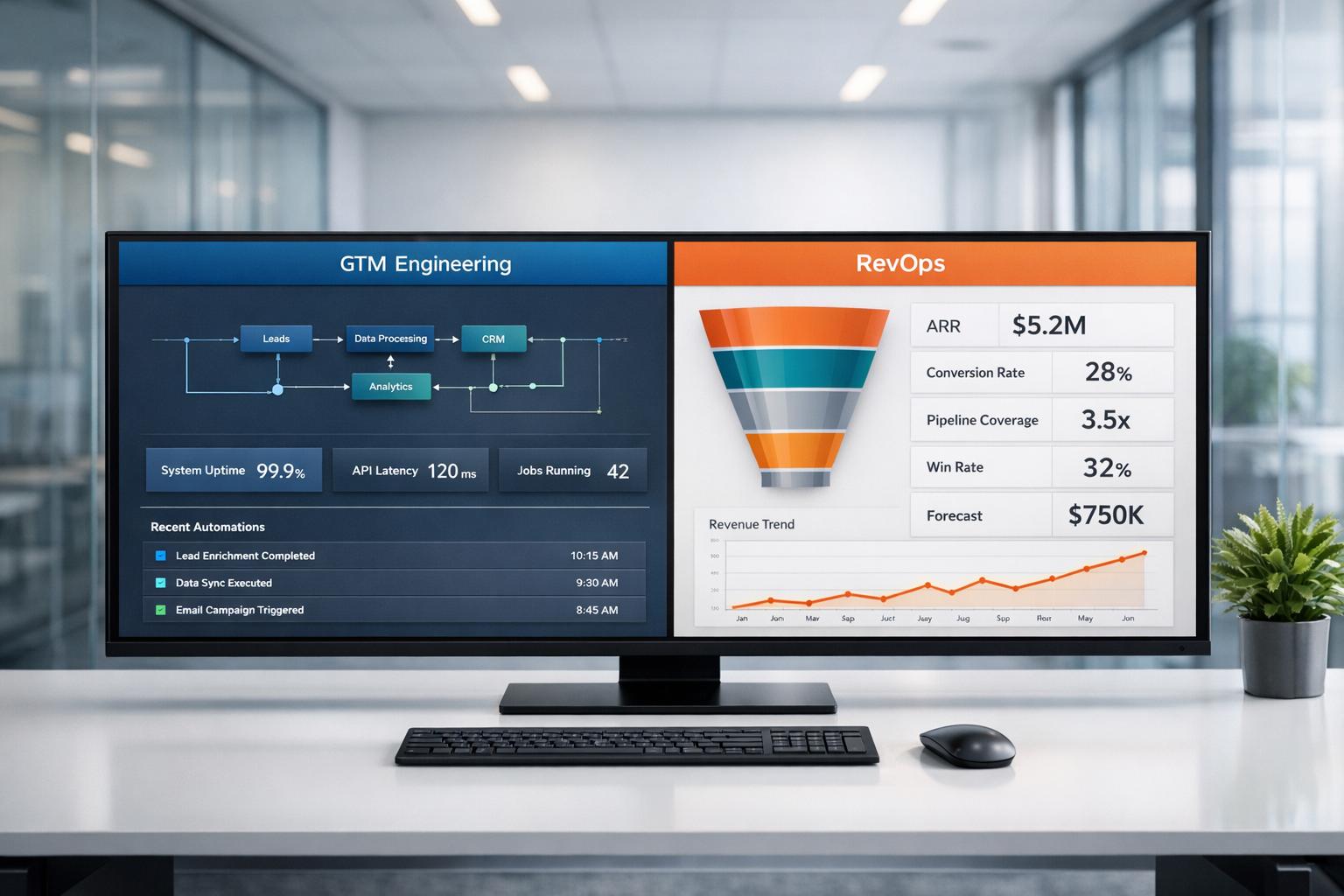
If your startup is struggling with manual tasks, scattered data, or slow processes, you’re likely debating whether to hire a GTM Engineer or a RevOps professional. Here’s the key difference: RevOps organizes and optimizes your revenue processes, while a GTM Engineer builds and automates the technical systems to scale them.
- Hire RevOps if your teams lack alignment, CRM adoption is low, or sales and marketing handoffs are clunky. They streamline processes without needing to write code.
- Hire a GTM Engineer if your challenges are technical – like integrating tools, automating workflows, or building custom systems. They focus on coding and automation to eliminate inefficiencies.
- Need both? As you scale, combining these roles ensures smoother operations and faster growth.
Quick Comparison:
| Role | Focus | Core Skills | Tools Used | Success Metrics |
|---|---|---|---|---|
| RevOps | Process alignment | CRM configuration, reporting | Salesforce, HubSpot, Tableau | Forecast accuracy, win rates |
| GTM Engineer | Technical automation | Python, APIs, data pipelines | Zapier, Snowflake, custom scripts | Automation coverage, time saved |
Main takeaway: RevOps refines your current setup; GTM Engineers build new systems. Choose based on your bottlenecks, or combine both for maximum impact.
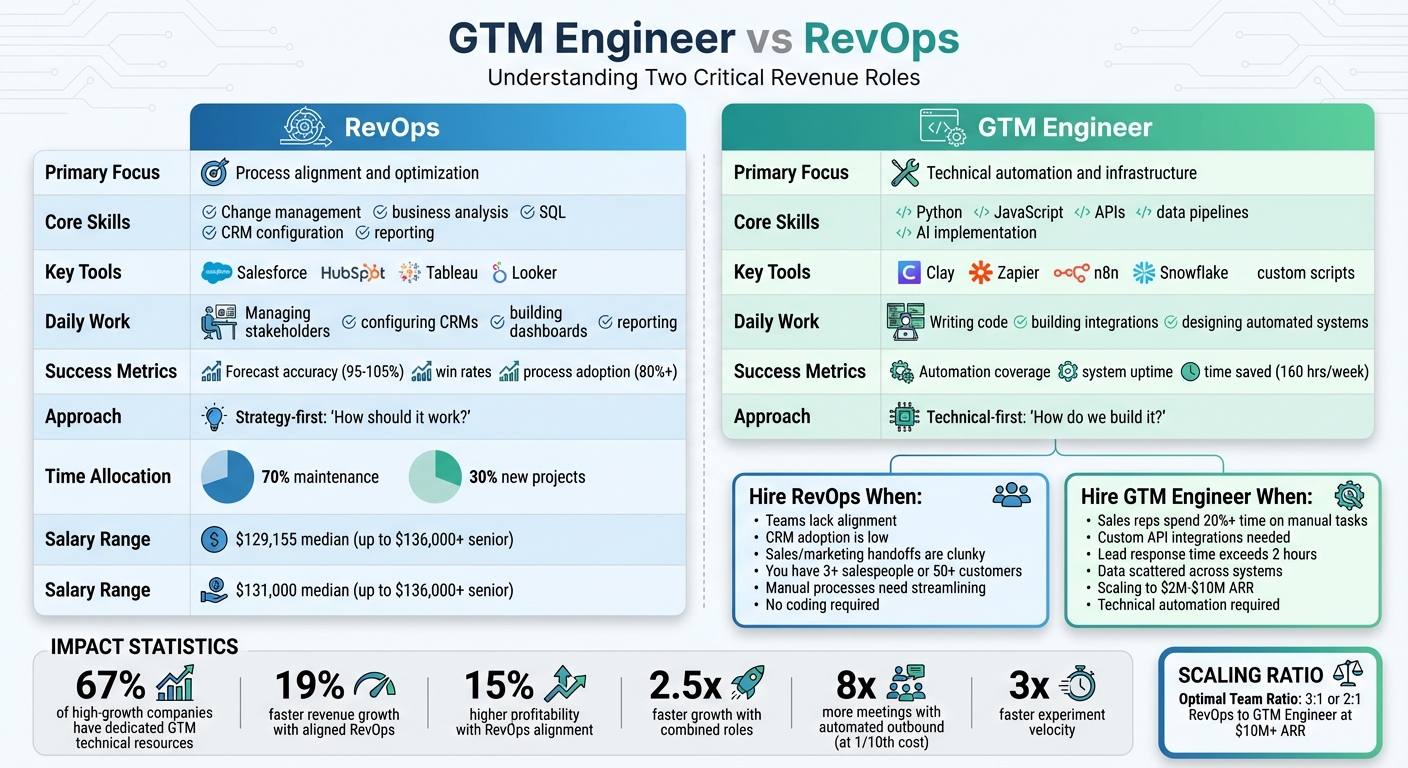
GTM Engineer vs RevOps: Role Comparison and Key Differences
What GTM Engineers and RevOps Do
To understand how GTM Engineers and RevOps contribute to your revenue engine, it’s important to look at their distinct roles. While both are essential, their focus and day-to-day responsibilities differ significantly. RevOps centers on aligning teams and refining processes, while GTM Engineers handle the technical side, building and automating the systems that power your revenue operations. As CandyboxCRM puts it, "RevOps defines the ‘rules of the game,’ while GTM Engineers build the playing field and make sure the game runs without interruption." Expecting one person to handle both roles is unrealistic – it’s like asking a mechanic to design a car’s transmission. Each requires a unique skill set. Let’s break down what each role entails.
GTM Engineer: Building Revenue Systems
A GTM Engineer is a technical expert focused on creating automated systems that eliminate revenue bottlenecks. They specialize in coding integrations, building scalable data pipelines, and implementing tools that unify your revenue stack. While traditional engineers focus on product development, GTM Engineers are laser-focused on commercial outcomes.
Their primary responsibilities include:
- Developing automated outbound systems.
- Creating real-time data pipelines for lead enrichment.
- Implementing AI-driven personalization tools.
- Building custom solutions when off-the-shelf tools fall short.
For example, one GTM Engineer developed 47 automations in just six months, saving 160 hours of manual work per week. They use programming languages like Python and JavaScript, APIs, and platforms like Clay, Zapier, and Make to streamline workflows.
What sets them apart is their problem-solving mindset. When faced with a challenge, they ask, "How do we build this?" rather than "How should this work?" They dedicate about 70% of their time to creating new capabilities and the remaining 30% to maintaining existing systems. Their success is measured by automation coverage, system uptime, and the measurable time saved through their work.
RevOps: Managing Revenue Operations
RevOps professionals, on the other hand, focus on ensuring that sales, marketing, and customer success teams operate in harmony. They are strategic operators who optimize and manage existing systems rather than building new ones.
Key responsibilities include:
- Configuring CRMs and designing sales processes.
- Building analytics dashboards for performance tracking.
- Managing vendor relationships and leading change initiatives.
- Ensuring data quality and effective lead routing.
RevOps professionals also focus on defining sales methodologies, setting service-level agreements, and creating accurate forecast models. Their work directly impacts metrics like forecast accuracy (targeting 95–105% of plan), win rates, and the length of sales cycles. Research shows that companies with well-aligned RevOps functions achieve 19% faster revenue growth and 15% higher profitability.
While GTM Engineers build the infrastructure, RevOps ensures these systems are used effectively to deliver predictable results. They focus on questions like, "How should we sell?" and "What process will drive the best outcomes?" Their success is measured by process adoption rates (aiming for over 80% compliance) and other performance indicators.
These distinct roles highlight how GTM Engineers and RevOps complement each other, setting the stage for a deeper comparison.
GTM Engineer vs RevOps: Main Differences
What Each Role Owns
The daily tasks of RevOps and GTM Engineers highlight their distinct focuses. RevOps handles the operational framework – establishing rules, processes, and governance to keep revenue teams aligned and efficient. This includes defining lead scoring systems, setting service-level agreements between marketing and sales, designing compensation plans, and ensuring data accuracy in the CRM. Their work ensures everyone follows a unified playbook and that the CRM reflects the actual state of the business.
GTM Engineers, on the other hand, manage the technical backbone. They create API integrations to connect disparate tools, build data pipelines for real-time lead scoring, and develop automated workflows based on the rules set by RevOps. For example, if RevOps establishes strict follow-up protocols, GTM Engineers ensure compliance by automating those workflows. This division of labor reflects the broader split between process design and technical implementation.
Technical Skills vs Business Skills
The skillsets of these roles also differ significantly. GTM Engineers bring advanced technical expertise – proficiency in programming languages like Python, JavaScript, and SQL, along with experience in API and webhook management. They also excel at building ETL pipelines and implementing AI-driven personalization. Their work is heavily focused on innovation, with 70% of their time spent on new builds and 30% on maintenance. This expertise comes with a salary range of $131,000 to over $180,000, reflecting the specialized nature of their work.
RevOps professionals, meanwhile, focus on business-oriented capabilities such as process design, change management, stakeholder collaboration, and financial modeling. They are skilled at aligning sales territories, optimizing compensation plans, and creating dashboards that executives actually use. While SQL and CRM proficiency are essential for RevOps, they don’t typically write custom code or manage complex integrations. Their median on-target earnings stand at $129,155, with senior roles exceeding $136,000. RevOps addresses operational challenges through process-driven solutions, while GTM Engineers tackle inefficiencies with automation.
Side-by-Side Comparison
| Feature | RevOps | GTM Engineer |
|---|---|---|
| Primary Focus | Process alignment and optimization | Technical automation and infrastructure |
| Core Skills | Change management, business analysis, SQL | Python, JavaScript, API integration, data modeling |
| Key Tools | CRM (Salesforce/HubSpot), BI tools (Tableau, Looker) | Clay, Zapier, n8n, Snowflake, reverse ETL platforms |
| Daily Work | Managing stakeholders, configuring CRMs, reporting | Writing code, building integrations, designing systems |
| Success Metrics | Forecast accuracy, win rates, process adoption | Automation coverage, system uptime, time saved |
| Approach | Strategy-first: "How should it work?" | Technical-first: "How do we build it?" |
| Time Allocation | 70% maintenance, 30% new projects | 70% building new systems, 30% maintenance |
The synergy between these roles is a game-changer for growth-focused companies. In fact, 67% of high-growth companies now employ dedicated technical resources for their GTM teams. Together, RevOps and GTM Engineering can drive 2.5x faster growth compared to traditional operations models. RevOps defines the strategy and processes, while GTM Engineers create the technical systems to scale those strategies effectively.
Choosing Between GTM Engineer vs RevOps
Deciding between a GTM Engineer and RevOps professional depends on the specific challenges your business is facing. Here’s a breakdown to help guide your decision.
When RevOps Is the Right Choice
If your operations are bogged down by manual processes and your teams struggle with alignment, RevOps should be your first hire. For example, if sales and marketing are out of sync, handoffs between departments are clunky, or CRM adoption is low, RevOps can step in to streamline these areas using your existing tools. Companies often reach this tipping point when they grow to 3+ salespeople or 50+ customers, as founder-led operations become impractical at that stage.
RevOps shines in creating structure by defining lead scoring systems, setting service-level agreements (SLAs) between teams, designing compensation plans, and building dashboards for executive insights. If your pain points revolve around team collaboration or process implementation, RevOps can deliver impactful results – all without needing to write a single line of code.
When You Need a GTM Engineer
For challenges rooted in technical complexity and data management, a GTM Engineer is the better fit. If your sales reps spend more than 20% of their time on tasks like manual list building or data entry, or if your tech stack demands custom API integrations beyond what tools like Zapier can handle, it’s time to bring in a GTM Engineer. Another clear sign is when inbound leads take over two hours to reach a rep, a delay that can cost you deals.
GTM Engineers handle problems that go beyond the scope of RevOps. They build real-time data pipelines, develop AI-driven lead scoring systems, and automate intricate workflows across disconnected tools. In our client work, the biggest wins come from automating the "invisible" tasks — the manual enrichment, the lead routing logic, the follow-up sequences that fall through the cracks when a rep gets busy.
The financial upside is compelling: automated outbound systems can generate 8x more meetings at just 1/10th the cost of manual processes. Companies typically find this role invaluable as they scale to the $2M–$10M ARR range, when simple CRM setups no longer suffice.
When You Need Both
As your company scales, you’ll likely need both roles working together. When quick fixes start to fragment your funnel and data becomes scattered across multiple systems, combining RevOps and GTM Engineering can supercharge your growth. A common approach is to maintain a 3:1 RevOps-to-GTM Engineer ratio at $10M+ ARR, shifting to 2:1 as your technical needs grow. This collaboration ensures seamless system integration and faster execution.
The results speak for themselves: 67% of high-growth companies now have technical resources dedicated to their GTM teams, enabling them to achieve 3x faster experiment velocity compared to traditional operations teams. This partnership lays the groundwork for scalable growth, which we’ll delve into further when discussing how GTM Engineering Services can address your specific needs.
How GTM Engineering Services Can Help
What We Do
GTM Engineering Services exists because we kept seeing the same pattern: Series A and Series B startups hire sales reps, scramble to generate leads, and wonder why their pipeline isn’t growing proportionally. The problem isn’t lead volume — it’s infrastructure. They’re losing deals to slow follow-up, bad routing, and manual processes that break under pressure. We build the systems that fix this.
Our goal is to transform disconnected tools into a seamless, unified revenue engine. Instead of simply tweaking existing systems, we build the foundational infrastructure your sales and marketing teams need to scale effectively – without adding unnecessary headcount.
We merge the strategic process focus of RevOps with the technical expertise of GTM Engineering. This means we don’t just align your teams; we also design and implement data pipelines, automate lead routing, and set up AI-powered workflows. When manual processes bog your team down, we eliminate those inefficiencies, delivering results like an 80% faster lead response time.
Our Services
Our process begins with a free GTM Stack Audit, a 30-minute consultation where we evaluate your current systems, identify leaks in your funnel, and provide a prioritized 90-day roadmap. This step is particularly useful for startups debating between GTM Engineering and RevOps, as it helps pinpoint whether your challenges require process improvements or technical automation. From there, we guide you through two key phases:
- Build Phase: This is where we tackle the essentials. We implement automated lead enrichment to pull real-time data like company size, funding, and tech stack. We set up multi-channel outbound sequences triggered by behavioral signals (e.g., job changes or funding rounds). CRM automation ensures instant lead routing and scoring, while pipeline analytics dashboards replace guesswork with actionable insights.
- Scale Phase: Once the foundation is solid, we focus on fine-tuning and growth. This includes increasing volume, tightening feedback loops, and introducing advanced AI workflows for hyper-personalized account-based marketing. Clients in this phase have seen impressive results, such as a 30% increase in freemium-to-paid conversions and a 40% boost in demo-to-customer conversion rates.
Get Started
If you’re stuck deciding between GTM Engineering and RevOps – or suspect you might need both – our free GTM Stack Audit is the perfect starting point. We’ll help you identify bottlenecks, streamline your processes, and build the infrastructure needed to scale your revenue engine. Whether your CRM is starting to show its limits or you’re preparing for your next funding round, we’re ready to help you take the next step.
Visit gtmengineeringservices.com to book your consultation and turn your GTM strategy into a self-sustaining system. Let’s build the revenue infrastructure that drives your growth.
Conclusion
When manual processes and scattered data hold back your growth, the choice between RevOps and GTM Engineering becomes critical. But this isn’t about picking one over the other – it’s about addressing your most pressing bottleneck. RevOps focuses on creating alignment and refining processes to keep your revenue engine steady, while GTM Engineering builds the technical systems that allow that engine to scale without piling on headcount. As Jake Gill, Founder at Engineered GTM, explains:
"RevOps optimizes existing systems. GTM Engineering starts with a blank canvas… One improves the machine; the other engineers it."
Startups often begin with a RevOps hire to establish consistent processes, bringing in a GTM Engineer later when manual workflows and disconnected systems start to limit growth. For companies scaling from $10M to $50M ARR, maintaining a 2:1 or 3:1 ratio of RevOps to GTM Engineers helps balance operational reliability with technical progress.
Ask yourself: Is your team bogged down with manual tasks? Is your data too disorganized to act on? If your reps are spending 20% of their time building lists by hand or if your speed-to-lead is dragging past two hours, those are clear signs your current setup isn’t keeping up. But here’s what most founders miss: they try to generate more leads before fixing the infrastructure that’s already leaking 30-40% of their pipeline. Accelerate before you innovate — plug the leaks first.
Misidentifying the role you need could cost you valuable time and momentum.
GTM Engineering Services is here to guide Series A and Series B startups through these pivotal moments. Our free GTM Stack Audit pinpoints whether your business needs process refinement or technical automation, delivering a prioritized 90-day roadmap. We specialize in building the automated systems that transform your GTM strategy into a predictable, scalable pipeline.
FAQs
How can I decide whether to hire a GTM Engineer or a RevOps professional?
Choosing between a GTM Engineer and a RevOps professional comes down to your company’s current stage and the specific challenges you’re trying to solve in your revenue operations. If your team is bogged down by manual tasks, disconnected data, or a lack of engineering resources, a GTM Engineer might be your best move. Their expertise lies in creating and automating systems that streamline tools, data, and workflows – perfect for scaling technical operations effectively.
On the other hand, if your primary goal is to improve process alignment, governance, and reporting across sales, marketing, and customer success, a RevOps professional might be all you need. RevOps focuses on refining workflows, ensuring data accuracy, and optimizing your tech stack to foster better collaboration and forecasting.
In reality, these roles often work hand in hand. A RevOps professional ensures strategic alignment across teams, while a GTM Engineer builds the technical foundation to enable and scale those strategies. If your main challenges are deeply rooted in technical complexity, bringing in a GTM Engineer could be the key to unlocking faster growth.
What unique responsibilities does a GTM Engineer have compared to RevOps?
A GTM Engineer is the technical backbone of your revenue operations, focusing on building and fine-tuning automated systems that drive efficiency and scale. They handle tasks like designing integrations between tools, setting up data pipelines, automating repetitive processes (think lead routing and scoring), and ensuring your revenue stack operates smoothly and without bottlenecks.
While RevOps zeroes in on aligning processes, governance, and reporting, the GTM Engineer is the one who brings the technical expertise to make those strategies work seamlessly. They ensure your systems are built to handle growth, deliver real-time data insights, and eliminate the chaos of fragmented data or outdated manual processes – especially crucial for teams with limited engineering bandwidth.
When should a company consider hiring both a GTM Engineer and a RevOps professional?
When growth starts hitting roadblocks due to manual workflows, scattered data, or a lack of engineering bandwidth, it’s time to bring in both a GTM Engineer and a RevOps professional. This tipping point often occurs around the Series A/B funding stage, when scaling demands stronger automation and smarter revenue systems.
If your team is wrestling with misaligned tools, clunky workflows, or the chaos of increasing operational complexity, pairing the strategic oversight of RevOps with the technical skillset of a GTM Engineer can lay the groundwork for smoother, more efficient scaling.