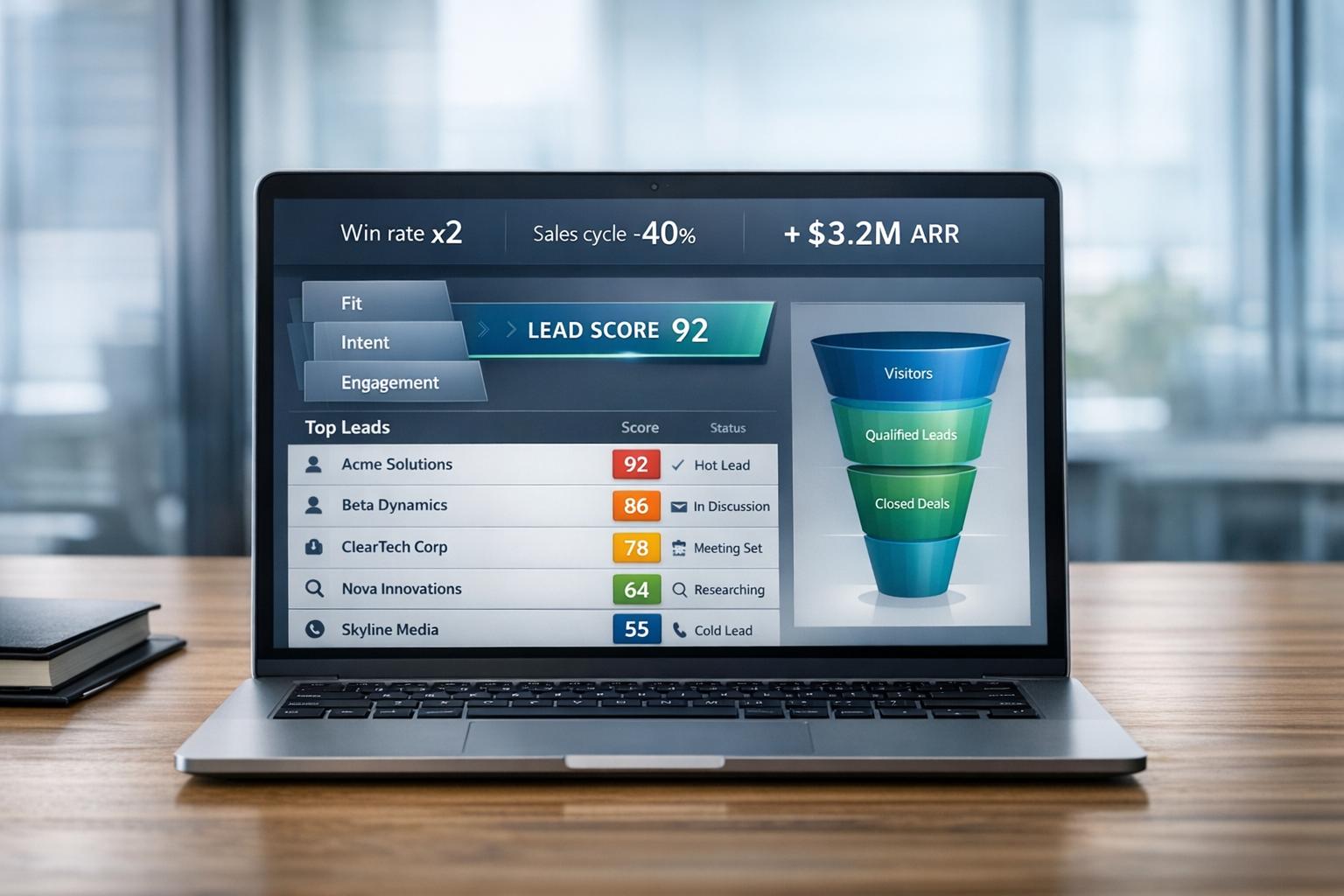
SaaS startups often struggle with unqualified leads, slow pipelines, and rising acquisition costs. TechVantage, a mid-market SaaS company, solved these challenges by implementing AI lead scoring. The results? A 100% increase in win rates, a 22% faster sales cycle, and $3.2 million in additional ARR – all without hiring extra reps.
Key Takeaways:
- Problem: Manual lead scoring wasted time and missed high-value leads.
- Solution: AI scoring analyzed fit and intent, automated routing, and reduced delays.
- Impact: Win rates doubled (18% → 36%), deal cycles dropped (60 → 47 days), and ARR grew from $12M to $15.2M in six months.
AI lead scoring isn’t just a tool – it’s a system that changes how startups manage growth.
Client Challenges Before AI Implementation
Slow Pipeline Movement
TechVantage faced a sluggish and inefficient sales process. By June 2024, their 50-person sales team had generated 960 opportunities in Q2, but a staggering 82% ended in closed-lost status. Sales reps were spending an average of 4.5 hours daily manually reviewing and scoring leads, leaving minimal time for actual selling activities. To make matters worse, follow-ups were delayed by 24–48 hours, missing the critical window when prospects were most engaged.
This delay came with a steep cost. Around 30% of qualified leads were lost to competitors who responded faster. The sales cycle stretched to 60 days – an unacceptably slow pace for a company with aggressive growth goals. Without insights into why leads weren’t converting, the marketing team couldn’t fine-tune their strategies, and operations struggled to identify pipeline bottlenecks. These inefficiencies drove up acquisition costs and hampered growth.
High Customer Acquisition Costs
In Q2 2024, TechVantage’s sales team wasted 1,968 hours – equivalent to 49 full work weeks – pursuing 787 deals that were never going to close. On average, each lost deal consumed 2.5 hours of effort. With sales reps bogged down by administrative tasks, the company’s customer acquisition costs spiraled out of control, stalling revenue growth.
"Our scoring system was built on firmographic data – company size, tech stack, title. But those are terrible predictors. What actually mattered was timing and intent – which our rules couldn’t detect." – Rebecca Martinez, VP of Sales, TechVantage
Their traditional lead scoring system only achieved 60–65% accuracy, meaning over a third of high-priority leads were misclassified. This flawed process played a direct role in TechVantage missing their $13.5M ARR board target by 11%. The inefficiencies in lead qualification and scoring not only inflated acquisition costs but also derailed revenue goals.
Manual Lead Qualification Process
Human bias was a consistent obstacle in TechVantage’s lead qualification process. Sales reps often prioritized well-known companies over high-fit startups due to brand recognition bias, and recency bias led them to treat the newest leads as urgent, regardless of actual intent. As a result, high-value opportunities were frequently overlooked, while time was wasted on low-potential leads.
The company’s CRM data was another pain point – only 35% of sales professionals trusted its accuracy. Analysis revealed that the pipeline was cluttered with unviable deals, draining resources and slowing progress. Additionally, the manual process lacked a feedback mechanism to learn from past mistakes.
These combined challenges – delayed follow-ups, rising costs, and flawed qualification – highlighted the urgent need for a systematic overhaul of TechVantage’s lead management approach.
The AI Lead Scoring Solution
To tackle sluggish pipeline movement, high acquisition costs, and the inefficiencies of manual lead qualification, GTM Engineering Services introduced an AI lead scoring system that transformed how TechVantage managed leads. By replacing outdated, rule-based processes with real-time predictive analytics, this solution eliminated human bias and drastically reduced time spent on administrative tasks.
Building the AI Scoring Model
GTM Engineering Services designed TechVantage’s AI scoring model by integrating their Salesforce CRM with multiple data sources, creating a comprehensive profile for each lead. The model evaluated prospects using five critical factors: company fit, intent signals, authority level, budget/timeline, and clarity of pain points.
The system used a mix of explicit signals – firmographic data like company size, funding stage, and technology stack – and implicit behavioral signals, such as visits to the pricing page, downloads of case studies, and webinar attendance. By analyzing three years of historical sales data, the AI identified patterns that strongly correlated with conversions. It employed a two-axis model to score fit and intent separately, distinguishing, for example, between a well-matched prospect with low engagement and a highly engaged lead that might not align perfectly. This approach reduced the misclassification errors that had plagued TechVantage’s earlier systems, paving the way for automated lead research and faster response times.
Automated Lead Enrichment and Routing
The AI system saved TechVantage 4.5 hours of manual lead research daily. When a new lead entered the system, it automatically enriched the profile with verified contact details, LinkedIn profiles, recent company updates, and technographic data. Using a waterfall enrichment model, it sequentially queried platforms like Apollo, ZoomInfo, and Lusha, achieving high data match rates.
High-scoring leads triggered instant Slack alerts and CRM updates, ensuring follow-ups happened in under five minutes – a critical window, as companies responding within the first hour are seven times more likely to qualify leads. The system also eliminated delays of 24–48 hours, which had previously cost TechVantage 30% of qualified opportunities.
Sales and Marketing Alignment
Beyond automating routing, the AI system bridged the gap between sales and marketing teams by standardizing lead quality definitions. With a shared, data-driven understanding of what qualified as a high-quality lead, the usual friction between the two teams disappeared. Instead of subjective debates over lead quality, both teams relied on scoring metrics rooted in actual conversion trends.
To enhance usability, GTM Engineering Services added a "Why This Score?" panel to each lead record in Salesforce, giving sales reps clear insights into the reasoning behind each score. Additionally, a closed-loop feedback mechanism allowed reps to mark leads as "closed-won" or "disqualified", feeding that data back into the AI model to continuously improve its accuracy.
Implementation Process
GTM Engineering Services rolled out TechVantage’s AI lead scoring system in a focused four-week sprint during mid-2024. The process was well-structured: week one focused on discovery and a data audit; weeks two and three tackled model development and CRM integration; testing and validation happened in week three; and the final week saw the system’s full launch, complete with team training.
Data Integration and Model Training
The first step was linking TechVantage’s Salesforce CRM to various data sources through API connections. The team pulled 18 months of historical data from Salesforce and Segment. Using Python’s pandas library, they consolidated this data into a unified feature table, setting the stage for effective model training.
A waterfall enrichment process was implemented to enhance data quality. This involved sequentially querying over 100 data providers to ensure comprehensive lead profiles, verifying everything from contact details and LinkedIn profiles to company updates and technographic data for every lead entering the system.
The AI model was built using XGBoost, a powerful gradient boosting algorithm designed to identify complex, non-linear relationships in data. To validate its performance, the team compared it to a simpler logistic regression model, confirming a 40% improvement in accuracy when identifying high-value prospects versus TechVantage’s previous rule-based system. Armed with precise predictions and a solid data foundation, the team shifted their focus to real-time pipeline monitoring.
Pipeline Analytics and Dashboard Setup
To give TechVantage’s sales and marketing teams a clear view of pipeline performance, GTM Engineering Services developed real-time dashboards. These tools tracked key metrics like lead score distribution, conversion rates by score tier, and average time-to-close for various segments. Sales leaders could quickly identify which lead sources and scoring thresholds delivered the best results, enabling smarter resource allocation.
The dashboards also featured management escalation alerts. For example, if a high-scoring deal stalled in the pipeline for more than 10 days, the system automatically sent a Slack notification to sales leadership. This proactive approach ensured high-value opportunities didn’t get lost during transitions between sales development reps and account executives.
Continuous Learning and Optimization
Real-time analytics laid the groundwork for ongoing system improvements. A closed-loop feedback process allowed sales reps to update lead statuses – marking them as "closed-won" or "disqualified" – directly in Salesforce. This outcome data was integrated back into the AI model every week, ensuring the scoring system continuously refined itself based on actual results rather than outdated assumptions.
The team also set up quarterly calibration meetings involving TechVantage’s VP of Sales, Rebecca Martinez, Head of RevOps, James Park, and the GTM engineering team. These meetings reviewed successful deals from the prior quarter, identifying patterns the model might have missed. Adjustments to scoring formulas during these sessions kept the system aligned with evolving market trends.
To handle the technical demands of real-time updates, middleware microservices were introduced to manage API calls and prevent CRM rate limits. This infrastructure ensured smooth processing of hundreds of leads daily without delays or performance issues. Together, these measures kept the system running efficiently while adapting to new challenges.
Measurable Results
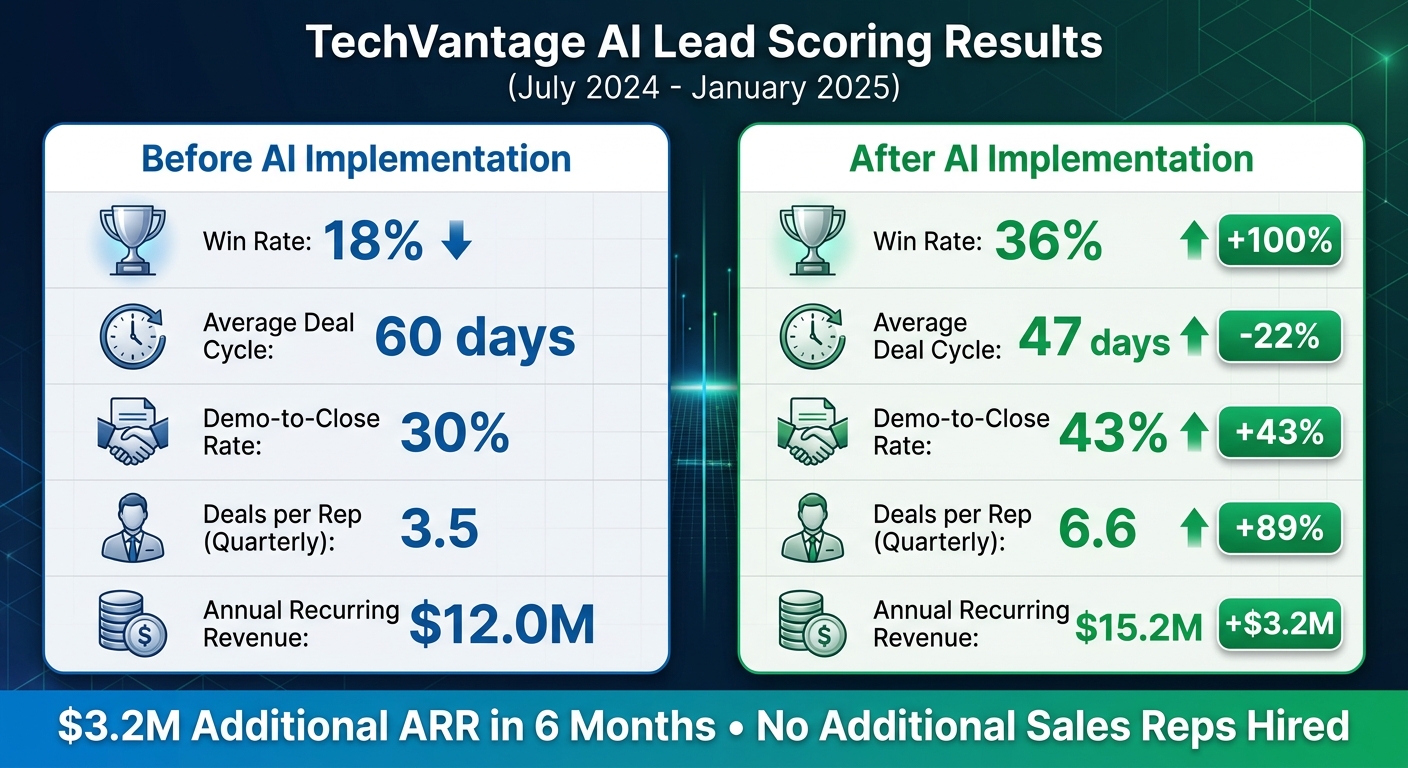
AI Lead Scoring Impact: Before vs After Results for TechVantage SaaS
After implementing the optimized system, TechVantage saw a dramatic transformation in its performance metrics. Over a six-month period (July 2024 to January 2025), the company’s win rate jumped from 18% to 36%, effectively doubling their sales close rate.
Lead Conversion Rate Improvements
TechVantage made huge strides in pipeline efficiency. The demo-to-close rate rose from 30% to 43%, meaning nearly half of all product demos resulted in closed deals – a 43% improvement. Individual productivity also soared, with sales reps closing an average of 6.6 deals per quarter compared to 3.5 before AI implementation – an impressive 89% increase.
"We didn’t hire a single new rep, but our output looked like we added 22 reps." – Rebecca Martinez, VP of Sales, TechVantage
The AI system’s ability to pinpoint high-intent prospects significantly reduced time wasted on low-potential leads, enabling the team to focus on the opportunities that truly mattered.
Shorter Sales Cycles and Lower CAC
The average deal cycle shrank from 60 days to 47 days, cutting the timeline by about 22%. This faster turnaround improved cash flow and allowed sales reps to handle more deals simultaneously. Additionally, automated lead enrichment and routing slashed the need for manual prospecting, which brought down customer acquisition costs. These improvements highlight how AI-driven lead scoring can streamline operations and boost efficiency.
Revenue Growth Impact
The financial payoff was substantial. Over the six months, TechVantage added $3.2 million in incremental annual recurring revenue (ARR), growing from $12.0M to $15.2M – all without increasing the size of the sales team. This underscores the effectiveness of the AI system.
| Metric | Pre-AI Implementation | Post-AI Implementation | Improvement |
|---|---|---|---|
| Win Rate | 18% | 36% | +100% |
| Avg. Deal Cycle | 60 days | 47 days | -22% |
| Demo-to-Close Rate | 30% | 43% | +43% |
| Deals per Rep (Quarterly) | 3.5 | 6.6 | +89% |
| ARR (6-Month Period) | $12.0M | $15.2M | +$3.2M |
Data sourced from the TechVantage case study (July 2024 – January 2025).
This shift wasn’t just about numbers – it also transformed team morale. Sales reps gained confidence in their leads, improving overall satisfaction and performance.
"The real value isn’t the math – it’s that my team is happy again. They’re not grinding through junk leads anymore." – Rebecca Martinez, VP of Sales, TechVantage
These results laid the groundwork for scaling AI-powered lead scoring even further.
Best Practices for Scaling AI Lead Scoring
TechVantage’s success wasn’t just about adopting technology – it was about creating a system that could grow and adapt alongside the business. For Series A and B startups aiming to achieve similar results, three priorities stand out: identifying the right signals, ensuring team alignment, and treating optimization as a continuous effort. These strategies, as shown by TechVantage, are key to driving scalable growth.
Identifying Intent Signals and Ideal Customer Profiles
The most effective AI models distinguish between firmographic fit and behavioral intent. This two-pronged scoring approach helps companies focus on leads that are both a strong fit and ready to act, while nurturing others appropriately. Firmographic data – like company size, industry, and job title – sets the foundation, but conversion often hinges on timing signals, such as recent funding, executive hires (like a VP of Marketing), or relevant job postings.
Technographic data adds another layer of insight. For instance, when a prospect outgrows a competitor’s basic tier or updates its tech stack, it often signals they’re open to alternatives. Grammarly demonstrated the power of this approach in March 2026 by analyzing behavioral patterns among millions of free users. They identified subtle indicators – like specific error types and document formats – that boosted premium upgrades by 80% and cut their sales cycle from 60–90 days to just 30.
Companies leveraging AI lead scoring can achieve conversion rates of up to 6%, nearly double the B2B average of 3.2%. The secret lies in waterfall enrichment to improve data quality. Regularly reviewing closed-won and disqualified data with sales teams helps fine-tune the AI model’s weighting of signals. Once the signals are clear, aligning teams around these insights becomes the next step.
Aligning Sales, Marketing, and RevOps
AI scoring delivers results only when teams trust and consistently use the system. Automated lead routing and seamless handoffs are critical to avoid bottlenecks. Between July 2024 and January 2025, TechVantage created a cross-functional task force, including VP of Sales Rebecca Martinez and Head of RevOps James Park, to analyze past wins and losses. They standardized follow-up protocols, requiring personalized recaps within two hours of demos. This collaboration doubled their win rate from 18% to 36% and added $3.2 million in incremental ARR.
To eliminate the "black box" problem, provide sales reps with explainability features that highlight the signals behind each lead score – like "visited pricing page 3x". This transparency fosters trust and drives adoption. Companies that implement engineered GTM workflows have reported a 31% reduction in Customer Acquisition Cost for SMB/mid-market teams and a 42% reduction for enterprise teams. Acting on leads within five minutes boosts qualification success rates by 10x compared to waiting an hour, making automated routing and alerts essential for fast responses. Once teams are aligned, the focus shifts to keeping the model sharp through ongoing optimization.
Continuous Optimization for Scale
AI models must evolve by learning from outcomes and improving over time. Using score decay algorithms – lowering scores after 30–60 days of inactivity – helps maintain a fresh pipeline. Quarterly reviews and retraining ensure the scoring model adapts to market changes and product updates. Companies that treat lead scoring as a dynamic process see a 77% boost in lead generation ROI.
OpenAI applied this approach in January 2026 while scaling outreach for DALL·E 2. They used Clay to scrape social media for users engaging with hashtags like #aiart and #midjourney, then enriched the data to find LinkedIn profiles and emails. This automated workflow identified 1,500 highly qualified leads and cut manual research time by 95%.
Tailoring scoring systems for different segments, such as Enterprise versus SMB, is also crucial since buying signals vary. Regularly analyze false positives and negatives – leads that scored high but didn’t convert – and adjust the model to avoid overvaluing certain signals. Companies implementing AI-driven automation report a 45% drop in lead acquisition costs and a 30% boost in sales productivity, though these results depend on continuous fine-tuning based on feedback from the field.
Conclusion
TechVantage’s shift from manual lead qualification to AI-driven scoring highlights how a systematic approach to GTM operations can transform a startup’s growth. By automating lead enrichment, predictive scoring, and aligning sales and marketing, they redefined their pipeline efficiency. This wasn’t just about adopting technology – it was about rethinking processes to create a scalable revenue engine.
The move from rule-based scoring to machine learning was pivotal. It allowed TechVantage to spot high-intent prospects that manual methods overlooked. Their sales reps, who previously spent 70% of their time on administrative tasks, could now focus more on selling. Automated routing ensured leads were contacted within five minutes, a critical factor in conversion success. The system also evolved over time, learning from every closed-won and disqualified lead to improve its precision. This constant refinement echoes the importance of continuous improvement.
For Series A and B startups struggling with slow pipelines, rising acquisition costs, and manual processes, the solution is clear. AI-powered lead scoring isn’t just a tech upgrade – it’s the foundation for scalable growth. Companies implementing these systems have seen a 31% drop in customer acquisition costs for SMB segments and up to 42% for enterprise teams. Conversion rates also doubled, reaching 6% compared to the B2B average of 3.2%. GTM Engineering Services specializes in building these automated revenue systems for funded B2B startups.
The process starts with clean historical data, separates scoring for fit and intent, and incorporates quarterly feedback loops to refine the model. As Dan Stevens from NBKC Bank shared about AI-driven lead distribution:
"ProPair has changed everything about lead distribution for us. We look back at our pre-ProPair days and wonder why we relied on gut feelings for such big decisions."
For startups grappling with sluggish pipelines and high-cost leads, AI-powered lead scoring offers a proven path forward. To accelerate your growth, consider implementing these systems today. GTM Engineering Services is ready to help Series A and B companies design scalable, automated solutions to secure their next funding round.
FAQs
What data is needed to start AI lead scoring?
To get started with AI lead scoring, you’ll need historical CRM data that captures lead interactions, actions, and outcomes. This data serves as the foundation for training a predictive model, which evaluates new inbound leads and estimates their likelihood of converting.
How does AI separate “fit” from “intent” in scoring?
AI separates "fit" from "intent" by using predictive models to analyze historical data. It evaluates fit by determining which leads are most likely to convert, while intent is gauged through engagement behaviors that indicate readiness to buy. This approach helps teams focus on the leads with the highest potential.
How can you quickly prove ROI from AI lead scoring?
To see fast ROI from AI lead scoring, zero in on clear, measurable outcomes. For example, you could achieve a 20–40% boost in sales-qualified leads and cut your sales cycle by 15% or more. With clean, high-quality data and a solid sales process, these improvements are often possible within just 3–4 weeks.