
A GTM Engineer designs automated systems that drive predictable revenue growth by connecting tools, optimizing workflows, and managing data for sales and marketing teams. Unlike RevOps, which focuses on maintaining existing processes, GTM Engineers build the technical infrastructure needed for scalable growth. They integrate CRMs, automate lead scoring, and create data pipelines, enabling faster lead engagement and reducing manual tasks.
Think of it this way: RevOps asks "how should this process work?" while a GTM Engineer asks "how do we build a system that makes this process run itself?"
Key Points:
- They act as "DevOps for revenue", automating sales and marketing systems.
- Core tasks include CRM integration, data quality management, and AI-driven workflows.
- By automating processes, they reduce costs and improve pipeline efficiency.
- Often critical for startups scaling from 10 to 100+ sales reps.
GTM Engineers are essential for startups aiming to replace manual processes with scalable, automated systems, ensuring faster growth and better ROI.
What GTM Engineers Do: Core Responsibilities
Building and Automating Revenue Systems
At the heart of a GTM engineer’s role is creating the technical framework that ties your entire revenue stack together. This involves integrating CRMs with tools like marketing automation platforms, enrichment software, and analytics systems to ensure smooth data flow from lead generation to conversion.
They also build automated, multi-channel outbound sequences that kick off based on specific triggers. For example, when a prospect visits your website, the system can automatically enrich their contact information, assess their qualification, and, if they meet your criteria, launch a tailored outreach campaign across LinkedIn, email, phone, and SMS. Tina Sang, Growth Lead at Artisan, explains how this works:
"When a prospect visits a user’s website, AI BDR Ava auto‑enriches their contact details, determines qualification status, and, if qualified, triggers a personalized outbound sequence. All of this is done without a human lifting a finger."
GTM engineers also develop systems to act on intent signals, such as funding announcements or job changes, triggering outreach at the right moment. This precision has helped SMB and midmarket companies cut customer acquisition costs by 31%, while enterprise teams have seen a 42% drop.
Technically, this requires building ETL and reverse ETL pipelines using tools like Fivetran or Stitch, ensuring data consistency across platforms with the CRM as the central source of truth. They automate lead routing and implement predictive scoring models to prioritize leads for faster engagement. The payoff? Leads contacted within five minutes are nine times more likely to convert.
In our client work, we’ve seen startups go from 2+ hour lead response times to under 5 minutes — and the impact on conversion is immediate. These systems not only streamline operations but also set the stage for efficient data handling, which is explored next.
Managing Data Quality and Workflow Optimization
Poor data quality can derail revenue efforts, which is why GTM engineers focus heavily on maintaining clean, reliable data. We call this "plugging the leaks" — the invisible infrastructure failures that cause 30-40% of qualified opportunities to slip through the cracks. GTM Engineers implement automated checks, deduplication processes, and standardized field formats to keep CRMs from becoming cluttered and outdated.
To bridge the gaps between fragmented tools, they use APIs and platforms like Zapier, Make, or Workato, enabling smooth data handoffs and eliminating time-consuming manual entry. These integrations can save sales reps 8–12 hours a week.
Workflow optimization is another key focus. GTM engineers tackle high-impact areas like instant lead routing, automated data enrichment with tools like Clay or Apollo, and real-time alerts for metrics that fall out of range. With strong alignment between sales and marketing teams generating 208% higher marketing revenue, and early GTM or RevOps hires boosting pipeline velocity by 15–20%, these systems deliver measurable results.
Creating Dashboards and Analytics
Once data quality and workflows are optimized, GTM engineers turn their attention to generating actionable insights. They build real-time dashboards using platforms like Looker or Tableau, giving teams a unified view of the customer journey – from lead capture to conversion tracking. These tools enable teams to identify trends and respond to market shifts in real time.
They also monitor pipeline health and velocity to identify bottlenecks and develop attribution models that measure marketing’s contribution to overall revenue. Advanced analytics may include integrating call data from tools like Gong or Chorus, which can highlight competitor mentions, customer objections, and sentiment trends. Predictive models further enhance decision-making by forecasting deal closures, lead conversions, and churn risks.
On the technical side, GTM engineers establish alert systems to catch data quality issues, API errors, and performance anomalies early. This proactive approach prevents minor glitches from snowballing into major revenue losses. With only 16% of B2B companies currently using marketing data for real-time decisions, the systems built by GTM engineers can be a game-changer for teams looking to stay ahead.
Skills and Expertise GTM Engineers Need
Technical Skills: CRM Platforms and Automation Tools
GTM engineers need to be experts in CRM platforms like Salesforce and HubSpot, handling tasks such as configuring custom objects, creating complex fields, and scripting advanced logic. With the average B2B marketing stack containing 45 tools and sales stacks averaging 64, these engineers must integrate disconnected systems using REST and GraphQL APIs.
They also rely on automation platforms to streamline workflows. Tools like Zapier, Make, Workato, n8n, and Clay allow them to build workflows without starting from scratch. Programming skills in Python, JavaScript, and SQL are equally important, enabling them to manipulate data, create custom connectors, and design advanced lead-scoring algorithms.
Data engineering is another key area. GTM engineers manage ETL and Reverse ETL processes, work with data warehouses like Snowflake, and create data models that position the CRM as the ultimate source of truth. These skills allow them to transform business needs into efficient, automated workflows.
Business Knowledge and Sales-Marketing Alignment
A GTM engineer’s role extends beyond technical expertise – they must also grasp how revenue generation works. Acting as a bridge between strategy and execution, they translate high-level business goals and Ideal Customer Profiles into seamless, automated systems. This demands a solid understanding of the B2B sales cycle, buyer behaviors, and signals that indicate purchase intent.
Their business insight shines in how they prioritize tasks. Instead of automating every process, they focus on impactful fixes like lead routing and enrichment, which can save individual reps 8–12 hours per week. With leads contacted within five minutes being nine times more likely to convert, GTM engineers design systems to minimize delays. Additionally, companies with strong sales-marketing alignment report 208% higher marketing revenue, and GTM engineers ensure that marketing data flows smoothly into sales systems without manual intervention.
Modern GTM engineers also bring AI into the mix, further enhancing their ability to streamline revenue processes.
Working with AI and Advanced Tools
In today’s landscape, a GTM engineer must be skilled in implementing AI-driven systems. Tools powered by Large Language Models (e.g., GPT-4) are used to automate prospect research, craft hyper-personalized messages, and summarize call notes. Platforms like Clay serve as essential hubs, integrating real-time signals (e.g., funding events, job changes, intent data) with automated enrichment and outreach workflows.
AI-powered assistants like ZoomInfo Copilot, Salesforce Einstein, and HubSpot AI are also key tools in their arsenal, offering predictive lead scoring and next-best-action recommendations. These platforms have been shown to reduce customer acquisition costs by 31% to 42%. With 71% of companies already integrating generative AI into at least one aspect of their operations and 67% of high-growth companies employing technical resources specifically for GTM initiatives, mastering AI tools has become a non-negotiable skill for today’s GTM engineers.
GTM Engineering vs. RevOps and Sales Ops
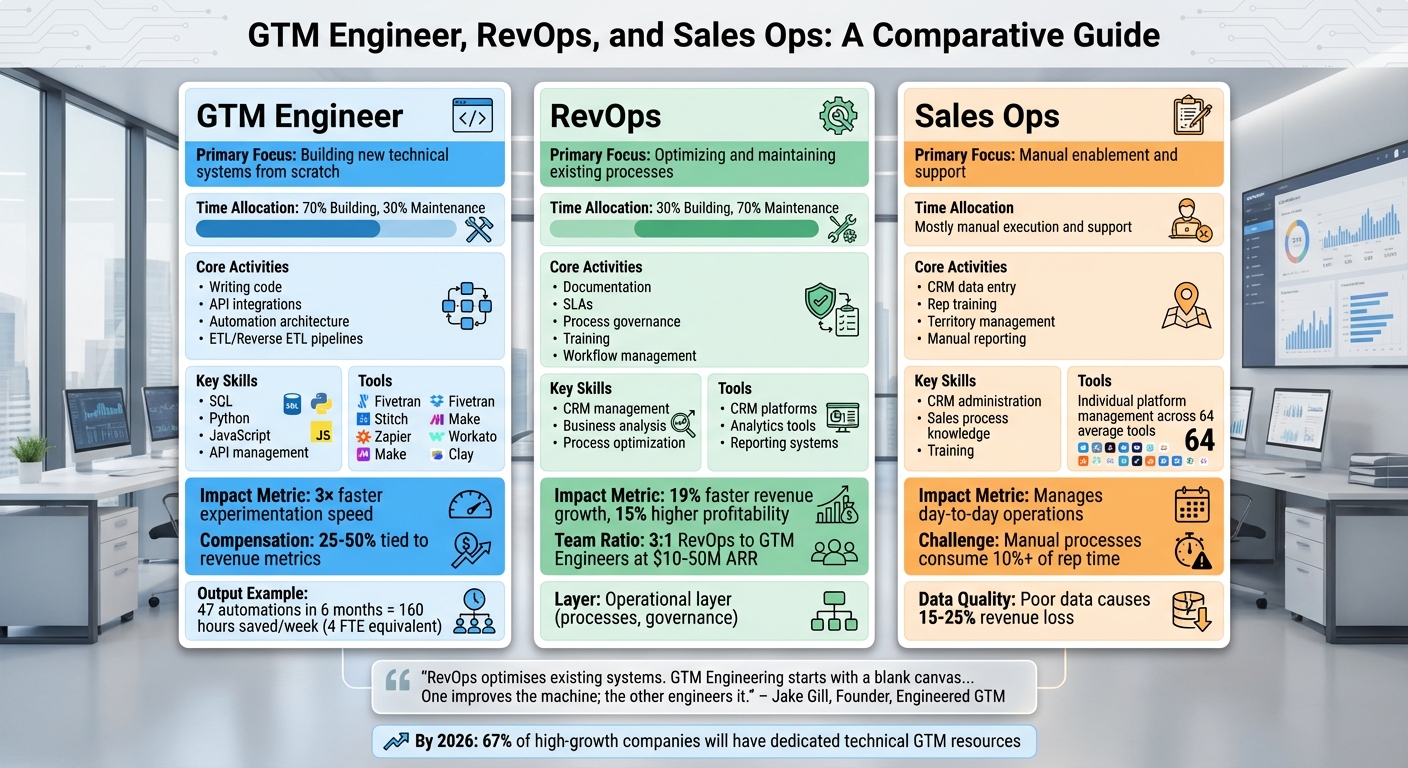
GTM Engineer vs RevOps vs Sales Ops: Key Differences
GTM Engineering vs. RevOps
The key difference between a GTM engineer and a RevOps professional lies in their approach to systems. RevOps focuses on optimizing and maintaining existing processes – things like creating documentation, managing SLAs, and ensuring workflows are followed. GTM engineers, on the other hand, build new technical systems from the ground up, designing the infrastructure that powers automation and scalability.
Time usage highlights this distinction: GTM engineers dedicate about 70% of their time to building new systems, while RevOps professionals spend most of theirs on maintenance. RevOps oversees the operational layer – processes, governance, and training – while GTM engineers work on the technical layer, managing APIs, databases, and integrations that enable automation.
"RevOps optimises existing systems. GTM Engineering starts with a blank canvas… One improves the machine; the other engineers it."
– Jake Gill, Founder, Engineered GTM
Companies with strong RevOps teams often see 19% faster revenue growth and 15% higher profitability. However, GTM engineering teams can achieve three times the speed in running experiments. At the growth stage (with $10–50M ARR), successful companies typically maintain a 3:1 ratio of RevOps to GTM engineers, adjusting to 2:1 as technical demands grow. GTM engineers also often have pipeline-related goals, with 25–50% of their pay tied to revenue metrics.
When compared to Sales Ops, GTM engineers similarly replace manual processes with scalable, automated systems.
GTM Engineering vs. Sales Ops
The difference between GTM engineering and Sales Ops is clear: Sales Ops focuses on manual enablement, while GTM engineers aim for seamless automation. Sales Ops teams typically manage CRM tasks, train reps, and provide manual support. In contrast, GTM engineers focus on creating scalable systems, using custom code and API integrations to unify tools and automate workflows. With the average B2B sales stack including 64 tools, Sales Ops often manages individual platforms, while GTM engineers build infrastructures that connect the entire stack.
Sales Ops handles critical tasks like territory management and reporting, but GTM engineers take automation to another level. For instance, one GTM engineer developed 47 automations in six months, saving 160 hours of manual work per week – equivalent to the output of four full-time employees. These efficiencies are crucial, especially when manual processes consume over 10% of a sales rep’s time.
Data quality is another area where GTM engineers excel. Poor data can lead to revenue losses of 15–25%. GTM engineers combat this by building automated pipelines for data enrichment and real-time validation, solutions that manual Sales Ops processes simply can’t match.
What Makes GTM Engineering Different
What sets GTM engineering apart is its ability to drive rapid experimentation and automation on a scale that traditional operations roles can’t achieve. GTM engineers enable faster testing, smoother data integration, and AI-powered automation. While RevOps defines strategy and Sales Ops executes it manually, GTM engineers create the technical backbone that allows both to scale without adding more headcount.
The required skill sets are distinct. RevOps professionals excel in areas like CRM management and business analysis, while GTM engineers need expertise in SQL, Python, JavaScript, and API management. By 2026, 67% of high-growth companies are expected to have dedicated technical resources for their GTM teams. Interestingly, about 45% of GTM engineers work as consultants or through agencies, helping companies test ROI before committing to full-time hires. In 2025, there were 128 GTM engineer job openings for every 92 SDR roles.
The trend is clear: businesses are focusing less on adding headcount and more on building systems that drive revenue growth efficiently.
How GTM Engineering Services Helps Funded Startups
GTM Engineering Services exists because we kept seeing the same pattern: Series A and B startups raise funding, hire sales reps, then wonder why pipeline isn’t growing proportionally. The problem isn’t lead volume or rep quality — it’s infrastructure. Founders get stuck fixing sales funnels instead of focusing on product-market fit, which points to weak revenue infrastructure that breaks under scaling pressure.
GTM Stack Audits to Identify Gaps
Every engagement starts with a free GTM Stack Audit – a 30-minute session that maps out the entire sales process, from capturing leads to enrichment, routing, handoff, and follow-up. This diagnostic pinpoints where things are breaking down, like SDRs wasting over 20% of their time on manual data tasks or inbound leads sitting idle for hours. Considering the average B2B sales stack includes 64 tools, it’s no surprise that many startups face inefficiencies from disconnected systems.
The audit delivers a 90-day plan with 3–5 actionable automation opportunities, helping startups reclaim 8–12 hours per rep each week. One key focus is speed-to-lead: leads contacted within 5 minutes are 9× more likely to convert, yet many startups take over 2 hours to route them to reps. By addressing these bottlenecks, the audit lays the groundwork for scalable systems and informs the next steps in building out your GTM infrastructure.
Build and Scale Phase Services
The implementation phase is designed to deliver results quickly, starting with immediate wins before tackling more advanced automation.
- Phase 1: Fixes major inefficiencies like lead routing, data enrichment, and lead scoring, often freeing up time and boosting conversion rates within the first month.
- Phase 2: Focuses on channel orchestration, introducing automated outbound sequences, inbound nurture flows, and real-time alerts for sales teams.
- Phase 3: Adds advanced capabilities, such as triggers based on job changes, product usage data, and Account-Based Marketing workflows.
This phased approach ensures startups don’t accidentally automate flawed processes, which could magnify problems instead of solving them. Using API integrations, reverse ETL processes, and automated data pipelines, the CRM becomes the single source of truth. Disconnected tools are integrated so data flows seamlessly between platforms like CRMs, enrichment tools, and sequencing software. By replacing manual workflows with automated systems, GTM Engineering Services helps startups transition from outdated processes to scalable revenue operations.
Why Work with GTM Engineering Services
For startups with $2M–$5M ARR, hiring a fractional GTM engineering service is far more cost-effective than bringing on a full-time hire. In-house GTM engineers typically cost between $120,000 and $300,000 OTE, a steep price for companies still fine-tuning their go-to-market strategy.
"Your GTM motion isn’t under-staffed – it’s under-engineered." – Clay
Conclusion: The Growing Need for GTM Engineers
Grasping the role of a GTM Engineer is essential for modernizing your revenue systems. For funded B2B startups, the transition from founder-led sales to scalable infrastructure is a pivotal moment. When manual processes drain your pipeline and teams spend more energy patching funnels than achieving product-market fit, the question isn’t just what is a GTM Engineer – it’s why you need one. A striking 67% of high-growth companies now dedicate technical resources to their GTM teams, highlighting how this role has shifted from optional to critical for startups seeking scalable growth before their next funding round.
Key Takeaways
A GTM Engineer specializes in building scalable, automated revenue systems. They connect fragmented tech stacks, establish data pipelines, and design workflows that eliminate the need for additional headcount. Unlike RevOps professionals, who refine existing processes, GTM Engineers bring a technical edge – they write code, build API integrations, and architect automation systems.
With the average B2B sales stack containing 64 tools and poor data quality costing businesses $12.9 million annually, the need for this role is clear. GTM Engineers tackle these challenges by creating a single source of truth through reverse ETL processes and automated pipelines. They leverage AI for lead scoring, develop signal-based prospecting workflows, and implement systems that enable non-linear scaling. This means a single rep, supported by automation, can outperform entire teams still reliant on manual tasks.
So, what is a GTM Engineer in practical terms? It’s a role that blends technical skills with revenue strategy, transforming scattered data and manual workflows into a cohesive, automated revenue engine. More importantly, it’s the person who stops you from scaling your problems. Before you add more leads or more reps, a GTM Engineer ensures the infrastructure can actually handle growth.
Next Steps for Your Startup
If your sales team spends 20% or more of their time on manual tasks, or if leads sit idle for hours before reaching a rep, it’s time to address these gaps in your infrastructure. Start with a free GTM Stack Audit to map your sales process and pinpoint areas where automation can make an immediate difference. This 30-minute diagnostic provides a 90-day implementation plan with actionable steps, such as fixing lead routing delays or deploying real-time enrichment workflows.
For startups with $2M–$5M ARR, tapping into GTM Engineering Services offers the expertise to build scalable systems without the $120,000–$300,000 expense of a full-time hire. Book your GTM Stack Audit today and shift from manual, founder-led sales to automated systems designed to scale with your growth.
FAQs
How is a GTM Engineer different from RevOps or Sales Ops?
A GTM (Go-to-Market) Engineer stands out from traditional RevOps and Sales Ops roles by focusing on technical systems and automation. While RevOps typically manages CRM configurations, data handling, and aligning processes across sales, marketing, and customer success teams, GTM Engineers take it a step further. They design and automate the infrastructure that drives modern go-to-market strategies. Think of them as the architects behind scalable, predictable revenue systems – they connect tools, build data pipelines, and create workflows that fuel growth.
What makes GTM Engineers unique is their hybrid approach. They’re part technical expert, part problem-solver, and entirely focused on eliminating manual work. Their expertise lies in automating processes, integrating platforms, and engineering solutions that optimize everything from lead generation to pipeline analytics and data enrichment. By bridging strategy with execution, they empower startups to harness automation, AI, and advanced revenue tools – all while driving growth in a smarter, more efficient way.
What key technical skills does a GTM Engineer need?
A GTM (Go-to-Market) Engineer combines technical know-how with strategic insight to build and automate systems that drive revenue growth. On the technical side, they need to be skilled in CRM platforms, marketing automation tools, workflow automation, and integrating various systems. Familiarity with scripting, API integrations, and managing cloud-based data infrastructure is also key.
Their work often revolves around automating tasks like lead management, outreach, and pipeline analytics. This not only reduces the burden of manual processes but also ensures cleaner, more accurate data. Collaboration is a big part of the job, as GTM Engineers partner with sales, marketing, and RevOps teams to ensure that technical solutions align with broader business objectives. The ultimate goal? Seamlessly connect tools and data to create systems that deliver consistent, measurable revenue growth.
Why are GTM Engineers essential for scaling startups?
GTM engineers play a pivotal role in helping startups grow by building the technical backbone that powers modern go-to-market strategies. While traditional RevOps roles often rely on manual processes and disconnected tools, GTM engineers take a different approach. They focus on creating scalable systems that connect tools, ensure smooth data flow, and automate critical workflows.
For startups chasing rapid growth, these engineers help eliminate bottlenecks caused by disorganized data and clunky processes. By building an automated revenue infrastructure, they empower companies to scale operations efficiently, respond to market shifts, and achieve steady growth – all without the need to dramatically expand their team. In short, GTM engineers are indispensable for startups looking to grow intelligently and sustainably.